Labour / Le Travail
Issue 94 (2024)
Article
“Workers in Saskatchewan Now Have a Clear-Cut Bill of Rights”: Labour Law, Social Democracy, and the Saskatchewan Trade Union Act, 1944–1950
Abstract: This paper examines the politics surrounding the construction, implementation, and administration of the Saskatchewan Trade Union Act (stua) between 1944 and 1950. The act is important because it reflects the first attempt by a social democratic government in North America to construct a system of labour law that ostensibly aligned socialist ideas with the rights of workers to form trade union freedoms. This makes the stua unique in Canadian labour and political history because the legislation demonstrated the policy priorities of the Co-operative Commonwealth Federation (ccf) and the Canadian Congress of Labour as both organizations were attempting to solidify their places in postwar Canada. This history reflects the fact that the ccf and the unions, like the left in general throughout the 1940s and 1950s, defined the working class narrowly, focusing attention on white and male breadwinners with women and racialized workers very much on the periphery. The history also demonstrates the inherent contradiction within social democratic reform politics, as the act extended numerous rights to workers to organize and collectively bargain but when those same workers pushed back against government decision-making during the province’s first public-sector strike in 1948, political tensions found many of those same social democrats acting in similar manners to their private-sector counterparts. These tensions within social democratic approaches to labour relations – so evident in the Saskatchewan experience – have become a central contradiction of the movement throughout the postwar period and continue today.
Keywords: Co-operative Commonwealth Federation (ccf); Canadian Congress of Labour (ccl); labour law; Trade Union Act; Saskatchewan; social democracy; gender; public-sector strikes
Résumé : Cet article examine les politiques entourant la construction, la mise en œuvre et l’administration de la Saskatchewan Trade Union Act (stua) entre 1944 et 1950. La loi est importante car elle reflète la première tentative d’un gouvernement social-démocrate en Amérique du Nord de construire un système de une loi du travail qui alignait ostensiblement les idées socialistes sur le droit des travailleurs de former des syndicats. Cela rend la stua unique dans l’histoire syndicale et politique du Canada, car la législation démontrait les priorités politiques de la Fédération du Commonwealth coopératif (ccf) et du Congrès du travail du Canada alors que les deux organisations tentaient de consolider leur place dans le Canada d’après-guerre. Cette histoire reflète le fait que la ccf et les syndicats, comme la gauche en général tout au long des années 1940 et 1950, ont défini la classe ouvrière de manière étroite, en concentrant l’attention sur les hommes et les blancs comme soutien de famille, les femmes et les travailleurs racialisés étant très en périphérie. L’histoire démontre également la contradiction inhérente aux politiques de réforme sociale-démocrate, puisque la loi accordait de nombreux droits aux travailleurs de s’organiser et de négocier collectivement, mais lorsque ces mêmes travailleurs se sont opposés au processus décisionnel du gouvernement lors de la première grève du secteur public de la province en 1948, les tensions politiques ont amené bon nombre de ces mêmes sociaux-démocrates à agir de la même manière que leurs homologues du secteur privé. Ces tensions au sein des approches sociales-démocrates en matière de relations de travail – si évidentes dans l’expérience de la Saskatchewan – sont devenues une contradiction centrale du mouvement tout au long de la période d’après-guerre et perdurent aujourd’hui.
Mots clefs : Fédération du Commonwealth coopératif (fcc); Congrès du travail du Canada (ctc); droit du travail; Trade Union Act; Saskatchewan; social-démocratie; genre; grèves du secteur public
It is precarious enough for Saskatchewan to have accepted the role of being a “guinea pig” for socialistic experimentation without the province also being made the “cheese” with which the election trap is to be baited in other parts of Canada.
—editorial, Leader-Post (Regina), 11 October 1944
By the end of World War II, the twin prospects of industrial legality and socialism were on the minds of Canada’s ruling classes. The rising political support for the social democratic Co-operative Commonwealth Federation (ccf) and the continued presence (and in some quarters, popularity) of the Communist-backed Labor-Progressive Party, combined with increasing popular support for greater public control over important pillars of the economy, had elites throughout the country worried about the real possibility of “socialistic experimentation.”1 The June 1944 election victory of the ccf in Saskatchewan was especially anxiety provoking.2
Closely tied to these shifting political winds was the growing power of the country’s organized labour movement. Throughout the war, both the industrial-based Canadian Congress of Labour (ccl) and the more conservative-inclined Trades and Labor Congress of Canada (tlc) were making loud calls for a legally protected industrial relations model to safeguard and promote union organizing and compulsory collective bargaining. As these demands were being made, an uptick in worker militancy – especially from newly unionized ccl workers in wartime industries – made the unions increasingly difficult for governments and employers to ignore.3
The combination of economic and political pressure from the left led the Liberal cabinet in Ottawa to issue Privy Council Order 1003 (pc 1003) in February 1944.4 Although limited to federal and wartime industries, the significance of these sectors during the war made it evident, in the words of legal historians Judy Fudge and Eric Tucker, that pc 1003 “dominated the labour relations field.”5 pc 1003 was structured around a peace model of industrial relations, in which state regulation made collective bargaining compulsory once a union demonstrated majority support in a single workplace (so-called majoritarian exclusivity).6 pc 1003 compelled unions to act as responsible economic actors by not spontaneously withdrawing their labour to solve common workplace disputes.7 The strike weapon was further constrained by limiting collective action until after legitimate attempts were made to complete a collective agreement. In the event of a breakdown in negotiations, workers then had to postpone job action until fourteen days had passed after a conciliation board reported its findings to the Minister of Labour. pc 1003 also made recognition and political strikes illegal.8
The federal state’s acceptance of a legal regime making collective bargaining “compulsory and effective,” in the words of radical ccl labour lawyer J. L. Cohen, was a major victory for the leadership of both union centrals.9 As Cohen and the ccl also recognized, however, the Liberal cabinet order conceded much to employers. pc 1003 did not ban company unions, did little to protect workers’ ability to wage successful strikes, and maintained a lengthy conciliation procedure meant to delay collective labour action. pc 1003 did not provide legislated union security measures (e.g. union dues checkoff), did not allow public-sector workers to join bona fide trade unions, and constructed only two unfair labour practice provisions that sought to limit the power of both unions and employers – effectively seeing them as equal economic actors – from overtly influencing individual workers in their choice of representation.10
Recognizing the limitations of pc 1003, social democrats in the ccf saw an opening and were determined to put forward an alternative in Saskatchewan. Even though the province’s economy was largely agricultural, the ccf appreciated that the party’s labour relations model could function as a template for other Canadian jurisdictions, and the Saskatchewan Trade Union Act (stua) achieved quick passage in the government’s first legislative session. The central architects of the new legislation included Premier Tommy Douglas; ccf lawyer Andrew Brewin; ccf Ontario leader E. B. (Ted) Jolliffe; the leadership in the national ccf, including David Lewis, national ccl president Aaron Mosher, and secretary-treasurer Pat Conroy; and a key social democratic member of the government’s nascent Labour Ministry, Ken Bryden, special adviser to the Minister of Labour.
At its core, the act was meant to reflect an ideal archetype of social democratic labour relations. The stua took the unprecedent step in Canada of banning company unions and expanded the right of collective bargaining to all workers, including those in the public service. The act created the most advanced union security protections in the country and did not erect cumbersome administrative delays before workers could legally strike. The stua enumerated twelve wide-ranging unfair labour practices, ten of which applied to employer behaviour. By restricting “all known unfair practices” that employers used to undermine unions, Ken Bryden believed, the legislation justly restricted the power of “the boss who can exercise total authority over the employee.”11
The template chosen by the ccf and endorsed by ccl leadership to create the stua borrowed almost exclusively from the American legislative (Wagner) model, only marginally reaching beyond its legal protections. Bringing the full Wagner model to Canada was something the federal Liberals and other provincial governments had resisted since 1935. Moreover, a significant number of the labour unions in both the tlc and ccl were aligned with American-based international unions and believed in the capacity of Wagnerism to protect and expand labour rights in Canada. Wagner’s explicit ban on company unions, protection of compulsory collective bargaining, and recognition of workers’ democratic ability to organize and strike free from cumbersome delays were all important rights that Canadian workers had lobbied for since 1935.
Yet, despite its benefits, there were limitations when Wagnerism was applied in Saskatchewan’s economy. The concentration on single-site organizing and overt focus on male-dominated industrial and trades workplaces did not easily lend itself to expanding unions into sectors where women and non-white male workers were concentrated. While in theory the act applied to workers in retail, agriculture, secretarial, and the broader service sector, in reality the stua was not designed with these workers in mind, nor did it envision broad sectoral organizations that could challenge employer power in these sectors. Added to this structural limitation was the reality that none of the existing ccl and tlc unions were actively engaged in organizing these workers in any meaningful way.
What is clear in examining the history of the stua is that both the ccf and the unions – like the left in general throughout the 1940s and 1950s – defined the working class narrowly, focusing attention on white and male breadwinners with women and racialized workers very much on the periphery. The Saskatchewan experience reflects the fact, as historian Nelson Lichtenstein has demonstrated in his examination of the Wagner Act in the United States, that the “law is not a social movement,” and that even sympathetic legislation is no guarantee that workers and unions will flourish if there is not an organizational will to help them do so.12 Neither the ccf nor the unions had a great desire to use the stua to organize the entire working class, including, as will be shown, so-called unskilled workers in small firms or on rural farms. Rather, the leadership in both union centrals lobbied for a Wagner-inspired act to expand their presence in the industrial and trades sector, with the public sector being an additional, significant sought-after prize for both organizations.
Like other early observers of the ccf government, Seymour Martin Lipset observed that the stua was “the most pro-union legislation in the democratic capitalist world,” but also that the basic structure of the act was clearly modelled on already existing legal freedoms in the United States.13 Recognizing this fact, the legal, political, and social history of the statute makes for an important case study in attempting to explain how social democratic reformers in the 1940s attempted to reconcile their beliefs in progressive public policy and defending worker rights with the realities of postwar capitalism.14 And, as Eric Tucker has contended, all regimes of capitalist industrial legality combine consent and coercion, albeit to different extents.15 The stua demonstrates how social democrats navigated the regulatory dilemmas that inevitably arise within these legal models, sometimes to the benefit of workers and at other times in the service of capital and government. In the short term, attempting to iron out the tensions between the ccf and the ccl made bringing the Wagner model to Saskatchewan a useful solution that initially satisfied most of the principal actors in the party and in the unions. Politically, the government also benefitted from the fact that employer lobby groups in the province were small and, in some cases, still in their infancy. Given their lack of influence, these groups simply defended the pc 1003 compromise as superior to the social democratic alternative. It was also the case that the act primarily benefitted an important worker constituency inside the main urban centres, which did not alienate the ccf’s strong support among rural farmers or significantly disrupt the agricultural economy.
Yet during the ccf’s tenure in government, the act increasingly tested the government’s postwar labour compromise. The act was never substantially altered after 1944 and calls for reform from local union activists were largely ignored. Many of the government’s new public-sector institutions – including its numerous Crown corporations – brought the ccf into the uncomfortable realm of acting as an employer to a growing unionized public service. In 1948, workers in the Saskatchewan Government Insurance Office (sgio) initiated the province’s first public-sector strike. Throughout this dispute, government adopted some of the worst private-sector employer tactics of hard-nosed bargaining, which undermined the government’s image as a defender of workers’ rights. This instance was indicative of some of the contradictions inherent to social democratic approaches to labour relations, well exemplified by the Saskatchewan ccf experience. Over time, these tensions weakened the ability of social democrats to build a broad protective labour law regime both in Saskatchewan and throughout the country.
The Political Economy of Workers and Work in 1930s and 1940s Saskatchewan
The politics surrounding the construction and passage of the stua cannot be understood without a brief examination of the political economy of the province in the 1930s and early 1940s. Saskatchewan’s population declined throughout the depressionary crisis of the 1930s, with a high of 921,785 people in 1931, falling to 895,992 people by 1941.16 That reduction was precipitated by the economic and environmental devastation that hit the farm sector during the Great Depression.17 The weakening of the agricultural sector led to economic stagnation throughout the remainder of the provincial economy, where declines in trade, manufacturing, retail, and other core economic services led to high levels of unemployment in the cities. In Regina, according to historian J. William Brennan, unemployment reached “crisis levels,” because of the shuttering of numerous manufacturing plants, including the large General Motors assembly plant in 1931.18 The shuttering of plants led to a large exodus of workers from the province, with the number of wage earners falling from a high of 145,568 in 1931 to 128,579 in 1941 (Figure 1).19 The province did not see the total number of wage earners reach 145,000 workers again until well into the 1960s.
At the beginning of World War II, Saskatchewan’s economy was still suffering the effects of the Great Depression, although crop yields and prices began to rebound in 1939. In the 1940s, the province remained heavily reliant on agricultural production; it accounted for 81 per cent of the province’s total economic activity. By 1948, that number had declined only slightly to 75 per cent.20 The prominence of agriculture was also reflected in the fact that over 30,000 paid workers laboured in that sector throughout the 1940s, which exceeded the total numbers of workers in the manufacturing and construction trades.21 Saskatchewan did not experience the wartime manufacturing boom that occurred in other provinces. In fact, in the decade between 1939 and 1950, manufacturing output never rose above 9 per cent of gross provincial product, yet it still accounted for the second-highest level of economic activity in the province.
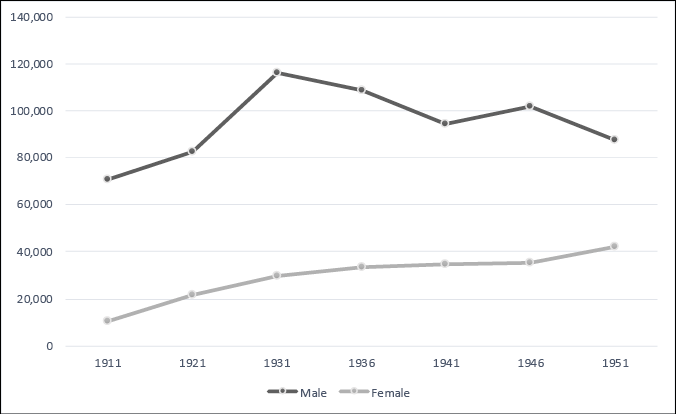
Figure 1. Wage earners in Saskatchewan, 1911–1951. Statistics Canada’s definition of “wage earners” excludes those workers involved in agricultural production.
Census of the Prairie Provinces, Saskatchewan, Wage Earners, 1946, table 22, “Numerical and percentage distribution of the gainfully occupied, 14 years of age and over, by occupational group and sex, 1911–1931, 1936, 1941, 1946”; Census of Canada, 1951, vol. iv, Labour Force, table 2, “Numerical and percentage distribution of the labour force, 14 years of age and over, by occupation group and sex, for Canada and the provinces, 1901–1951.”
Throughout the 1940s, wage earners directly tied to the manufacturing and construction sectors resided primarily in the four main urban centres of Regina, Saskatoon, Moose Jaw, and Prince Albert. Inside those cities, 12,839 male wage earners toiled in the manufacturing of food (including meat-packing and mass production of animal products), wood products, textiles, pulp and paper, printing, equipment (mostly tied to agriculture), and consumer goods. Many of these workers formed the foundation of the unions inside the provincial ccl, which founded the Saskatchewan Federation of Labour (sfl) on 19 November 1944.22 The largest ccl union in the province was the meat packers, and its members played an essential role in leading the province’s labour movement throughout the 1940s and 1950s.
Male workers aligned with the tlc were primarily in the manufacturing of metal works, including machinists, boilermakers, riveters, and chemical production workers.23 Throughout the province, there were 8,123 workers employed in the skilled construction trades, while another 17,100 were in the railway sector. There was no provincial body of the tlc, but most of the tlc leadership in Regina and Moose Jaw was drawn from these sectors. While the ccl represented a small percentage of rail workers, it did not have members inside the skilled construction trades. In the provincial capital, the influential Regina Trades and Labour Council, which had long been dominated by tlc members in the building and printing trades, played an important role in local politics. A similar situation existed in Moose Jaw and Saskatoon, where the local labour council remained an important player in city politics.24 In total, there were 9,584 workers inside the organized labour movement in 1943–1944. Of this total, 7,647 laboured in the four major provincial cities.25 Outside of these urban centres, however, neither the tlc nor the ccl had a significant presence.
The structural and regional divisions of the main union centrals in the province included differences of political partisanship with the ccf, Liberal Party, and even Communist Party. The tlc had a long presence in the province. The internal culture of the Saskatchewan tlc, as Walter Cherwinski aptly recognizes in his study of the union central, was one of white working-class men, mostly in the skilled trades, who were in unions affiliated with the America Federation of Labor (afl). Inside the afl, the spectre of Samuel Gompers shaped the union political culture, and that reality fit easily in Saskatchewan, where union locals aligned their political interests with whichever party seemed to favour organized skilled working tradesmen.26 As the ccf slowly gained in popularity and adjusted its urban labour platform to reach out to working-class men, some tlc union activists took notice. A few union locals ended up affiliating with the party, and some members ran for office under the ccf banner, but support for the ccf both internally and externally was always fragmented. Some tlc unions (and individual members) were tied to old notions of political neutrality, others aligned with the old Liberal Party, and some were quiet Communists. The result, Cherwinski concludes, was friction and suspicion in an already divided and small provincial movement.
In contrast to the Saskatchewan tlc, the ccl unions in the province were not quiet about their political allegiances or organizational goals. The industrial union organizations had burst onto the Canadian union scene in the 1930s on the heels of organizing breakthroughs by the Congress of Industrial Organizing (cio) in the United States. The cio in Canada, like its borrowed American namesake, concentrated its organizing efforts in the industrial sectors where thousands of so-called unskilled workers were left unorganized and largely ignored by tlc unions. The strength in industrial organizing led many ccl activists to closer relations with the social democrats, who promoted a form of socialism to challenge the power of capital and the state. For the ccf, closer relations to the ccl were also essential to an electoral breakthrough among industrial workers and to form a permanent financial and voting base for the party. This electoral strategy was more complicated in Saskatchewan, as Gad Horowitz has identified, because so much of the ccf’s electoral base was among rural farmers.27 Nevertheless, the ccl’s “missionary zeal for getting more workers into unions” had begun to transform the labour relations scene inside of Saskatchewan’s cities in the late 1930s and early 1940s.28 In these circles, many of the ccl leaders were committed socialists. Most were open supporters of the ccf, while some aligned with the Communist Party. The ccl’s eagerness for economic and social change certainly separated it from the longer established and more cautious tlc unions in the province. That institutional and cultural difference between these organizations did not end until the merger of the two union centrals in 1956 to form the Canadian Labour Congress.29
The conservatism of the tlc and the more progressive unionism of the ccl had little implication for women workers, whom both organizations largely ignored. In Saskatchewan, non-agricultural women’s employment was tied to the service sector, where the “missionary zeal” for union organizing was slow-moving. While the service sector grew in prominence throughout postwar period, in the 1940s, women in Saskatchewan were largely relegated to paid employment tied to the household or care professions. In 1941, 28,840 women workers – a clear majority – were gainfully occupied in the service sector, 11,208 of whom were employed as domestic servants and another 4,715 as housekeepers; 8,277 women were employed in professional services such as nursing and teaching, with another 6,000 women employed in clerical work. Throughout the decade, those numbers did not dramatically change. While women elsewhere in the country entered the manufacturing sectors in record numbers during the war, that did not occur in Saskatchewan. Although there were some ccl unions that encompassed larger groups of women in laundry services, there was not a large presence of women inside the union central. In 1946, there were virtually no women in the manufacturing sector outside of a few hundred workers employed as seamstresses involved in local dressmaking.30 In this period, there were no women in the senior leadership of either the tlc or the ccl.
By 1951, women workers remained tied to the service sector, working in personal services such as telephone operators, private cleaners, waitresses, and housekeepers. Outside the home, 4,418 women worked as retail salesclerks, while another 11,270 worked in clerical positions.31 Although women workers were expanding outside the private home, many remained in the care professions of teaching and nursing just as they had prior to the war. Even in the public service, women’s employment was slow to take hold in the late 1940s and 1950s. As the public sector became a more prominent area for women’s employment by the 1960s, employment data suggests that women were still overrepresented in clerical and care professions inside the public service.32 Throughout the decade, there was no significant increase in women workers in areas such as manufacturing, construction, and the skilled trades or in higher-paid services such as law and finance or inside government.
Although women’s paid employment remained an essential part of the local economy, women had still not made inroads in the ccl or tlc near the end of the 1950s. To be sure, women had been active in the ccf from its inception, yet there were virtually no women in the leadership of the ccf government. In 1947, Saskatchewan passed the first bill of rights in Canadian history, which, among other rights protections, safeguarded the ability of individuals to secure employment regardless of racial or religious background.33 Remarkably for a social democratic political party, however, the bill did not prohibit discrimination on the basis of sex. Historian Carmela Patrias hypothesizes that the exclusion of human rights for women derived from the government’s “general paternalistic attitude toward them.”34 Looking at the party’s labour policies in this period, there is a great deal of truth in this observation. The party did not make women’s economic realities a priority, nor did the unions push for significant protection for women workers.35 Government and union failure to treat the rights of working women as a serious issue in this period profoundly limited the success of ccf labour policies.36 During its time in government, the ccf did not actively promote women’s employment or challenge the dominant gendered division of labour in society but, as we shall see, in some cases actively promoted it.
The CCF and the Saskatchewan Trade Union Act, 1944
Notwithstanding the overt gender biases of the labour and social democratic movements, the growth of the paid labour force during the war years placed added pressure on all governments to address organized labour’s core demand for legislative protection for compulsory collective bargaining. Yet if reform at the federal level occurred at a tarrying pace, it was virtually lethargic in Saskatchewan. Tied as it was to agricultural production, the long-governing Liberal Party showed little interest in addressing local and national labour demands for a protective legislative regime. In 1938, the Saskatchewan Liberals passed the Freedom of Trade Union Association Act, which made joining a trade union legal (this had been the case federally since 1872).37 The legislation also prohibited several unfair labour practices, such as yellow-dog contracts and discrimination against workers who joined a union, but it did not compel employers to recognize or bargain with a union in the workplace.38
In 1943, the Liberal mla from Moose Jaw, George William Baker, introduced a private member’s bill modelled on many of the ccl and tlc legislative demands. Baker’s legislation would have provided for compulsory collective bargaining in the province. It also constructed a political system for certification whereby the minister would oversee the process, but it did specifically ban union blacklisting and company unions.39 The ccf opposition supported the bill, but the Liberals pushed it to the Select Committee on Law Amendments, which conducted provincial hearings throughout the remainder of the 1943 legislative session. During the hearings, both labour and the newly formed Saskatchewan Employers Association (sea) argued about the merits of compulsory collective bargaining, with employers defending the status quo and their company unions.40 The eventual select committee report endorsed Baker’s legislation, although it made several recommendations to amend the bill, which would have weakened the union security provisions in the draft act. The select committee also recommended that the government exclude farm, domestic, and professional workers from the act.41 The report was silent on the banning of company unions, which suggests a tacit endorsement of these employer organizations. Even with these many concessions to employers, the bill was given lukewarm support by the Liberals and was not passed. Pressed further by events beyond their control, in April 1944, the Saskatchewan Liberals passed the Labour Relations Act,42 which mimicked the federal Liberal government’s pc 1003 order. With a June election fast approaching, however, the legislative environment was about to be upended.
The 1944 election of the ccf in Saskatchewan has become a focal point for studying social democratic reform politics in Canada. From its origins, the party – a product of agrarian and working-class discontent during the Great Depression – reflected internal tensions between urban workers, socialists, reformers, unions, middle-class professionals, and conservative farmers.43 Given these diverse ideological and material conflicts inside the party, the Saskatchewan wing of the ccf was a compromise between political groups that sought to balance social democratic ideas of public ownership of key resources, democratic planning, and protection for workers with promises to protect land ownership and the profitability of rural farmers. Some of the ccf’s earliest policy positions – which included improved wage policies and compulsory collective bargaining for workers and protective land tenure, insurance protection for lost harvests, and more co-operative organizations for marketing and selling farm products – spoke to the economic weaknesses of these groups in the 1930s.
Notwithstanding this broad and often contradictory political coalition, the ccf’s leaders pushed for a series of policy reforms in the late 1930s and early 1940s to expand its electoral support to the middle class and other moderate groups. Many of these reforms constrained some of the core principles of rural socialists, including ending calls for co-operative farming and public land tenure in the agricultural sector. The party also altered its economic messages, emphasizing “planning” as opposed to “public ownership,” limiting its criticisms and attacks on private capital and the capitalist system, and emphasizing regulation of the worst excesses of the private market as opposed to replacing or radically altering capitalist social relations.44 As the province moved out of the Great Depression, the party aligned its positions to the fact that farmers were increasingly seeking more capitalist freedoms to grow, distribute, and market their products. Recognizing this reality, the ccf’s policy changes moving into the 1944 election were designed to draw support from unions, professionals, small business, and those directly tied to the rural economy.45 The moderation of the party was facilitated by the election of federal mp T. C. (Tommy) Douglas to the leadership in 1942 after long infighting between former leader and farmer-radical George Hara Williams and long-time party steward M. J. Coldwell.46 Williams’ decision to volunteer for the Canadian armed forces in 1941 provided an opening for the party to move on the leadership question, and after 1942, Douglas became the face of the party in Saskatchewan.
The 1944 campaign was dominated by questions of rural Saskatchewan and the farm economy. The party was also actively working to align its program with workers in the industrial and skilled trades who, according to Cherwinski, were struggling to define themselves in a “sector of the economic community which by and large is by definition urban and industrial in an environment which is rural and agricultural.”47 The ccf’s plan to reach these voters was entitled “Labor and Urban Security.”48 The first pledge, oft repeated on the campaign trail, was to introduce a sweeping form of compulsory collective bargaining in the province.49 The platform also included a series of new policies to address fears of postwar economic insecurity, promising to increase the minimum wage, address workers’ compensation for workplace injury, and increase labour representation on government boards and commissions.50
At least in part because of the policy promises, in the seven months prior to the 1944 election, union affiliation to the party reached a high of sixteen organizations.51 Party activists cited their policy promises and the role of organized labour in the election as contributing to the urban electoral sweep on 15 June 1944, as the ccf won all the seats in Regina, Moose Jaw, and Saskatoon, and all of the single-member constituencies in Prince Albert, Swift Current, Yorkton, Weyburn, and North Battleford.52
Once Douglas and the ccf were sworn into office, on 8 July 1944, the government wasted little time in implementing its labour promises. One of Douglas’ first challenges was to appoint a minister (along with capable staff) who was tasked with multiple political, legal, and administrative challenges in constructing new labour laws and regulations in the province. Aside from navigating the relationship between local tlc and ccl officials – itself no easy undertaking – the new minister had to consult and work with the national ccf as well as fend off criticisms from business and hostile media. The minister also was unable to ignore the Communists inside the unions, many of whom were critical of the new government and to whom the ccf was particularly antagonistic. Douglas assigned this complicated task to former mayor of Regina Charles C. (C. C.) Williams and, initially, appointed as his acting adviser an existing public servant named J. H. (Harry) Williams. C. C. Williams’ most immediate credentials for the position of minister were that he was a relatively seasoned politician with executive experience and held a tlc union card as a former train dispatcher on the Canadian National Railway.
These appointments did not sit well with local union leaders in the ccl. With plans solidifying to create the sfl in November, and with a goal of organizing the broader public service, several prominent ccl organizers cast aspersions on the government for its lack of consultation with the unions.53 Hub Elkin, a Packinghouse organizer about to be named founding president of the sfl, did not mince words in criticizing these appointments.54 Elkin believed that C. C. Williams was “one of those amiable, well-met fellows who doesn’t know or do anything,” and that being a train dispatcher “kept him closer to management than labor.” As for the appointment of J. H. Williams, Elkin dismissed him as a former Liberal who “did the government’s dirty work to prevent” the “setting up of ccl unions in the province.”55
When a ccl delegation led by Elkin’s fellow ccl Packinghouse organizer and future sfl executive secretary W. G. (Bill) Davies met with Douglas at the legislature, they echoed Elkin’s earlier criticisms.56 During that meeting, the ccl accused the new minister of being overly loyal to the tlc and not supportive of broader worker interests.57 Meanwhile, newly minted ccl organizer and cantankerous former coal miner and oil worker organizer Alex (A. A.) McAuslane condemned him as a “labor rat.”58 Douglas set aside these criticisms, claiming in a private letter to national party secretary David Lewis that many in the local ccl delegation were “Communist elements” and that “part of their policy from the beginning has been to make impossible demands or to circulate false rumours in order to drive a wedge between the labour movement and the Government.”59 Utilizing what would become a common tactic when provincial party-labour relations grew tense, Douglas refused to back down and asked the national party and the national union leadership to calm the labour waters in the province.60
The relations between the ccl unions and the ccf were of particular importance to David Lewis. Lewis believed that the success or failure of the ccf throughout the country was tied instrumentally to its relationship with organized labour. That being the case, he took special interest in the Saskatchewan ccf’s labour file, looking for “model labour legislation” that could be used in party campaigns across the country.61 He was also keen to win over worker support from “Labour-Progressive people,” thereby solidifying the ccf as the voice of the organized working class. Lewis was therefore adamant that divisions within the labour movement, including those between the tlc and the ccl, “could not be allowed to become a reason for inactivity and inadequate consultation with or representation of labour.”62 To that end, Lewis became a central player in the Saskatchewan ccf’s labour politics, routinely inserting his analysis and advice in working with the national ccl and tlc unions to smooth over union-party relations when the unions conflicted with the government. In Lewis’ frank communication with Douglas and other members of the government, he too criticized the appointment of the two Williamses. Speaking about the Labour Minister, Lewis conceded that he had rarely “met a man more willing, nicer or more decent than Charlie,” but he had also “seldom met a man less adequately equipped for an important job such as he has.”63
Lewis underscored the notion that C. C. Williams did not have a conception of the importance of the ccf labour policies, nor did he have the political adeptness to engage the two union centrals in meaningful consultation.64 Lewis repeated the concerns of local ccl activists who believed that Williams was partial to tlc unions and maintained a general anti-ccl bias in both his attitude and actions. Lewis believed that from “the ccf point of view, this is a great pity because in the long run the ccl organizations will be of much greater value to the political movement than the afl ones.” If Douglas did not address the problems made by appointing C. C. Williams, Lewis thought that it was necessary to replace J. H. Williams with a “deputy minister from the ccl” and that the government ought to continue to consult with national officials. Regular consultation, Lewis believed, would counter local criticisms because most local ccl people were “either definitely Communist Party or are very young and inexperienced and probably not very fit for office.” Although this observation was exaggerated and simplistic, Lewis warned that the government had to pay special attention to any applicant’s “political views” to avoid appointing anyone with “communist connections.”65
The problem of who would advise C. C. Williams was solved by the national party in alliance with the ccl unions. The strategy that the national leadership devised to address their concerns was to bring onside like-minded ccf labour leaders to place pressure on local ccl union activists. Special attention also had to be taken to accommodate Pat Conroy, ccl national treasurer, who was not an open ally of the ccf. All of this, the party believed, would weaken the hand of Communists in Saskatchewan. Finally, the party and the ccl tasked themselves with finding a suitable replacement for J. H. Williams.66 To accomplish this, Lewis sought the advice of Fred Dowling, national president of the Packinghouse workers, who “always functions as a ccf’er first.”67 The party then recruited Ken Bryden to assist C. C. Williams in running the new department. Bryden was an Oxford-trained economist who had spent the early years of the war as an economics instructor at the University of Toronto before taking a job in the federal Department of Labour in 1941.68 Having become convinced that “working in the federal Department affords little opportunity for contributing to labour standards,” Bryden was easily persuaded to move to Regina so that he could work under a ccf government to promote, draft, and administer genuine pro-worker legislation. By the end of August 1944, even C. C. Williams had become convinced that he needed outside assistance and was eager to be in touch “with young Bryden” to advance the ccf’s labour program. Douglas replied in a telegram that the minister ought to “secure Bryden as soon as possible.”69
Acquiring Bryden allowed the work that had already begun on a new trade union act to accelerate.70 Throughout the summer of 1944, several prominent national ccf leaders were working behind the scenes to assist in creating a model act that reflected the intersection of ccl and ccf policy ideas. Emphasizing this convergence is important to understanding who was invited to the table (and who was not) and tells us a great deal about the long-term priorities of the social democratic movement in Canada. In preparing the act (and all of the immediate labour-related legislation passed in the first ccf term), none of those consulted were outside existing unions. Those drafting the act were mostly lawyers, and the consulted unions were male dominated, concentrated in the manufacturing sector (ccl) and in the trades (tlc). This contributed to the government’s view of the world of collective bargaining, trade union organizing, and workplace regulations as a purely white, male affair.
To be sure, the government believed its legislation was inclusive and open to all workers. C. C. Williams stated that the legislation recognized that “farm labour will be free to set up organization” alongside all “other workers.” Yet he was also adamant that organizing would be done independently of government assistance or through other legislative protections.71 Williams’ declaration on the rights protected and the limits of government support for organizing suggested that the main beneficiaries of the act were in sectors where unions were already present. In other words, after the passage of the act, it would be up to the unions to put the resources into organizing all sectors. Whether unions would agree to commit to such strategies was certainly an open question.
While the national party recognized that “it was politically undesirable for the Saskatchewan government to import a lawyer from Ontario for the purpose of consultation regarding legislation,” it intervened nevertheless. The opportunity to draft a model act to appeal to workers across the country was too important for the party and the ccl unions to leave in Saskatchewan’s hands alone.72 Both Lewis and national ccf chairperson Frank Scott suggested that Andrew Brewin, an Ontario lawyer, fly to Regina to assist in drafting the new legislation. Brewin had been active in ccf circles since 1935, was aligned with the League for Social Reconstruction, had represented labour unions in the Ontario Labor Court and the Ontario Labour Relations Board, and was a close confidant of fellow lawyer and Ontario ccf leader E. B. Jolliffe.73 Brewin’s and Jolliffe’s names had been approved and supported by Charlie Millard, national director of the Canadian Steelworkers, ccf director of political action, and ardent anti-communist.74 Millard agreed that the Steelworkers would shoulder the expense of the trip because, according to Lewis, “model labour legislation would be of great importance to his union and those associated with him right across the country.”75 Recognizing the importance of this bill, several national officers in the ccl and the ccf followed Brewin and Jolliffe to Regina, seeking ways to shape new labour policies in the province.
By early August, Brewin presented a working draft to Douglas and Williams that created the foundation for the new trade union act. Brewin, whose draft melded his allegiance to both the party and the ccl, stated that he believed it was “an advance upon any labour legislation in Canada, and would be recognized as such by labour.” He decided to use a modified version of the Wagner Act in Saskatchewan. He believed that the Wagner model fostered independent unionism because it outlawed a “variety of different methods which have been used extensively throughout the whole North American continent to interfere with the rights of employees to free choice of bargaining representatives.”76 Brewin suggested that this model also eliminated company-dominated unions and industrial espionage. He believed that the US Congress’ construction of an independent administrative agency (the National Labor Relations Board) to adjudicate a defined list of unfair labour practices empowered union organizers, encouraged genuine collective bargaining, and limited the ability of courts and judges to interfere in the process. Building on this idea, Brewin constructed a relatively long list of unfair labour practices and granted significant powers to a newly constructed labour relations board to enforce the act. The draft also did not shy away from recommending that public servants be given the right to organize.77 While perhaps lacking in legal or political originality, the draft reflected Brewin’s and the ccf’s certainty that Wagnerism protected basic worker and union freedoms better than any existing model in Canada.78
What became clearer as the act crystallized into its final form is that Brewin did not ground his model of industrial legality on pc 1003’s “peace obligation,” whereby collective action is interpreted by government as something to be feared, delayed, or stopped altogether.79 Rather, Brewin’s act was supportive of collective action insofar as it did not require unions to overcome cumbersome legal hurdles to go on strike.80 In fact, the act barely mentions strikes at all, omitting all mandatory strike delays that existed in pc 1003 (and in every other province that had passed some form of labour legislation up to this point). Under Brewin’s act, unions were not required to participate in mandatory conciliation procedures and could, in theory at least, strike at any time. This omission left numerous common law tools in the hands of employers to weaken strikes through the courts.81 And, in spite of the fact that future strikes in the province would be shaped by employer usage of court-imposed injunctions, neither the ccf nor its successor, the New Democratic Party, ever addressed this issue through legislation.82
“Discriminatory, Class Legislation of a Coercive and Punitive Nature”: The Terms of the STUA
Fully drafted by the start of the fall session, the new act played a central role in the government’s economic policy agenda.83 Outlining an ambitious program that consisted of over 60 bills, the ccf’s first Speech from the Throne reinforced its commitment to provincial planning, greater public control over natural resources and nascent industry, economic security on the farm, and socialized hospital insurance. The speech also emphasized the government’s determination to modernize education services and to construct several new administrative departments (including a new stand-alone Ministry of Labour). These themes were premised on the government’s general policy goal to “enhance the security” of broad sections of the working population.84 Economic security was to be achieved by a host of legislative changes that provided statutory vacations with pay for workers to “find some respite from the daily routine of work without loss of income.” The government also proudly proclaimed that it would be introducing the “most advanced labour legislation in the Dominion of Canada.” The speech did not contain, however, the party’s long-held commitment – made during the 1944 campaign – to implement a 40-hour workweek.85 Given that the 40-hour week was already becoming common during the war, ccf inaction on this question was a concession to businesses and farmers in the province.86
Nevertheless, the stua did reshape the institutional foundations of capital’s relationship with workers and the provincial state, leading to Bryden’s calculation that it would “probably provoke more opposition than any other Bill which has been introduced this session.”87 Given the extent of the bill, his warning was judicious. Consisting of 28 clauses, the act legally required employers and unions to engage in “good faith” collective bargaining (s 8(1)(c)), banned company-dominated unions (s 5), and created a labour relations board with real legal powers, including those to “require an employer to disestablish [existing] company dominated organizations” (ss 4–5, 13–15, 18).88
The newly constructed Saskatchewan Labour Relations Board (slrb) was given the power to issue orders directly. The slrb could discipline employers or workers whose actions violated the act (ss 9–11) and could order an employer to bargain collectively (s 5(c)). In contrast to the War Labour Relations Board, if an order was not followed, it was then filed with the court and thus became enforceable as an order of the court. Borrowing direct language from the Wagner Act, the stua made it clear that employees in Saskatchewan had the “right to organize in and to form, join or assist trade unions and to bargain collectively through representatives of their own choosing” (s 3).89 The slrb was able to certify new unions where support was clear (usually card-based), but when the existence of majority support was in question, the Board was required to hold a vote if 25 per cent of the unit demonstrated support. The act also avoided the so-called double quorum issue: majority support was determined by the majority participating in the vote, rather than a majority of those in the unit whether participating in the vote or not (ss 6–7).90 In a concession to the tlc, the act also allowed the Board to certify new units by skill (s 5(a)).
While the stua did not place significant obstacles in front of workers engaging in collective action, it did address issues of conciliation and strike delay. Under the act, the Minister of Labour had the power to appoint a board of conciliation for any dispute that might result in a strike or lockout (s 16). The participants could agree on conciliation outside the discretion of the minister, but each party had to consent to the process (s 18).91 Where the stua stood out from the pc 1003 framework – and, indeed, from the federal Industrial Disputes Investigation Act dating from 1907 – was in its departure from mandatory conciliation prior to engaging in lawful strikes or lockouts.92
Where the act demonstrated its real imperium – and thus where it was singled out for direct criticism by employers, the press, veterans’ organizations, Liberals, and some farmers – was in its approach to the administration and enforcement of unfair labour practices and its union security clauses. The act listed twelve unfair labour practices, ten of which applied to employer behaviour (s 8(1)(a)–(j)) and two that applied to labour (s 8(2)(a)–(b)). Besides the normal restrictions on employers interfering with workers’ associational freedoms, including thwarting the formation of a labour organization, employers could not refuse to bargain in good faith, were required to negotiate with a union representative (a shop steward) over grievances, were forbidden from instituting yellow-dog contracts, and could not threaten to shut down or move a plant in the course of labour disputes or use the lockout weapon during bargaining if an application of inquiry was before the Board.93 Unions, by contrast, were forbidden from coercing or intimidating anyone into joining a union and were not able to use the strike weapon if a dispute was being adjudicated by the Board.
Perhaps the most powerful tool that that the drafters of the act gave to the provincial state to enforce the unfair labour practices outlined in section 8(1)–(2) was contained in section 12. If it was determined “that any employer has wilfully disregarded or disobeyed any order filed by the Board,” the cabinet was empowered with the extraordinary power “to appoint a controller to take possession of any business, plant or premises of such employer in Saskatchewan.” If the company continued to disobey or refute the Board order, the government was able to, upon application of the Board, appoint a controller “to take possession of any business, plant or premises of such and employer.” Although Bryden recognized that “this section will undoubtedly evoke a storm of protest,” it was “nevertheless fair and reasonable” because it gave the Labour Relations Board real power to prosecute and punish unfair labour practices and to prevent prolonged strikes by workers against incalcitrant employers.94
Finally, the bill took the unprecedented step of placing into legislation two union security provisions that did not exist in any other jurisdiction in the country. In addition to legislating the so-called union checkoff (s 23) requiring employers to deduct union dues from an employee’s pay (when requested in writing by the union), the act also included a maintenance of membership requirement, wherein each agreement (also by written request of the union) all new workers had to maintain their membership in the trade union “as a condition of employment” during the life of a contract.95 Although workers were able to opt out of the checkoff, under the maintenance of membership clause, existing members of the bargaining unit were not required to join the union, but any employee who was hired by the firm after certification had to become a member of the union within 30 days of being hired (s 25). While maintenance of membership provisions were not unheard of in collective agreements across Canada, especially in the construction and skilled trades, they were far less common in manufacturing and other unionized settings.96 And while the unions championed these security protections as preserving the gains made in the workplace for all employees, the maintenance of membership provision become a point of conflict between the unions and government throughout the 1950s, as some unions sought to use this clause to discipline strikebreakers, to attack communist members inside of unions, and to restrain some anti-union workers.97
In a carefully prepared memo, Bryden outlined a series of arguments for cabinet to defend the stua.98 He believed that the government should take pride in enacting the “most advanced labour legislation on the Continent,” which was “the fairest and most just” for workers. He outlined the far-reaching nature of the act but also acknowledged its alignment with the transformation of postwar worker-union relations occurring in the United States and, to a lesser extent, in Ottawa. Rather than a purely legal interpretation of the stua, Bryden used a sociological analysis of power – rare in internal government memos examining new policy – that explained why a social democratic government needed to act to protect the “fundamental right of citizens in their capacity as employees.” This legislation used the legal powers of the state to offset employer power insofar as it “clearly established the fundamental democratic rights of employees to organize and bargain collectively.” It was imperative, he underscored, for the government to communicate that “the actual situation is that the scales are at present heavily weighted on the side of the employer, and the employer has available to him if he cares to resort to them, a far greater variety of unfair practices.” If the government was criticized because the list of unfair labour practices restricted employer behaviour far more than union action, he suggested that government call attention to the fact that achieving “a formal balance by listing the same number of unfair practices on both sides would be a gross caricature of fairness because it would ignore entirely the highly one-sided nature of the existing situation.”99
In Bryden’s view, the new law would contribute to a stabilizing and co-operative form of labour relations in the province. Not only did it provide employers with a level of contractual dependability, but it also advanced a fair legal process for disputes to be settled by the “semi-judicial functions given to the [Saskatchewan Labour Relations] Board.” The Board’s powers to enforce the act mimicked what the Roosevelt administration had accomplished in the United States, “which after a decade of experience” demonstrated that a neutral administrative body could solve workplace disputes in a fair and neutral manner.100
Hardly a repudiation of capitalism or an embrace of socialism, the act’s goal was not to unfairly disadvantage employers but rather to iron out the structural inequities between the parties. Bryden believed that more enlightened employers would recognize that the act “does not attempt to interfere with bargaining once it has started. The bill, as it should, leaves the actual terms of agreement to be determined by free negotiation between the parties.”101 Except for the inclusion of union security in a collective agreement (if requested by the union in writing), there was no obligation on employers at the bargaining table beyond meeting and negotiating in good faith.
Business and its allies did not agree with Bryden’s levelled assessment. These groups interpreted the bill as a direct frontal attack on capitalist freedom. Large employer organizations such as the local branch of the Canadian Manufacturers’ Association (Prairie Division) (cma) thought that the stua was “most extreme and one-sided in its provisions” and would create irreparable damage to industry, the agricultural community, and “individual employees.”102 The Saskatchewan Employers’ Association, a relatively new coalition of business organizations in the province, called the stua “discriminatory, class legislation of a coercive and punitive nature.”103 It argued that the bill and the quasi-judicial powers given the Labour Board were clearly unconstitutional and a violation of its rights.104
The cma claimed to represent 90 per cent of all industrial production in the province, reflecting the interests of employers in natural resources, iron and steel production, services, textile, paper products, chemicals, food, and breweries. These manufacturers were particularly critical of the government, somewhat ironically, for prioritizing labour legislation in a small, agriculturally based province.105 The sea took a similar position, arguing that the government was championing industrial workers in cities while ignoring the plight of the rural farmer whose reliance on labour was precarious and seasonal.106 Employers criticized not only the stua but all the government’s main economic priorities assisting workers. They opposed the Minimum Wage Act, changes to the Workmen’s Compensation Act, the shorter workday, and vacations with pay alongside the stua. Employers believed that the benefits to workers were too generous, hurt business competitiveness, and did not align with farmers and agricultural production in the province.
Commenting for the cma, E. R. Kennedy attacked the stua as biased and misguided, asserting that it “places the trade unions and their agent in a position of irresponsibility to the law and leaves the employer practically defenceless.” Kennedy excoriated the act as a whole because, in his mind, it “assumes that the trade union and its agents can do no wrong and provides the most drastic penalties for employers, even when they may be acting within what should be legitimate rights.”107 Although he did not elaborate on what those “legitimate rights” entailed – presumably the restrictions on property – the punitive measures in sections 8 and 12 and the union security clauses were top of mind.
When faced with an act drafted by the ccf in alliance with key partners in the labour movement, organized business re-aligned their long-held opposition to collective bargaining. Instead of opposing the notion of a legalized labour relations regime, business became ardent defenders of the pc 1003 order issued in Liberal Ottawa. Arguing for uniformity of collective bargaining rules across the country (something the organization opposed in other jurisdictions), the cma championed the mandatory conciliation procedures embedded in the federal order.108 Without these strike-preventing provisions, business refused to support a bill that it believed attacked private capital and its long-held privileges. To delay and hopefully influence the bill, the cma encouraged, just as it had in 1942, that the bill be sent to the Select Standing Committee on Law Amendments so that it “receive the full consideration which its importance warrants.”109
Opposition to the Trade Union Act was equally vociferous from the local and national press, where criticism centred on the unique powers that the act would hand to the Labour Relations Board. The Leader-Post (Regina), long recognized for its overt hostility to the ccf and support for the Liberal Party, ran several editorials and opinion pieces decrying the new bill as unnecessary (preferring federal war orders), as a violation of individual rights, as redundant in an agricultural society, as a political tool for the ccf to make gains elsewhere, as an authoritarian attack on British constitutional rights, as an assault on the courts and judges, as rushed (and thus ignoring the plight of farmers), as an attack on employers, as a “class” law, and as a violation of the rights of individual workers who will have unions forced upon them by unnecessary union security clauses.110 Intriguingly, the Canadian Legion picked up on the criticisms of union security provisions and encouraged the government to scrap these legislative provisions so that returning veterans were not “forced to join the union designated by those now employed.”111 The recitation of wrongs manufactured by the Leader-Post and the Legion was matched only by the unique coverage that the bill – and the ccf government – received from the national business press, with the magazine Canadian Business launching a monthly column reporting on and critiquing the “socialist” activities of the government; its first column included scrutiny of the Trade Union Act.112
Notwithstanding the criticism, Williams pushed ahead, introducing the bill on 7 November; it was passed on 10 November 1944. Although the contents of the bill had been released in various speeches throughout the fall session, the opposition centred its disapproval on the ccf undermining private enterprise in the province. These condemnations focused on the power of the Board to “take over and operate any business if the owner persists in disregarding or disobeying orders of the provincial labor relations board.”113 The opposition also pointed to the inability of employers to appeal labour board decisions to the courts and fulminated against the long list of unfair labour practices, claiming they were unfair and biased. The Liberals also argued that the union security provisions undermined the autonomy of private enterprise and limited the discretion of employers at the collective bargaining table.
The Saskatchewan Law Society joined the chorus of opposition on these points, decrying the Board’s newfound legal powers as an afront to “British justice.”114 In the legislature, the Liberals challenged the constitutionality of the new act and were able to raise the hackles of the government after insisting “that the real purpose of the bill was to promote the political welfare of the ccf in other parts of Canada,” a criticism in which there was certainly a large kernel of truth.115 Although the opposition dragged out a five-hour debate and repeatedly attempted to push the bill to the Law Amendment Committee as requested by the cma and the sea, the government stared down its critics and voted unanimously to approve the new act.116 On 23 January 1945, the act was proclaimed and, for the first time, a social democratic version of Wagnerism became the governing principle of labour relations in a Canadian province.
This legislative success pushed the ccl and the ccf closer together and provided a real example of the ccf’s promise to workers across the country. The ccl’s Political Action Committee was proud to champion the bill, to demonstrate the fact that the government had “done more for labour in three months than three decades of old party government,” concluding that “workers in Saskatchewan now have a clear-cut bill of rights.”117 In this vein, in its 1948 campaign literature to re-elect the ccf in Saskatchewan, the ccl released a cartoon featuring the travels of lovable “Labour Louie” (Figure 2). Louie is a stereotypical working-class man from Saskatchewan who is “anxious” to examine “labor conditions in other parts of Canada.”118 As part of his labour “trek,” Louie engages in multiple conversations with workers, many of them women, who were falling behind because of Conservative and Liberal attacks on workers. On his travels, Louie discovers that workers across the country are labouring under low minimum wages and have little public health coverage, with virtually no paid vacation time. Louie is shocked to find that trade unionists are struggling almost everywhere, with some being placed in jail for striking (Québec) or having their international unions outlawed (PEI). In other cases, new draconian legislation (BC) and a ban on bargaining for public-sector workers (Ontario) undermine workers’ rights in those provinces. Luckily for Louie, he returns to Saskatchewan, where his rights are protected and his vacation time and health insurance are guaranteed by the ccf government. Louie’s message to support the ccf was reflected in the ccl’s belief that social democratic labour policies protected labour rights and preserved the dignity of workers.
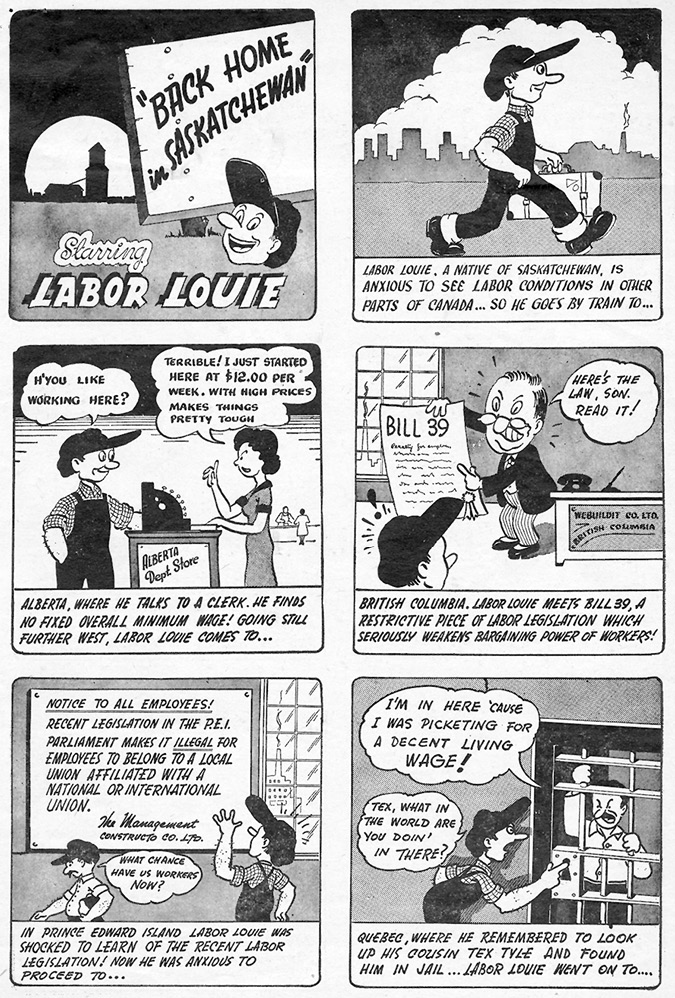
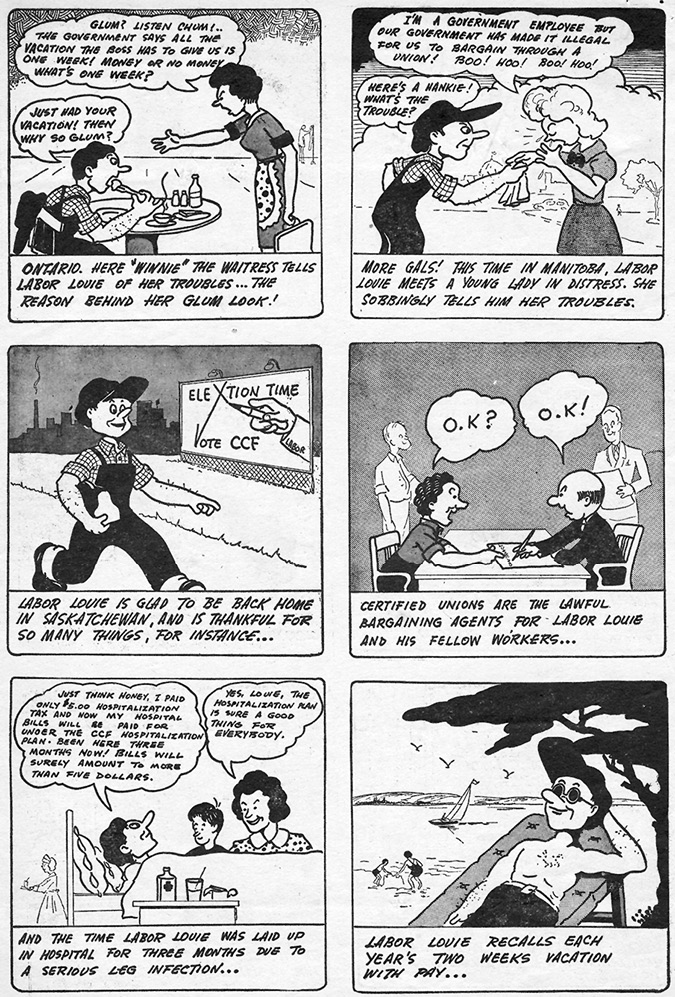
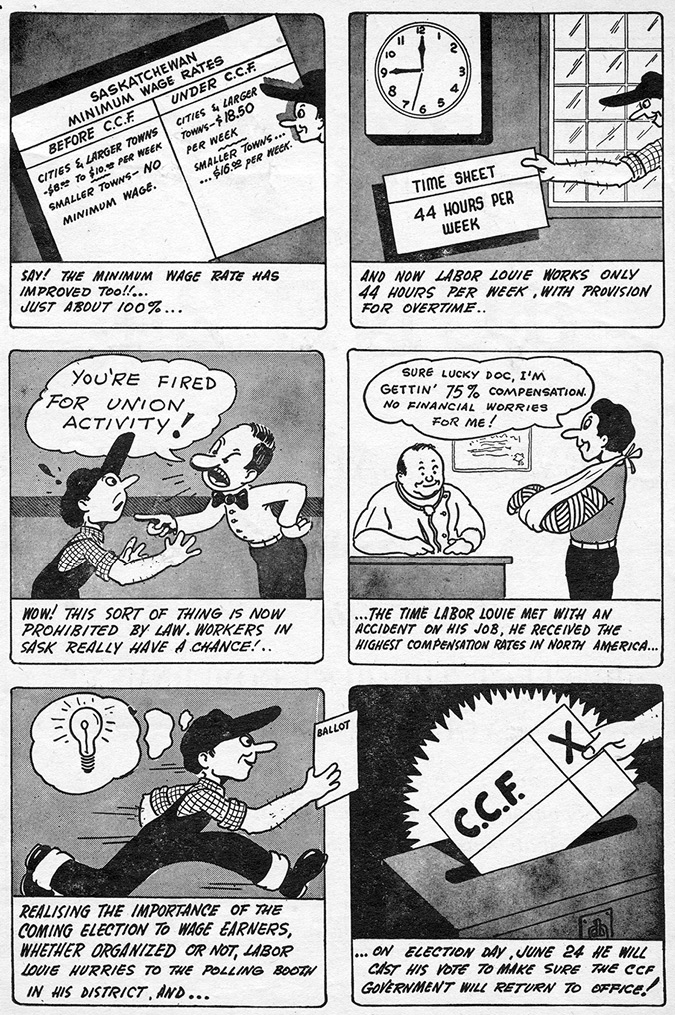
Figure 2. Labour Louie cartoon, ccl Campaign Material, 1948–1949.
ccf Labour Material, “‘Back Home in Saskatchewan,’ Starring Labour Louie,” mg28 I 103, clc fonds, vol. 180, Saskatchewan-Saskatchewan Federation of Labour, part 3 1948–1949, lac.
“Frankly, the Saskatchewan Situation Is Political Dynamite”: Organized Labour and the CCF after the Trade Union Act
With the stua enacted, the government’s next order of business was the establishment of the new Saskatchewan Labour Relations Board.119 Over the remainder of the government’s tenure, the slrb remained a focal point of conflict as it strove to define its legal powers. Not surprisingly, employers endeavoured to undermine worker organizing through the usual union-avoidance tactics, including blacklisting union activists, firing union organizers, and avoiding genuine good-faith bargaining. Yet as labour endeavoured to counter those actions before the Board, employers attempted to destabilize the slrb through legal challenges in the courts. The main legal argument put forward by employers was that the Board functioned as a court and therefore fell outside the jurisdiction of provincial authorities. While the government was eventually successful in refuting these challenges, the legal disputes lasted well into the 1950s.120
The immediate implication of these employer legal challenges was that the Board became more “courtroom like,” leading to longer hearings and more detailed legal proceedings. Recognizing this, organized labour repeatedly petitioned the provincial government for legal assistance to defend unions that might be dragged through lengthy legal proceedings, with the tlc going so far as to recommend banning lawyers before the Board (unless both sides agreed to use them). Although the government expressed sympathy for the position of the unions, the recommendations were never acted upon.121
Employer hostility to the Board emerged as the act spurred a flood of new organizing and labour activity. In one high-profile case, the Board recommended, and the government accepted, a decision to publicly appropriate a box factory in Prince Albert. This decision arose from a particularly belligerent owner who had repeatedly violated the provisions in the act regarding unfair labour practices.122 This was the only time this power was ever used in the province, although unfair labour practices unquestionably continued to occur.123 Nevertheless, the government believed that the box factory incident sent a strong message, as Ken Bryden later admitted, because it was “undeniable that a good many of these Orders would not have been obeyed if representatives of the Government had not read the riot act to the employers concerned.”124
The certification numbers of the Board’s early years tell a dramatic story. Within its first year, 174 applications, representing 10,728 workers, were filed before the Board. Of those applications, 108 were successful, as 6,623 new workers joined labour unions. The success rate of unions in 1945 alone increased the number of new workers covered by collective bargaining agreements by over 40 per cent.125 Those organizing trends continued throughout the government’s time in office, even as the pace slowed in the later 1940s. Over the first five years of the stua, 17,569 new workers were organized into unions, representing a 75 per cent success rate for certification applications before the Board (Table 1).
Table 1. Total Certifications, Saskatchewan, 1945–1950
|
Year |
Number of applications |
Number of workers affected |
Number of applications granted |
Number of workers affected |
Success rate (%) |
|---|---|---|---|---|---|
|
1945 |
174 |
10,728 |
108 |
6,623 |
62 |
|
1946 |
190 |
5,545 |
149 |
3,557 |
78 |
|
1947 |
133 |
4,357 |
114 |
3,464 |
85 |
|
1948 |
107 |
3,770 |
76 |
2,159 |
71 |
|
1949 |
80 |
1,336 |
69 |
903 |
86 |
|
1950 |
58 |
1,472 |
43 |
863 |
74 |
|
Totals |
742 |
27,208 |
559 |
17,569 |
75 |
Source: Data from Saskatchewan Department of Labour, Annual Reports, 1944–1951.
Judged by the sheer growth of union membership and union locals during the ccf’s multiple terms in government, the Trade Union Act can certainly be deemed a net positive. Unions in both labour centrals were clearly taking advantage of a legislative environment that did not place significant legal obstacles in the way of unions winning certification applications (Figure 3).
Yet even in this positive legal environment, real limitations are evident. Outside of the public sector, tlc unions were, for the most part, organizing in existing sectors of strength and not expanding in new sectors. The ccl, which had caused a stir in its organizing drives earlier in the war, was solidifying its base in small manufacturing firms and making some progress in the natural resource sectors. Organizing by both labour centrals was occurring in traditionally male-dominated sites such as the public service, construction, skilled trades, manufacturing, and the railways. Unions organizing outside of the two main union centrals – many of them reactionary and quasi-company unions such as the Canadian Federation of Labor – were faring poorly under the new Trade Union Act (Table 2).126
Neither of the main union centrals was making dramatic inroads in areas with higher levels of women’s employment, except perhaps for ccl breakthroughs in health services and in communication services such as telephones.127 Over time, the slow absorption of women workers into the public service did alter these dynamics for the tlc, but those employment changes were still a decade or more away. In the meantime, ccl unions were slowly branching out into some service areas where the workforce was more diverse, but these successes came with significant structural challenges. In 1951, the ccl-affiliated Retail, Wholesale, Department Store Union (rwdsu) was the most active union organizing in areas where women made up a significant number of workers. It had organized fifteen locals representing 1,413 workers in the province’s restaurants, hotels, grocery stores, and other retail employment sites.128 Yet rwdsu’s successes were quite restricted, the ccl recognized, by the fact that the union was meeting considerable resistance from small, anti-union employers. Added to this pressure, W. G. Davies acknowledged, was that the “immediate possibilities for new unions” in the retail sector “seemed to be confined to relatively small groups, involving rather costly servicing.”129 Davies’ recognition of the risks and high costs associated with organizing small workplaces pointed to a structural limitation that was never contemplated in the drafting or administration of the stua. As the Labour Minister had commented during the drafting of the act, workers and unions could not look to the government for assistance in organizing workers in any sector. The social and economic cost had to be endured by individual unions and often proved impossible to sustain.
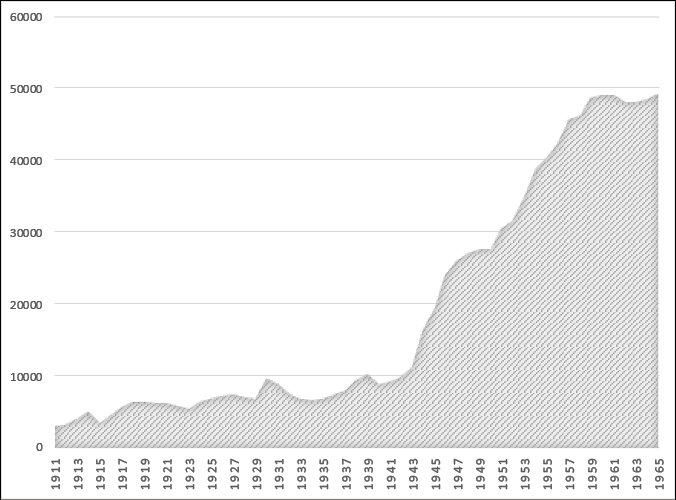
Figure 3. Number of union members in Saskatchewan, 1911–1964.
Data from Saskatchewan Department of Labour, Annual Reports, 1944–1965.
Table 2. Successful Organizing by Union Central
|
Year |
TLC union affiliations |
Workers |
CCL union affiliations |
Workers |
Unaffiliated |
Workers |
|---|---|---|---|---|---|---|
|
1945 |
90 |
6,623 |
18 |
2,073 |
0 |
0 |
|
1946 |
120 |
2,145 |
29 |
1,412 |
0 |
0 |
|
1947 |
75 |
1,962 |
39 |
1,502 |
0 |
0 |
|
1948 |
48 |
539 |
28 |
1,650 |
0 |
0 |
|
1949 |
49 |
466 |
30 |
437 |
0 |
0 |
|
1950 |
18 |
117 |
22 |
356 |
3 |
390 |
|
Totals |
400 |
11,852 |
166 |
7,430 |
3 |
390 |
Source: Data from Saskatchewan Department of Labour, Annual Reports, 1960–1961.
The tlc did not shy away from organizing in sectors that aligned with workers in the skilled trades or other professional sectors, especially in the broader public sector. And as the act made organizing less cumbersome, the tlc expanded slowly into other professional services. Yet, in its regular briefs to government, the tlc rarely moved beyond recommending the strengthening of existing regulations in already unionized industries. tlc unions were openly hostile to organizing women and were critical of women working in traditional “men’s jobs.” “The tlc made several disparaging remarks concerning married women’s employment and disapproved of the government’s hiring of women in higher-level policy positions.”130 In response, Premier Douglas noted it was government policy that “married women shall not be appointed or continued in the public service,” and, while it was “impossible to impose a similar standard upon other employers in the province,” his government did not plan to upset the status quo on this issue.131
With attitudes akin to the premier’s ubiquitous inside the unions, it is not surprising that an examination of the total makeup of union locals in 1961 shows no dramatic demographic shift in the workers organized in the postwar era under the stua. The unions remained heavily centred in traditional sectors of trades, manufacturing, natural resource extraction, and an area unique to Saskatchewan within Canada for union penetration in this era – the public service.
Both union centrals were eager to organize the public service. In fact, the first certification applications to the Saskatchewan Labour Relations Board came from the civil service, where organizing had begun as early as August 1944.132 The skirmish for the loyalty of the workers inside the public service reached deep into the political backrooms of the ccf. Officially, the government was “strictly neutral” on the question of which unions were to represent the civil service.133 C. C. Williams, however, made several early missteps, one of which was to encourage ccl organizers to avoid civil-service organizing while the government set up its new administrative machinery. That guidance was interpreted as one typically echoing the worst anti-union employers and did not sit well with the ccl unions.134 Responding to Williams’ numerous blunders on the issue of public-sector organizing, national ccl treasurer Pat Conroy lambasted the Labour Minister for adopting “an attitude that cannot be considered as helpful or impartial in our proposed campaign to organize civil service employees and other workers throughout the Province of Saskatchewan.”135 Although Conroy’s concerns were met with a firm denial from the minister and premier, questions over Williams’ allegiances hovered over the public-service organizing campaigns.
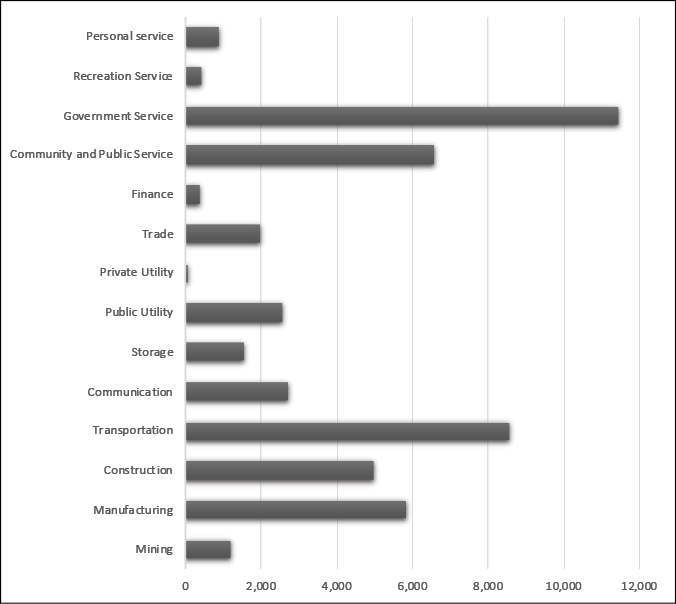
Figure 4. Union membership in Saskatchewan, 1960–1961.
Data from Saskatchewan Department of Labour, Annual Reports, 1944–1951.
ccl organizers were also furious about the tlc’s efforts in gaining the affiliation of the already existing, non-union Saskatchewan Civil Servants Association (scsa). National official and local ccl representative A. A. McAuslane publicly insulted the plans of the leadership of the scsa and the tlc, accusing them “of issuing second rate, class B, affiliations to the Saskatchewan Services Association lending aid to company unionism against the bona fide United Civil Servants of Canada, ccl.”136 Many interpreted McAuslane’s combative approach as “tactless and offensive,” and Douglas believed he was doing “a great deal of damage to the cause of the ccl.”137 In an scsa vote on 22 September 1944, almost 90 per cent of the existing membership supported affiliation to the tlc. Though ccl-supporting civil servants complained that the ccl was never presented as a viable option to scsa members, the Labour Board certified the tlc local in early 1945.138 The government was then able to quickly reach a first contract with the union, agreeing on moderate wage increases, a shortened workweek, vacations, and other bread-and-butter union issues such as guaranteeing promotion based on seniority and creation of a union-management grievance procedure.139
The tensions between the ccl and tlc were not settled when the scsa was certified. The ccl successfully organized workers at Saskatchewan Telephone (the United Telephone Workers) and at various mental health hospitals in Weyburn (Douglas’ own constituency) and North Battleford (the United Civil Servants of Canada). Members of the Oil Workers’ Union had pushed to organize workers at Saskatchewan Power, and many of these workers ended up affiliating with the ccl, although not without substantial fights with the tlc.140 In one case, the ccl filed an application to the Labour Relations Board claiming to represent workers in the mental hospitals, but the Board recognized that some of the workers in the proposed unit had already signed union cards with the tlc and denied the ccl’s application.141 On behalf of the ccl, Douglas personally intervened in the certification application and asked the Board to reconsider the matter. Upon review, the Board certified the ccl locals in the mental health hospitals.142 This intervention remained a point of contention for tlc officials and called into question the government’s stated neutrality in organizing the civil service. The tension between the unions and the ccf led Eamon Park, director of organizing with the ccl, to conclude that, “frankly, the Saskatchewan situation is political dynamite.”143
The conflicts between the ccf and the main union centrals over organizing were amplified when the government entered negotiations as the employer.144 That tension amounted to dozens of interactions between national officials and local unions, as collective bargaining took centre stage for local unions. For the most part, the ccf avoided significant public-sector strike action throughout its tenure, but it never seemed able to achieve amicable relations with local ccl unions. The government’s archive files are filled with documentation of meetings between ccf and ccl representatives attempting to construct an institutional buffer between public-sector-union collective bargaining demands and the broader political goals of the ccf government.145 The hope from both parties was the establishment of “a permanent joint committee composed of representatives of the Government of Saskatchewan and the ccl” in order to manage “relationships between management and labour.”146 In almost all instances, these institutional arrangements failed, with even Douglas expressing doubt that the “committee can do the job.”147 Douglas complained to national union officials that provincial tensions between the ccl and the ccf were due to the “inexperience of some of the organizers, many of whom are unacquainted with negotiation techniques” and “sadly in need of some guidance.”148 Given the premier’s attitude, it is perhaps not surprising that it often took direct intervention by national union leadership and national ccf leadership to avoid significant job action.
In one case, the recalcitrant attitude of the government did provoke a strike. On 18 November 1948, workers at sgio walked off the job after collective bargaining broke down between the ccl-affiliated Saskatchewan Insurance Employees Union and management. The sgio was created in 1944 in the same three-day legislative fury that created the Trade Union Act. Over the next two years, it became a Crown corporation and part of the government’s compulsory auto insurance scheme. Ostensibly, the 1948 strike was a dispute over wages and benefits, but the conflict also reflected a segment of the working class that was eager for change. The membership of the union was relatively young, reflecting a new generation of workers inside the public service. Some of the workers were newly hired women, and the membership was poorly compensated. The union’s wage demands reflected workers looking to play catch-up after the war and to guard against postwar inflationary pressures. Meanwhile, the government responded in ways that reflected some of the worst tactics of private-sector employers, including a refusal to put a salary package on the table because it did not recognize the legitimacy of the union’s wage demands. The settlement that ultimately ended the strike included some significant gains for the workers inside the sgio but was influenced by the close relationship that key personnel inside the government maintained with national ccl officers. Both the former and the latter applied significant pressure on the local union to end the conflict.
The strike itself should not have been a surprise. ccl national president Aaron Mosher, secretary-treasurer Pat Conroy, and sfl executive secretary W. G. Davies had all sent letters to Douglas and the cabinet as early as February pointing out that the wage requests from sgio employees “have been reasonable and that their representatives have justified the position, in light of the comparison of wages and salaries in other provinces.”149 Conroy warned Bryden that management’s “lack of a positive attitude” was fuelling “frustration and irritation, and a strike mentality” among government insurance workers.150 That frustration was amplified, as historian Robert Lindsay has shown, because of the “spectacular success” of the sgio and the high revenues generated by the new Crown corporation.151
Union wage demands ranged from 22 to 27 cents per hour and asked for a 37½-hour workweek. Management costed this request as a 49 per cent wage increase overall, but the union disagreed with that number given the different wage structures inside sgio. Union representatives were most critical of the uncooperative approach taken by government negotiators at the bargaining table, especially the company’s vice-chairman, O. W. Valleau. Valleau had been the rural ccf minister responsible for creating the sgio in 1944, before his defeat in 1948. At the bargaining table, management refused to even counter the wage offers made by union negotiators because “the union won’t lower its wage demands.”152
The government’s refusal to negotiate certainly fuelled a boisterous attitude on the picket line, as 120 men and women strikers walked off the job in Regina, with another 30 joining in six smaller locations across the province. Picketers had been warned by their union that they were expected to remain peaceful and to avoid “unseemly conduct of any kind.” Failure to comply with these instructions, the union warned, could result “in expulsion from the Union and consequent severance of employment with the office as per maintenance of membership provisions agreed upon as between the corporation and the Union.”153 For the reporter describing the Regina picket line, the jovial mood of the well-dressed crowd was comparable to having a “holiday,” with “the girls wearing heavy coats, slacks, and boots, while the boys wore parkas, overshoes, heavy-mitts, and wool sweaters.”154
News reports uncritically noted the gendered division of labour on the picket line. Women strikers were observed preparing coffee and pastries while the men were noted to be “making wise-cracks” to passers-by. The strikers, the Leader-Post concluded, were “mostly youngsters” who “looked like high-school kids at a football game.”155 Defiant of government claims that it could not afford wage increases, picketers carried signs decrying the sgio “Surplus over $1,000,000” and claiming, subversively, that they were just going to organize and to “vote Liberal next election.” The defiance from many of these newly minted unionized workers was certainly reflected in the remarks of union president W. H. Turner, who was clear that the union was willing to stay on the line through the cold winter months until its members’ demands were heard and taken seriously.
Turner’s frustration, expressed in press reports and private letters, was centred on management’s lack of a single counter-offer to the union’s wage demands. In contrast, management’s public relations response blamed union greed, stated that workers were being unreasonable, and publicized existing wage categories that attempted to shame those at the bottom of the hierarchy for asking for too much since they were likely “direct from school.”156 Government officials stated that they were not against a wage increase but that the union was acting irresponsibly.
The government’s obstructive positions unified many on the left, as the Labor-Progressive Party, the Regina Labour Council (tlc affiliate), the provincial sfl (ccl affiliate), and numerous ccf supporters all expressed sympathy for the strikers.157 The sfl demanded that cabinet intervene directly in the dispute and settle the strike amicably.158 Meanwhile, workers across the Crown sector, but especially in the telephones and power commission, were considering waging a sympathy strike, but this was prevented by union leadership.159 As the strike dragged on over the next three weeks, management scrambled to contain what was clearly a public relations nightmare, opening an office in the legislature to deal with outstanding insurance claims. The union asserted that such an action was akin to employing scab labour, although much of the work was being done by management officials.160
The turmoil between the union and the government created no end of merriment for the editorial writers at the Leader-Post, who wrote no fewer than six editorials decrying the government and its “socialist” policies. The Leader-Post believed that the ideologues in government were mismanaging the strike; the paper also critiqued the ccl’s greed. It also took the opportunity to point to problems with public insurance and, especially, the overall problems of what Douglas had repeatedly said was the “most advanced labour legislation in the country.”161
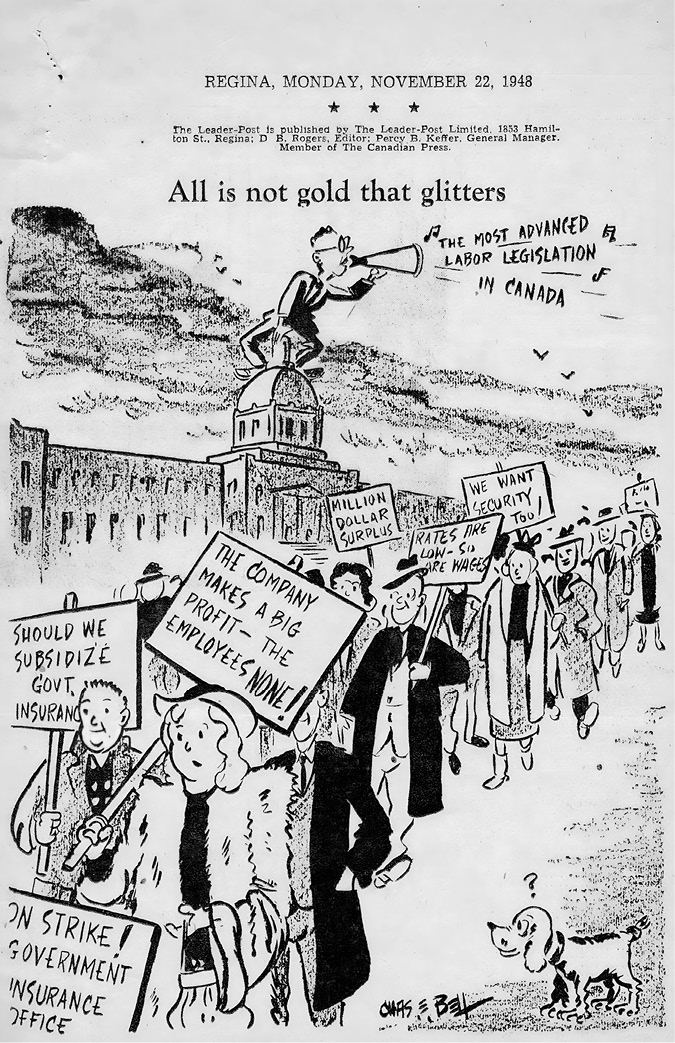
Figure 5. “All is not gold that glitters,” editorial cartoon published in the Leader-Post(Regina), 22 November 1948.
Meanwhile, dozens of telegrams were flowing between Ottawa and Regina, with ccl and ccf officials desperately trying to save political capital in order to end the strike on reasonable terms.162 While the immediate interests of the workers themselves were not always in the foreground of this dialogue between officials, Mosher continued to suggest that the union’s wage requests “do not to us appear to be outrageous.” At Douglas’ request, he agreed to have Pat Conroy “attempt conciliation in the Insurance dispute.”163 Conroy was eventually able to arbitrate an end to the dispute, with the union winning a 35 per cent wage increase (a settlement that certainly might have been arrived at earlier had management been willing to meaningfully negotiate with its union).
The end of the strike did not end tensions between the government, unions, and employers, And the conflict between the ccl and the ccf opened the door for many employer organizations to challenge the legitimacy of the Trade Union Act. In a series of advertisements and public releases, the Saskatchewan Employers’ Association called into question government labour policies and union attitudes to collective bargaining and strike action (see Figure 5). The employer assault claimed that the government was incompetent in managing its own workers and that it was a mistake to allow public-sector workers to unionize. Employer comments in the national press also placed blame on representatives inside the Department of Labour for favouring labour in this dispute, taking aim at former ccl personnel who had been appointed to public-service policy positions.164
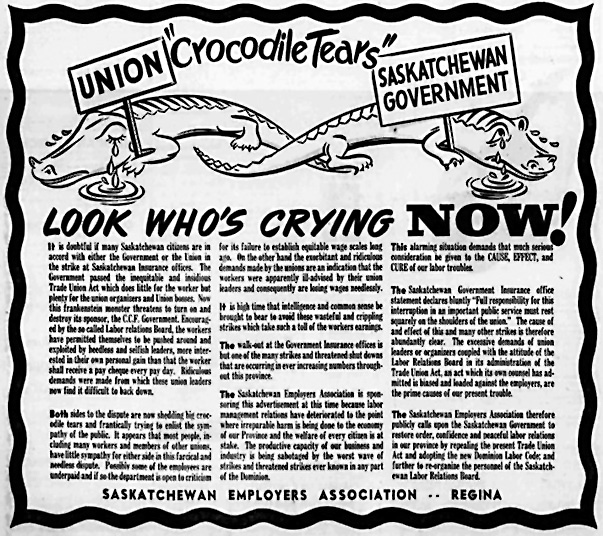
Figure 6. “Crocodile Tears,” an anti–Trade Union Act advertisement placed in newspapers by the Saskatchewan Employers’ Association.
Leader-Post (Regina), 7 December 1948.
Perhaps responding to this pressure with an eye on future electoral success, the government prepared a detailed policy response with which it surprised the ccl delegates during their annual brief on 17 December 1948. The government confirmed that a great number of the public utilities and Crown industries were currently in (or were soon to enter) collective bargaining. Recognizing this, the government wanted to avoid the parties’ “approaching each other like two dogs quarrelling over a bone” because it was “doubtful whether the bone legitimately belongs to either of us, but may in fact belong to the people of the province as a whole.”165 While hoping to maintain the goodwill of both parties and “to protect from exploitation the individual who has not been able to acquire economic power through ownership of land or capital,” the government pointed out that “wealth had to be created before it can be distributed.” Public wealth creation was to occur through numerous social democratic initiatives, including the promotion of Crown corporations and some public ownership. The government aimed to “identify our cause with the common man,” including workers, farmers, and everyday people in other jurisdictions, and so needed to avoid creating “new privileged groups once we have abolished the old ones” – essentially accusing the unions of trying to create a new aristocracy of labour within the public service. While the government professed it was committed to the principles of trade unionism, it believed that there had to be a mutual assurance from the unions that the wealth “produced by effort on the part of the workers, and good organization and administration on the part of management” be equitably shared by the “common” people of Saskatchewan.
To meet its goals, the government proposed a new approach to public-sector negotiations. Besides beginning each new bargaining session with a mutually agreed statement on joint objectives, it also proposed that the government would “introduce a general policy to bring the various interests of producer, consumer, and public servant, in relation to one another.” This would then be balanced against the union’s wage demands. The ccf concluded by suggesting that the sfl pledge to adopt a “harmonious relationship between the government and its employees,” and to “not permit industrial strife,” so that the broad ideals of both movements could be met. In other words, the unions had to stop threatening politically embarrassing strike action to achieve larger gains at the bargaining table.
Douglas penned a forthright letter to Mosher on 20 December, making it clear that the 1948 strike had been a political and economic debacle, and urged the national leadership to adopt the government’s new policy statement to avoid such a problem in the future. Douglas’ hectoring tone was certainly informed by an ongoing and bitter private sector dispute in the Estevan coal region, where the militancy of the ccl local was threatening the energy supply in nearby cities and towns.166 While the Saskatchewan ccf recognized capitalist inequality as the root of the economic problem that caused job action, it also saw such actions in the public sector as a threat to its broader political project. Douglas’ words are worth quoting at length for what they reveal about the tension between social democratic approaches to governance and the party’s political and economic relationship to the unions:
The principal issue is the challenge which is being continually laid down by the Unions as to whether the employees of the Government Insurance Office, or any other group of workers, can in effect decide whether the government can maintain its services. There is only one answer to this question. The citizens of Saskatchewan, including the members of trade unions, can govern through their elected representatives and no other way. We agree that within that general statement there is room for a great deal of compromise and modification to enable various groups of citizens to protect themselves against exploitation by the community by association in trade unions, co-operative societies, or in many other ways. We must categorically state, however, that there can be no opportunity for any group to use their economic or political power to establish a favoured position among their fellows except by consent of the community as a whole express through their democratic franchise. That is what the ccf stands for. That is why we have brought in the Trade Union and Co-operative and other Acts, to give various groups the chance for self-protection against the old vested interests of capitalism. We did not pass these measures in order to create a new class of privileged persons.
Douglas conceded to Mosher that after the sgio strike he was “under tremendous pressure from our own ranks who have always feared the urban trade union movement.”167
Such pressure coming from its own rural caucus was clearly something the ccf in Saskatchewan took seriously. Essentially, through Douglas, the government was demanding that unions concede one of their most important freedoms – the freedom to strike – so that the public-sector union provisions in the stua remained in place. Douglas’s position reflected the inherent contradictions of his role as political leader, premier, and ostensibly a defender of union freedoms within a postwar social democratic party that had come to terms with a mixed capitalist economy. The Trade Union Act, with all the rights it granted to workers and their unions, was the epitome of the party’s labour relations regime. Beyond the act, the ccf was more interested in building the economy. While workers were not an afterthought, they were expected to align themselves with the broad policy goals of the party, even it meant lower wages and benefits.
Union responses to the government’s new industrial relations proposal were predictable. Harry Chappell, ccl representative for prairie organization, expressed a deep-seated anger that the ccl’s social democratic allies were asking the unions to “consider foregoing certain basic trade union rights and prerogatives – including the right to strike whenever we were forced into a position of having to use such a weapon.” While Chappell recognized that mistakes had been made during the sgio strike, he also believed that government negotiators from sgio had made the same kind of “reactionary statements … that many hard-boiled employers had quit using ten years ago.” Chappell also stated that the ccl’s political and economic agenda was not one where the unions were simply “to become a slavish appendage of the ccf.” Rather, he believed that both entities had the right and obligation to defend the interests of their members. While he conceded that the unions “really didn’t want strikes,” he recognized that they were sometimes vital to pursing union objectives.168
Notwithstanding his clear anger and disappointment, Chappell also conceded that the Saskatchewan ccf was still a vital political partner with the ccl. He recognized that the party had real political problems with its rural farm base and was worried that some of those mlas might begin pushing for an erosion of the union security clauses in the act. Without the checkoff and maintenance of membership provisions in the act, Chappell worried that unions might lose the valuable foothold they had gained over the past decade. While Chappell expressed concern about setting up a new institutional form of industrial relations along the lines proposed by the ccf, because he felt it might weaken union demands at the bargaining table, he nevertheless expressed hope that if it was led by senior ccl officials, including Conroy and Mosher, it had a greater chance of success. After these appeals, the ccl sent Pat Conroy on a goodwill tour to revitalize joint industrial relations meetings and to calm the heated political waters. Those meetings had some initial success, but over the long term the joint industrial relations meetings proved much more difficult to sustain.169
The tension inherent in the ccf’s approach to labour relations continued to plague the government through other conflicts with ccl unions. Perhaps the most dramatic conflict occurred in 1955, when the government brought David Lewis to Regina to mediate a dispute between power workers and the government. In that dispute, the government threatened binding arbitration to eliminate the right to strike, despite having decried such action as undemocratic and authoritarian when the federal Liberals used such tactics in 1950 to end a national railway strike.170 Notwithstanding the hypocrisy, a settlement was reached. Political calculations kept many of the unions’ powder dry throughout the ccf’s time in government, as numerous disputes continued to require national intervention by senior ccl and ccf operatives to stave off potential strike action.
Conclusion
The Saskatchewan ccf’s Trade Union Act is clearly unique in Canadian labour and legal history. It was the product of local and, especially, national ccf officials working with nationwide leadership in the ccl to build a unique social democratic model of labour relations in Canada. The act was even more noteworthy given the political risks that the government took in prioritizing a far-reaching labour relations program in a largely agriculturally based economy. While the stua borrowed most of its ideas from the American Wagner Act, it did include some social democratic ideas that pushed back against the absolute right of private employers to defeat union drives. The act expanded unionization to the public service, took a clear stance against company unions, and vastly expanded union security provisions. The stua empowered the newly constructed Saskatchewan Labour Relations Board to enforce many of its provisions, including the power to recommend that private businesses be placed under a government controller. It defended workers’ right to strike, placing few legal obstacles in the way for unions to exercise this right. For many of the unions in the ccl and the tlc, these provisions were transformative.
For their part, private sector employers saw the act as “iniquitous, unfair, and irresponsible legislation which in the long run will do the true interests of labour irreparable harm.”171 Yet, aside from their rhetorical defence of “free enterprise,” they could not block the passage of the act or persuade the government to water down its content. Reflecting this weakness, businesses used other tools to undermine union abilities to organize, whether through the traditional union-avoidance strategies or challenging the powers of the Board in court. After the 1948 sgio strike, business also continued its long campaign to undermine the legitimacy of the unions while stressing publicly that the ccf imposed labour standards on employers that did not apply equally to its own dealings with public-sector workers.
Unions championed the act, fought for its contents, battled a recalcitrant Labour Minister, and pushed to defend their newly won rights at the Labour Board and elsewhere. Under the terms of the stua, workers were organized in record numbers. The new unions, many of them in heretofore non-organized workplaces, created a solid foundation for union centrals to grow and prosper in the postwar environment. By the end of the 1950s, the ccl and tlc unions (now part of the Canadian Labour Congress) had grown substantially in the manufacturing, construction, public transportation, and public and government services sectors. Yet, outside of the public service, this growth was drawn from a segment of the working class that already formed the foundation of the ccl and tlc unions in the years before the passage of the act. Neither the ccl nor the tlc was able to organize in areas where women or other marginalized groups were working in significant numbers. Such a reality suggests that even the most favourable labour law environment will not, by itself, produce the organization of the working class as a whole that might promise to fundamentally transform the relationship between workers and private enterprise. As the uneven and far-from-universal organizing that had emerged under the stua became clearer in the 1950s, the government neither altered the act nor intervened directly to expand efforts to organize working people in the province.
Inside the government, labour relations proved complicated. When collective bargaining demands challenged the government’s economic priorities, the government routinely leaned on national party and union leaders to counter the demands of local public-service unions. The sgio strike reflected this union-party-government contradiction. In this instance, the government needed support from outside forces to rein in the union’s demands because the government believed its job was to balance all interests in the economy rather than appeal to a small subsection of the working class. When acting as an employer, the ccf no longer interpreted economic realities as deeply divided by class antagonism. The government’s embarrassment over the sgio dispute led it to ask the unions to voluntarily concede their right to strike in the name of larger social democratic political priorities. This policy response indicated that the rights of labour were secondary to the party goals of managing the mixed capitalist economy and avoiding embarrassing labour conflicts in its own sphere of influence.
In many ways, the early history of the Saskatchewan Trade Union Act points to a fundamental weakness of social democratic policy reforms after a governing party makes peace with capitalist realities. What the early experience of the act demonstrates is that even when sympathetic parties control the halls of legislative power, working-class demands will be in tension with broader political goals. Meanwhile, capitalists will seek to undermine worker gains. From the moment the ccf introduced the stua, business organized to undermine the legal rights it outlined. In response, the government did little to amend the bill in a way that put more pressure on capitalists and their rights of property. To be sure, union successes in the early years of ccf government in Saskatchewan were buttressed by a government that was willing to compromise, negotiate, and find solutions with national party and union officials that were not shaped by the heavy hand of the police, the courts, or other draconian methods. But the history of the stua likewise suggests that the act alone, notwithstanding Douglas’ repeated statements that it was the “most progressive trade union and labour legislation in Canada,” did not significantly challenge the class and legal powers that shaped class and gender relations in 1940s and 1950s Saskatchewan.172
I would like to thank Larry Savage, David McGrane, Julia Smith, and Eric Tucker for their helpful comments on earlier drafts of this paper. Thanks also to Kirk Niergarth, who provided invaluable editorial advice to bring this paper to publication. I would also like to acknowledge the incredible insight and detailed comments made by all three reviewers of this piece. Their commentary and observations were instrumental in improving the article. As always, however, all errors and omissions remain entirely my own.
1. A 1942 Gallup poll placed the ccf at 21 per cent in public support, up from 8 per cent in 1940. By contrast, the Liberals enjoyed the support of 55 per cent of the electorate in 1940, but only 39 per cent in 1942. In the same poll, a significant minority of respondents (23 per cent) opposed the government’s wartime restrictions imposed on the Communist Party. Aligning with rising support for the left, a Gallup poll in 1948 showed that 48 per cent of English Canadians (and 37 per cent of francophones) supported greater government control over business, industry, and agriculture in Canada (with 11 per cent undecided). See Gallup and Fortune Polls, “Domestic Issues in Canada,” Public Opinion Quarterly 6, 4 (Winter 1942): 655–657.
In early 1943, the ccf was also polling well in Ontario, with one Gallup poll placing the party at 36 per cent, 3 percentage points ahead of the Liberal government. The ccf eventually finished second in the summer campaign, four seats and four percentage points behind the newly elected Progressive Conservatives. See “Public Opinion Polls,” Public Opinion Quarterly 7, 3 (Autumn 1943): 493. On the Ontario election campaign and the ccf in the 1940s, see Gerald Caplan, The Dilemma of Canadian Socialism (Toronto: McClelland and Stewart, 1973).
2. On the 1944 election victory of the Saskatchewan ccf, see the classic analysis by Seymour Martin Lipset, Agrarian Socialism: The Cooperative Commonwealth Federation in Saskatchewan; A Study in Political Sociology, updated ed. (Berkeley: University of California Press, 1968), 149–160.
3. Although critical of the reformist politics of the labour leadership, the growth of labour’s political power during World War II has been well chronicled in Peter McInnis, Harnessing Labour Confrontation: Shaping the Postwar Settlement in Canada, 1943–1950 (Toronto: University of Toronto Press, 2002). Wendy Cuthbertson challenges McInnis’ arguments about the reformist nature of labour leadership in her Labour Goes to War: The cio and the Construction of the New Social Order, 1939–45 (Vancouver: UBC Press, 2012). On the increase in worker militancy in this period, see Mikhail Bjorge, “The Workers’ War: The Character of Class Struggle in World War II,” PhD diss., Queen’s University, 2017.
4. pc 1003 was the first compulsory collective bargaining regime sanctioned by federal authorities, although some provinces had passed legislation recognizing these rights in some form in 1943 and 1944. The literature on the Liberal construction of pc 1003 is vast. Perhaps the most comprehensive overview of the class dynamics leading to the construction and consolidation of pc 1003 is found in Judy Fudge and Eric Tucker, Labour Before the Law: The Regulation of Workers’ Collective Action in Canada, 1900–1948 (Toronto: Oxford University Press, 2001). Equally critical is Bryan Palmer’s Working-Class Experience: Rethinking the Politics of Labour, 1800–1991 (Toronto: McClelland and Stewart, 1992), 278–284. See also Leo Panitch and Donald Swartz, From Consent to Coercion: The Assault on Trade Union Freedoms (Toronto: Garamond, 2003). Peter McInnis examines the construction of pc 1003 in Harnessing Labour Confrontation. Taylor Hollander is much more sympathetic to the Liberal Party, and particularly to Prime Minister Mackenzie King’s approach to labour relations in the 1940s; see Hollander, Power, Politics, and Principles: Mackenzie King and Labour, 1935–1948 (Toronto: University of Toronto Press, 2018).
5. Fudge and Tucker, Labour Before the Law, 273.
6. In its simplest form, majoritarian exclusivity is the component of Wagnerism that protects the democratic right of workers in a single plant to choose their bargaining agent (through a majority vote or card-check process). For more discussion of Wagnerism, see Eric Tucker, “Shall Wagnerism Have No Dominion?,” Just Labour: A Canadian Journal of Work and Society 21 (Spring 2014): 1–27.
7. Panitch and Swartz, From Consent to Coercion, 13–14.
8. Canadian War Orders and Regulations, “pc 1003,” 17 February 1944, https://guides.library.utoronto.ca/ld.php?content_id=34417172. For an overview, see Judy Fudge and Harry Glasbeek, “The Legacy of pc 1003,” Canadian Labour and Employment Law Journal 3 (1995): 357–400.
9. J. L. Cohen, “pc 1003,” 1944, 6, J. L. Cohen fonds (hereafter jlc fonds), file Reports Re: pc 1003, mg30 A 94 38, Library and Archives Canada (hereafter lac). On Cohen’s politics and activity with labour in this period, see Laurel Sefton MacDowell, Renegade Lawyer: The Life of J. L. Cohen (Toronto: University of Toronto Press, 2001).
10. Canadian Congress of Labour (ccl), Report of the Special Committee of the Executive Council for the ccl on pc 1003 and pc 9384, 15 January 1945, jlc fonds, file Reports Re: pc 1003, mg30 A 94 38, lac.
11. W. K. Bryden, strictly confidential memo to T. C. Douglas, Premier, 3 November 1944, Tommy Douglas Fonds, F117, R 33.1 (hereafter tcd fonds), file no. 302 (7-8), Legislation, July 1944–April 1946, Public Archives of Saskatchewan (hereafter pas).
12. Nelson Lichtenstein, State of the Union: A Century of American Labor (Princeton: Princeton University Press, 2002), 39.
13. Lipset, Agrarian Socialism, 279.
14. To be sure, some important academic works have explored historical aspects of the act in important ways. See, for instance, Walter J. C. Cherwinski, “Organized Labour in Saskatchewan: The tlc Years, 1905–1945,” Ph.D. diss., University of Alberta, 1972, 274–310; Robert Lindsay, “Co-operation and Conflict: The ccf and the Canadian Congress of Labour in Saskatchewan, 1944–1956,” MA thesis, University of Saskatchewan, 1987; Beth Bilson, “The Prairie Face of Labour,” in Jene M. Porter, ed., Perspective on Saskatchewan (Winnipeg: University of Manitoba Press, 2009), 197–214; Bilson, “John East Iron Works v. Saskatchewan Labour Relations Board: A Test for the Infant Administrative State,” in Judy Fudge and Eric Tucker, eds., Work on Trial: Canadian Labour Struggles (Toronto: Irwin, 2010), 44–47. Former ccf staffer Thomas McLeod and his son, Ian McLeod, devote a chapter to the construction of the act in Tommy Douglas: The Road to Jerusalem (Toronto: Fifth House, 2004), 197–206. Former Saskatchewan public worker A. W. Johnson also briefly discusses the act in his Dream No Little Dreams: A Biography of the Douglas Government of Saskatchewan, 1944–1961 (Toronto: University of Toronto Press, 2004), 81–83, 133–134; Doris French Shackleton, Tommy Douglas (Toronto: McClelland and Stewart, 1975), 177–183. See also Glen Makahonuk, “Labour Relations and the Saskatchewan Coal Miners’ Strike of 1948–1949,” Saskatchewan History 39, 1 (1986): 5–6. For non-academic examinations, see Makahonuk, Class, State, and Power: The Struggle for Trade Rights in Saskatchewan, 1905–1997 (Regina: CUPE Saskatchewan, 1997) and Jim Warren and Kathleen Carlisle, On the Side of the People: A History of Labour in Saskatchewan (Regina: Coteau, 2005).
15. Eric Tucker, “The Faces of Coercion: The Legal Regulation of Labor Conflict in Ontario, 1880–1889,” Law and History Review 12, 2 (1994): 278–339.
16. The Canada Yearbook 1943–1944, Census Statistics of the General Population (Ottawa: Dominion Bureau of Statistics, 1944), 79.
17. Province of Saskatchewan, A Submission by the Government of Saskatchewan to the Royal Commission on Dominion-Provincial Relations (Canada, 1937), 171–203, 287–301.
18. J. William Brennan, “‘The Common People Have Spoken with a Mighty Voice’: Regina’s Labour City Councils, 1936–1939,” Labour/Le Travail, no. 71 (Spring 2013): 56–57. See also Patrick H. Brennan, “Thousands of Our Men Are Getting Practically Nothing at All to Do: Public Works Relief Programs in Regina and Saskatoon, 1929–1940,” Urban History Review/Revue d’histoire urbaine 21, 1 (1992): 33–45.
19. Government of Canada, Census of the Prairie Provinces, 1946, vol. II, Occupations, Industries, Earnings, Employment, and Unemployment, table 22, “Wage-earners, 14 years of age and over, by sex, showing total and average earnings and total and average weeks employed during the 12 months prior to the census date, for the province of Saskatchewan, census years, 1911–1931, 1936, 1941, 1946” (Ottawa, 1946), 502.
20. The Canada Yearbook 1939, Census Statistics of the General Population (Ottawa: Dominion Bureau of Statistics, 1939); The Canada Yearbook 1950, Census Statistics of the General Population (Ottawa: Dominion Bureau of Statistics, 1950), 389.
21. It is worth noting, however, that the seasonal nature of farm labour meant that thousands of men in construction and manufacturing also spent at least some of the year working on farms for wages. See Bilson, “Prairie Face of Labour,” 199. For an overview of farm labour on the prairies, see Cecilia Danysk, Hired Hands: Labour and the Development of Prairie Agriculture, 1880–1930 (Toronto: McClelland and Stewart, 1995).
22. Records from the Saskatchewan Federation of Labour’s founding convention recognize this membership demographic. Among the leadership of the founding of the sfl in late 1944 were workers in the main urban centres, mostly from the meat-packing sector and the railway unions. There were also representatives from the newly minted oil unions, electrical workers, woodworkers, miners, and some police unions. They were soon joined by workers in the telephone system and in mental health hospitals. Grain handlers also joined by the end of 1945. Among unions that would have included women workers were the jute and laundry bag workers and laundry workers, most of whom were situated in Moose Jaw. See N. Riches, secretary, Saskatchewan Federation of Labour, List of Labour Unions and Labour Councils in Saskatchewan, 12 April 1945, clc Papers, File Saskatchewan-Saskatchewan Federation of Labour, 1944–1947, mg28 I 103, vol. 179, lac. See also Saskatchewan Federation of Labour, Minutes and Resolutions of Saskatchewan Federation of Labour, First Convention, 19 November 1944, GR 73-1, Records of the Saskatchewan Federation of Labour (hereafter sfl Records), R-146, file no. 27a, Conventions 1944, pas. For a very general discussion of these events, see Warren and Carlisle, On the Side of the People, 126.
23. Census of Canada, 1951, vol. iv, Labour Force, table 11, “Labour force, 14 years of age and over, by occupation and sex, showing age group, material status, years of schooling, and class of workers, for Canada and the provinces” (Ottawa, 1951), 125–131.
24. Cherwinski, “Organized Labour in Saskatchewan.”; J. W. Brennan, “Common People Have Spoken,” 49–86. On Moose Jaw, see John Larsen and Maurice Richard Libby, Moose Jaw: People, Places, History (Regina: Coteau, 2001), 97–103, 113–120.
25. Government of Saskatchewan, First Annual Report of the Department of Labour of the Province of Saskatchewan, 31 December 1944, 51. Lindsay claims that these numbers were low, arguing that the numbers were significantly higher for ccl unions. See “Co-operation and Conflict,” 21.
26. Cherwinski, “Organized Labour in Saskatchewan,” 237–266, 238. While the tlc was not antagonistic to political action, it tended to avoid partisan relationships with political parties unless there were direct benefits to its membership. See Gad Horowitz, Canadian Labour in Politics (Toronto: University of Toronto Press, 1968), 62–66.
27. Horowitz, Canadian Labour in Politics, 143.
28. Warren and Carlisle, On the Side of the People, 113.
29. For an overview of labour socialism on the prairies, see also James Naylor, The Fate of Labour Socialism: The Co-operative Commonwealth Federation and the Dream of a Working-Class Future (Toronto: University of Toronto Press, 2016).
30. Government of Canada, Census of the Prairie Provinces, 1946, vol. II, Occupation, Earnings, Employment, table 3, “Gainfully occupied, 14 years of age and over, by occupation and sex, showing age, marital status, years of schooling, and industrial status, for the province of Saskatchewan” (Ottawa, 1946), 328–334. In terms of wartime employment gains for women, one of the largest employers was the armed services themselves, as 1,352 women from the province joined the military.
31. Census of Canada, 1951, vol. iv, Labour Force, table 11, “Labour force, 14 years of age and over,” 131–137.
32. See annual reports of the Saskatchewan Public Service Commission, 1944–1966 (Regina: Queen’s Printer).
33. Carmela Patrias, “Socialists, Jews, and the 1947 Saskatchewan Bill of Rights,” Canadian Historical Review 87, 2 (2006): 265–292.
34. Patrias, “Socialists, Jews,” 280–281.
35. On the Saskatchewan ccf’s poor record of women leadership and policies to address structural inequality in this period, see David McGrane, “A Mixed Record: Gender and Saskatchewan Social Democracy,” Journal of Canadian Studies 42, 1 (2008): 183–186.
36. Joan Sangster, Dreams of Equality: Women on the Canadian Left, 1920–1950 (Toronto: University of Toronto Press, 1989), 92–93, 99, 122. Sangster argues that the ccf in the 1930s and 1940s did take positions on women wage earners, but that “working women figured less prominently than homemakers in the ccf’s electoral strategies.”
37. The Freedom of Trade Union Association Act, 1938, c 87, s 1, Revised Statues of Saskatchewan (rss), 1940, c 312, s 1. See also Fudge and Tucker, Labour Before the Law, 214. It is fair to argue that the protections in the 1938 bill constructed a legal floor that was preserved in all subsequent statutory collective bargaining laws in the province.
38. Yellow-dog contracts were a frequent tool used by employers in the 1920s and 1930s to delay or defeat union drives. A yellow-dog contract required, as a condition of employment, an employee to agree to not support or join a trade union.
39. Government of Saskatchewan, Report of the Commission on Employer-Employee Relations (Bill no. 51-1943), 1 December 1943; Bill 51, An Act Respecting the Right of Employees to Organize and Providing for Conciliation and Arbitration, 1944.
40. “Consumer Must Be Protected – Employer Urge upon Commission,” Leader Post (Regina), 18 August 1943. The sea was the first province-wide business lobby in the province, founded on 14 June 1943.
41. Government of Saskatchewan, Report of the Commission on Employer-Employee Relations.
42. An Act Respecting Relations between Certain Employers and Employees, 1944, c 95, s 1, rss.
43. Although there remained a deep-seated tension between rural farmers and urban workers throughout the postwar period, leaders like David Lewis viewed the ccf experience in Saskatchewan as evidence that the party of Canadian socialism had successfully merged the political priorities of these two groups. See Lewis, “Farmer-Labor Unity: The Experience of the ccf,” Antioch Review 4, 2 (Summer 1944): 166–176.
44. See Lipset, Agrarian Socialism, 164–167.
45. On the moderation of the movement into a conventional political party, see the classic studies by Walter D. Young, The Anatomy of a Party: The National ccf, 1932–61 (Toronto: University of Toronto Press, 1969) and Leo Zakuta, A Protest Movement Becalmed: A Study of Change in the ccf (Toronto: University of Toronto Press, 1964). See also Peter Sinclair, “The Saskatchewan ccf: Ascent to Power and the Decline of Socialism,” Canadian Historical Review 54, 4 (1973): 424–433. Alvin Finkel has challenged Sinclair’s observations, arguing that this turn toward social democratic moderation (or even progressive liberalism) was very much a feature of electoral moderation by the national ccf in this period. See Finkel, The Social Credit Phenomenon in Alberta (Toronto: University of Toronto Press, 1989), 211–213.
46. John Conway, Prairie Populist: George Hara Williams and the Untold Story of the CCF (Regina: University of Regina Press, 2018). On Coldwell’s moderate approach to labour politics and his antagonism with Williams, see Walter Steward, M. J.: The Life and Times of M. J. Coldwell (Toronto: Stoddart, 2000), 94–105.
47. Cherwinski, “Organized Labour in Saskatchewan,” 5.
48. Co-operative Commonwealth Federation (Saskatchewan Section), “Labor and Urban Security,” 1944, Political Pamphlet, Political Pamphlets-ccf (Sask.), nos. 41–50, pas.
49. “Platforms for Labor of Three Parties,” Leader Post (Regina), 13 June 1944.
50. There was no mention of the unique circumstances of women workers, women’s economic insecurity, or protecting racialized workers in the party’s labour literature. Unlike the ccf in this period, the Communist Party was actively promoting women’s right to work and equal pay initiatives. See Sangster, Dreams of Equality, 165–192.
51. Surprisingly, only three of these affiliations came from ccl unions, suggesting there was still apprehension from the industrial unions to align their political priorities with the Saskatchewan ccf. Nevertheless, affiliated unions were a mixture of unions, representing a cross-section of trades, railway unions, manufacturing, and natural resource extraction. ccf, “Unions Affiliated with the ccf in Saskatchewan,” 23 March 1944, mg28 iv 1, ccf Records, vol. 172, file Trade Union Relations, 1942–1947, lac. The provincial wing of the party championed these affiliations in their local party paper; see “Trade Unions Affiliated with the ccf Saskatchewan Section,” Saskatchewan Commonwealth, 24 May 1944, 3.
52. See former president of the Saskatchewan ccf and academic Carlyle King, “The ccf Sweeps Saskatchewan,” Canadian Forum, July 1944, 79. See also King’s reflection of this period in “A Beginning in Politics: Saskatchewan ccf, 1938–1943,” Saskatchewan History 36, 3 (1983): 102–114.
53. “Provincial Labor Federation Planned – at ccl Meeting in Moose Jaw,” Leader Post (Regina), 8 August 1944.
54. For an overview of this tension, see Lindsay, “Co-operation and Conflict,” 50–70. Elkin was instrumental in organizing the Swift Canadian meat-packing plant in Moose Jaw. In 1942, Elkin was appointed national organizer for the Steelworkers, and in 1943, he became a national Packinghouse representative. Elkin’s hostility to C. C. Williams did not ease even after he was appointed Deputy Minister of Labour in 1949, where the two frequently clashed. See also Warren and Carlisle, On the Side of the People, 118–120.
55. H. Elkin, confidential letter to F. W. Dowling (director, United Packinghouse Workers’ Association), 16 July 1944, tcd fonds, file no. 295 (7-2), Labour Unions and Collective Bargaining Agreements, pas.
56. W. G. Davies, ccl Unions of Saskatchewan, confidential letter to T. C. Douglas, 19 July 1944, tcd fonds, file no. 295 (7-2), Labour Unions and Collective Bargaining Agreements, pas. Several ccl and ccf officials commented on Williams’ favoritism towards the tlc, accusing him of acting like an employer and company boss. Davies knew well the problems that ccl union organizers had in opposing the tlc. In 1941, Davies had worked closely with Elkin and the ccl to displace a tlc local at the Swift Canadian Slaughterhouse plant in Moose Jaw. On this tension, see Cherwinski, “Organized Labour in Saskatchewan,” 213–214. That organizing drive contributed to labour division in the province and had been highlighted as a major source of tension by the select committee studying the 1943 bill on labour relations. See Government of Saskatchewan, Report of the Commission on Employer-Employee Relations, 39–40. Davies was appointed executive secretary of the sfl in 1945. In 1956, he became a ccf mla, and later in the 1950s and early 1960s, Minister of Public Works and Public Health. After the ccf/ndp was defeated in 1964, Davies remained an active mla until 1971.
57. The ccl unions advocated for the appointment of Dempster Heming, mla from Moose Jaw, whom they believed was “a good and sincere man to the job of Minister of Labour for the Province of Saskatchewan.” Prior to the election, the party championed Heming’s labour experience in its party newspaper, which dated back to 1912. Heming was elected to city council in 1937 with support from the local labour council and then, in 1944, was elected as ccf mla. See “Heming Has Wide Labor Experience,” Saskatchewan Commonwealth, 24 May 1944.
Appointing Heming as Labour Minister was impossible for Douglas because he had already appointed fellow Moose Jaw mla and lone lawyer (and former mayor and Social Credit candidate) in the caucus, John Corman, to be Attorney General. Douglas’ principal secretary, T. H. McLeod, later conceded that J. H. Williams’ appointment may have been “a little hasty” but maintained that the “various squawks we have been getting from the ccl” represented “Labour-Progressive thought and is contributing its little bit to disrupt friendly relations.” McLeod, letter to David Lewis, 22 July 1944, tcd fonds, file no. 295 (7-2), Labour Unions and Collective Bargaining Agreements, pas.
58. T. C. Douglas, letter to David Lewis, 18 August 1944, tcd fonds, file no. 672 (18-6), Labour, pas. McAuslane remained a constant thorn in the side of the government. See also T. C. Douglas, letter to Pat Conroy, 18 August 1944, mg28 I 103, Canadian Congress of Labour Fonds (hereafter ccl fonds), vol. 198, file 17, Provincial Government Saskatchewan, Prime Minister, 1930–1944, lac. On McAuslane’s personal history, see Wayne Roberts, Cracking the Canadian Formula: The Making of the Chemical Workers’ Union (Toronto: Between the Lines, 1990), 25–27.
59. Douglas to Lewis, 18 August 1944, pas.
60. Douglas to Conroy, 18 August 1944, lac.
61. David Lewis, letter to T. C. Douglas, 21 June 1944, mg28 iv 1, ccf Papers, vol. 93, file T. C. Douglas, 1936–1946, lac; David Lewis, personal and confidential letter to T. C. Douglas, 19 July 1944, tcd fonds, file no. 295 (7-2), Labour Unions and Collective Bargaining Agreement, pas.
62. David Lewis, letter to Thomas H. McLeod, 31 July 1944, mg28 iv 1, ccf Papers, vol. 93, file T. C. Douglas, 1936–1946, lac.
63. David Lewis, personal and confidential letter to T. C. Douglas, 23 August 1944, tcd fonds, file no. 672 (18-6), Labour, pas.
64. Lewis’ opinion was not without merit. In a personal letter to Douglas, Williams admitted that in his conversations with tlc representatives on the federal labour relations board, many felt that “pc 1003 has worked out fairly well,” but they also recognized that “something different will have to brought in after the war.” Considering that his government had specifically campaigned against pc 1003 and its various limitations, this was a surprising position for the ccf Minister of Labour to highlight. See C. C. Williams, personal letter to Tommy Douglas, 24 August 1944, tcd fonds, file no. 672 (18-6), Labour, pas.
65. In highlighting local ccl activists’ “communist connections,” Lewis was most likely referring to J. M. Toothill. Toothill was a member of the Canadian Brotherhood of Railway Employees (CBRE) and a former labour alderman in Regina who had been injured in the Regina Riot in 1935. Toothill was also active in the formation of the sfl, elected first VP of the organization in 1944, and was president for a year in 1945. See Saskatchewan Federation of Labour, Resolutions of the Saskatchewan Federation of Labour, First Convention, 19 November 1944, GR 73-1 sfl Records, R-146, file no. 27a, Conventions 1944, pas. Douglas claimed that “Toothill is the known leader of the Communist Party in Saskatchewan.” See Douglas to Lewis, 18 August 1944, pas. The rcmp certainly believed that Toothill was “communist supported.” See Reginald Whitaker and Greg Kealey, eds., rcmp Security Bulletins: The War Series, 1939–1941 (St. John’s: Canadian Committee on Labour History, 1985), 85.
66. This tension was well documented by Pat Conroy in his early correspondence with the government. In one letter, he advised his local members to work with the government where possible but that the ccf could not “assume an attitude of partiality to our Congress.” While he believed that the ccf government was not to “be held responsible for the work which our Congress can do,” he also felt that the only way for progress was for a mutual exchange of dialogue, recognizing that disagreements were all but inevitable. See Pat Conroy, letter to T. C. Douglas, 1 September 1944, tcd fonds, file no. 295 (7-2), Labour Unions and Collective Bargaining Agreements, pas.
67. David Lewis, personal and confidential letter to T. C. Douglas, 24 August 1944, tcd fonds, file no. 672 (18-6), Labour, pas. These meetings also allowed the party to “stop the truculent attitude of [national organizers] McAuslane and the others.” The ccf leader in Ontario, E. B (Ted) Jolliffe, also emphasized that the “malicious activity of communist organizers” was attempting to delay the government in this area; he suggested to Douglas “that [he] take full advantage” of the party’s relations to the Packinghouse Workers and “keep closely in touch with the Congress leaders at Ottawa and make regular practice of taking them into his confidence.” E.B. Jolliffe, letter to David Lewis, 21 August 1944, mg28 iv 1, ccf Records, vol. 97, file E. B. Jolliffe 1937–1952, lac.
68. W. K. Bryden, letter to T. C. Douglas, 1 August 1944, tcd fonds, file no. 672 (18-6), Labour, pas. See also Johnson, Dream No Little Dreams, 81–83.
69. C. C. Williams to Douglas, 24 August 1944, pas; T. C. Douglas, telegram to C. C. Williams, 28 August 1944, tcd fonds, file no. 672 (18-6), Labour, pas.
70. The immediate concern for the drafters of the act was securing federal permission to legislate in an area still covered by the federal government under the emergency powers granted by the War Measures Act. While there was some dialogue with federal Labour Minister Humphrey Mitchell and George O’Connor, chairman of the War Labour Relations Board, about how ongoing Saskatchewan cases would be adjudicated and its personnel compensated, the permission was granted primarily because it aligned with the federal government’s new support of collective bargaining and because Saskatchewan had few industrial sectors tied to war production. The sectors most directly tied to the federal war orders included mining, refining oil for petroleum products, transportation, communication, and public service utilities including gas, electric, water, telegraph, and telephone lines. Only a small percentage of these industries were prominent in the province. Under wartime order pc 3738 (1944), the provincial branches of the Wartime Labour Relations Board were able, according to ccf member and lawyer Andrew Brewin, to divide “the cost of administration in the regulations between the province and the Dominion,” and the agreement could be “terminated by either party on six months’ notice.” See C. C. Williams, personal letter to Hon. T. C. Douglas, 29 August 1944, tcd fonds, file no. 302 (7-8), Legislation, July 1944–April 1946, pas. See also Andrew Brewin, Premier T. C. Douglas Memorandum on Proposed Trade Union Legislation, 10 August 1944, tcd fonds, file no. 295 (7-2), Labour Unions and Collective Bargaining Agreements, 10 August 1944, 1, pas; “Labour Code Act to Be Rescinded, States Douglas,” Leader Post (Regina), 17 August 1944.
71. “Farm Workers May Organize,” Leader Post (Regina), 15 September 1944.
72. Lewis to Douglas, 19 July 1944, pas.
73. Andrew Brewin, curriculum vitae 1953, mg28 iv, ccf Records, vol. 89, file Andrew Brewin, 1953, lac; “Andrew Brewin: Veteran mp Was a Defender of Civil Liberties,” Globe and Mail, 23 September 1983. In his cv, Brewin claimed that he had “drafted the stua as the most advanced trade union legislation in North America.” Brewin’s son, John F. Brewin, has written extensively about his father. See J. F. Brewin, “Francis Andrew Brewin: ‘He Who Would Valiant Be’; The Making of a Canadian Anglican Christian Socialist,” MA thesis, Vancouver School of Theology, 1999, 62–70. Andrew Brewin remained active in the party for several decades and was an ardent defender of civil rights for Japanese Canadians during and after World War II. He played a vital role in defending the Saskatchewan Trade Union Act when businesses tried to undermine it before the Supreme Court and the Judicial Committee of the Privy Council in the 1950s. He also consulted on the Saskatchewan ccf’s construction of public automobile insurance in the early 1950s.
74. For a sympathetic summary of Millard’s role in the ccf and ccl, see Jennifer Hassum, “The Labour-Academic ‘Brain Trust’ of the Early ccf, 1930–1950,” in Roberta Lexier, Stephanie Bangarth, and Jon Weir, eds., Party of Conscience: The ccf, the ndp, and Social Democracy in Canada (Toronto: Between the Lines, 2018), 30–36. On Millard’s and Lewis’ almost fanatical anti-communism, see Palmer, Working Class Experience, 290–298. See also Irving Abella, Nationalism, Communism, and Canadian Labour: The cio, the Communist Party, and the Canadian Congress of Labour, 1935–1956 (Toronto: University of Toronto Press, 1973), 54–65.
75. Lewis to Douglas, 19 July 1944, pas.
76. Brewin, T.C. Douglas Memorandum on Proposed Trade Union Legislation, 4, 5.
77. This position was given added support by the final report from the Saskatchewan Reconstruction Council, which recommend that public servants be free to join trade unions and to engage in collective bargaining. See Saskatchewan Reconstruction Council, Report of the Saskatchewan Reconstruction Council (Regina: King’s Printer, 1944), 194–195. The Reconstruction Council was a body appointed by the previous Liberal government to examine postwar economic and social issues. It was chaired by F. C. Cronkite, dean of the University of Saskatchewan’s Law School. Among its other members were former Liberal mla W. G. Baker, who had sponsored the 1943 Collective Bargaining Act prior to the election of the ccf in June. The Reconstruction Council’s report in this area was surprisingly forward thinking, providing important political legitimacy to the Douglas government. In addition to its support for collective bargaining and unionization, the report endorsed a 40-hour workweek and the adoption of “holidays with pay for all classes of labour.” The council also supported enhanced health and safety legislation and recommended improved conditions for women, including ending employment discrimination based on marital status. It also argued that “domestic workers, farm labourers and all classes of labour not now covered be included in all labour legislation” (emphasis mine).
78. Brewin’s draft act formed the basis of numerous meetings between the Saskatchewan government and central party and union officials. Meetings with David Lewis, Ted Jolliffe, Charlie Millard, Frank Scott, Claire Gillis (mla and former coal miner), Angus MacInnis (mp), and the national leadership in the ccl placed the final touches on the act by the end of August. See Lewis to Douglas, 23 August 1944, pas.
79. For more discussion, see Bilson, “Prairie Face of Labour,” 207.
80. The only caveat that made its way into the act was that strikes were unable to occur if a case was before the Labour Relations Board or if the parties agreed to have the dispute investigated by a Board of Conciliation.
81. These tools included the “nominate” and “economic” torts, which consisted of broad civil wrongs such as nuisance, trespass, conspiracy, intimidation, and inducing breach of contract (among others). As many legal commentators have noted, alleged violations of torts allowed employers to apply for injunctive relief in the courts to end or weaken picket lines. See Judy Fudge and Eric Tucker, “The Freedom to Strike in Canada: A Brief Legal History,” Canadian Labour and Employment Law Journal 15 (2009–2010): 333–353; Fudge and Tucker, “Forging Responsible Unions: Metal Workers and the Rise of the Labour Injunction in Canada,” Labour/Le Travail, no. 37 (Spring 1996): 81–120. See also Charles W. Smith, “‘We Didn’t Want to Totally Break the Law’: Industrial Legality, the Pepsi Strike, and Workers’ Collective Rights in Canada,” Labour/Le Travail, no. 74 (Fall 2014): 93.
82. The national ccl leadership had only minor concerns with Brewin’s draft. It had apprehension with Brewin’s constricted legal interpretations of employees and the narrow classifications of workers who were able to legally join a union. There were also some slight criticisms of the power of the Labour Relations Board. All of these concerns were addressed in the final act. A. R. Mosher, letter to F. A. Brewin, 27 September 1944, mg28 I 103, ccl fonds, vol. 198, file 16, Provincial Government Saskatchewan Department of Labour and Industries, 1930–1944, lac.
83. The final touches of the bill were concluded in E. B. Jolliffe’s room in the Hotel Saskatchewan. See Warren and Carlisle, On the Side of the People, 129.
84. “20-point Legislative Program Is Outlined,” Leader Post (Regina), 19 October 1944.
85. See Charles Smith, “Class Struggle from Above: The Canadian State, Industrial Legality, and (the Never-Ending Usage of) Back-to-Work Legislation,” Labour/Le Travail, no. 86 (Fall 2020): 109–122. It took endless political lobbying and numerous labour actions, including a significant strike by railway workers in 1950, before the 40-hour week became the accepted norm by capital and the state in the postwar period.
86. This concession was widely denounced by the ccl unions. See Saskatchewan Federation of Labour, Submission to the Honourable C. C. Williams, Minister of Labour, Government of Saskatchewan, concerning Hours of Work Legislation, 7 November 1946, mg28 I 103, clc fonds, vol. 179, file Saskatchewan-Saskatchewan Federation of Labour, part I, 1944–1947, lac; Legislative Submission of the Saskatchewan Federation of Labour, ccl to the Government of the Province of Saskatchewan, 15 December 1947, R-156, sfl Records, file no. 66b, Legislative Submissions, pas.
87. Bryden to Douglas, 3 November 1944, pas.
88. All parenthetical references are to The Trade Union Act, 1944, SS 1944(2), c 69.
89. The concept of an “employee” was given broad interpretation by the drafters of the act. There were no restrictions on who could join a union. The act defined a “union” as three or more workers in the employ of a single employer. Legally, farm and domestic workers were able to form unions, but officials inside the Ministry of Labour did not believe that either of these groups would have the capacity to form unions “for many years to come.” See Department of Labour, “The Trade Union Act: Analysis of Bill by Sections,” Fall 1944, tcd fonds, file no. 302 (7-8), Legislation, July 1944–April 1946, pas.
90. This issue was debated thoroughly at the War Labour Relations Board. See Fudge and Tucker, Labour Before the Law, 277.
91. Labour unions were correspondingly not made legal persons under the act and therefore could not be made party to any legal action in court, nor could unions (or union actions on picket lines) be deemed actionable as a restraint of trade (ss 19–22).
92. Mandatory conciliation was a feature that originated in the Industrial Disputes Investigation Act and was often followed in provincial adaptations of it after 1925.
93. The act implies that the employer was required to compensate the union representative for the time spent doing grievance work (s 8(1)(d)). Brewin discussed the usage of yellow-dog contracts in his memo to Douglas and Williams in early August 1944. See Andrew Brewin, “Confidential Draft of an Act to Protect the Right of Workers to Organize into Trade Unions Free from Interference by Employers for the Purpose of Collective Bargaining,” 10 August 1944, tcd fonds, file number 295 (7-2), Labour Unions and Collective Bargaining Agreements, pas.
94. W. K. Bryden, “The Trade Union Act 1944: Analysis of the Bill by Sections,” 2 November 1944, tcd fonds, file no. 302 (7-8), Legislation, July 1944–April 1946, pas. Bryden urged the government to argue that if an “employer persistently and willfully violates a Board order, and by so doing flagrantly interferes with the fundamental rights of his employees, it is only just that he should be deprived of his right to operate his plant until such time as he is willing to obey the law. The section will not, of course, be invoked except in extreme cases.” The power itself was not without precedent. Bryden was aware that the Liberal government in Ottawa had “appointed controllers in certain cases during the past few years, and in doing so has eliminated the possibility of what appeared to be serious strikes” during the war.
95. This provision also was borrowed and amended directly from the American experience. During the war, the American War Labor Board awarded a maintenance of membership clause to any union whose leadership agreed to a no-strike pledge during the war. Under US rules, all workers in a unit became members of the union as a condition of employment for the duration of the contract. All members (whether new or existing) were given a 15-day “escape” clause in which they were free to withdraw from the union, which would remain in effect during the life of a contract. After the passage of Taft Hartley in 1947, maintenance of membership clauses became the standard form of union security clauses (with opt-out provisions) in the United States. On the American experience, see Nelson Lichtenstein, “Ambiguous Legacy: The Union Security Problem during World War II,” Labor History 2, 18 (1977): 214–238.
96. Canada, Department of Labour, “Union Security Clauses in Collective Agreements,” Labour Gazette, (1954): 1140–1141. See also Michael Dudra, “Union Security in Canada,” Labor Law Journal 12 (1961): 585–594. The history of maintenance of membership clauses is not well studied in Canada. However, these clauses were devised over the bargaining table in the skilled trades as a compromise to solve disputes between unions and employers over the instigation of union shop agreements.
97. See C. C. Williams, letter to R. E. Hale, Director of Organization, Prairie Provinces, ccl, 29 April 1954, R-389, C. C. Williams Papers, Trade Unions, file no. 78, pas. See also Shackleton, Tommy Douglas, 178–179.
98. Bryden to Douglas, 3 November 1944, pas.
99. Bryden to Douglas, 3 November 1944, pas.
100. Bryden to Douglas, 3 November 1944, pas.
101. Bryden to Douglas, 3 November 1944, pas.
102. E. R. Kennedy, assistant secretary, Prairie Division, Canadian Manufacturers’ Association, “Letter to T. C. Douglas Re: Draft Bill – Saskatchewan Trade Union Act, 1944,” tcd fonds, file no. 302 (7-8), Legislation, July 1944–April 1946, pas.
103. Saskatchewan Employers’ Association (sea), “Statement by the Saskatchewan Employers’ Association regarding Draft Trade Union Bill,” 10 October 1944, 2, tcd fonds, file no. 302 (7-8), Legislation, July 1944–April 1946, pas.
104. H. L. McLennan (Saskatchewan Employers’ Association), letter to T. C. Douglas, 12 October 1944, tcd fonds, file no. 305 (7-11), Trade Union Act, pas.
105. Canadian Manufacturers’ Association (cma) (Prairie Division), “Submissions to the Premier and Members of the Legislative Council of Canada,” 15 September 1944, tcd fonds, file no. 295 (7-2), Labour Unions and Collective Bargaining Agreements, pas.
106. sea, “Statement…regarding Draft Trade Union Bill,” 10 October 1944, pas; Saskatchewan Employers’ Association, “Industrial Peace Requires Sound Labour Legislation,” 1945, tcd fonds, file no. 301 (7-7), Miscellaneous, August 1944–September 1950, pas.
107. Kennedy, “Letter to T. C. Douglas Re: Draft Bill,” pas.
108. cma (Prairie Division), “Submissions to the Premier and Members of the Legislative Council,”15 September 1944, pas.
109. The strategy to move the bill to the Law Amendments Committee was part of a larger campaign by the cma, as several local chapters throughout the province flooded the premier’s office with telegrams claiming unanimous support among its members for such an action. See, as an example, J. C. McDonald (Prince Albert cma), telegram to T. C. Douglas, 30 October 1944, tcd fonds, file no. 302 (7-8), Legislation, July 1944–April 1946, pas. See also various letters from W. L. McQuarrie, provincial secretary, Retail Merchants’ Association of Canada, letter to T. C. Douglas and C. C. Williams, 31 October 1944, tcd fonds, file no. 302 (7-8), Legislation, July 1944–April 1946, pas.
110. “The Proposed New Act,” Leader Post (Regina), 9 September 1944; “Labor Unions and the Farm,” Leader Post (Regina), 12 September 1944; H. H. Kritzwiser, “ccf National Strategy: Labor Beachhead Taken,” Leader Post (Regina), 27 September 1944; “The Proposed Labor Law,” Leader Post (Regina), 28 September 1944; “Danger to the Courts,” Leader Post (Regina), 2 October 1944; “Why the Mad Rush?,” Leader Post (Regina), 11 October 1944; “Haste Makes Waste,” Leader Post (Regina), 21 October 1944; “The Attack on Justice,” Leader Post (Regina), 9 November 1944.
111. Len Chase, provincial secretary, Saskatchewan-Canadian Legion, letter to T. C. Douglas, 16 October 1944, and letter to T. C. Douglas, 20 October 1944, both in tcd fonds, file no. 302 (7-8), Legislation, July 1944–April 1946, pas. See also “Three-Way Protest Is Made by Legion,” Leader Post (Regina), 9 November 1944. The sfl responded with a series of petitions, ads, and public pamphlets to counter the narrative that the rights of worker veterans were being undermined by union security clauses in the act. See sfl pamphlet, “Veteran Worker: Security through ‘Maintenance of Membership’; A Message from Organized Labour,” 1945, and Nelson Clark, sfl recording secretary, letter to all Councils and Locals, 18 November 1945, both in sfl Records, R-146, GR 73-1 68, file Maintenance of Membership, pas.
112. See “ccf Government,” Canadian Business, November 1944, 33.
113. “Contentious Trade Union Act Given First Reading in Provincial House,” Leader Post (Regina), 7 November 1944.
114. “Employers Call Bill ‘Class’ Law,” Leader Post (Regina), 7 November 1944; “Powers Protested by Law Society,” Leader Post (Regina), 10 November 1944. Williams publicly responded to the Law Society’s assessment, stating that the authority granted to Saskatchewan Labour Relations Board was common in other areas of enforcement and that the “powers which [the act] confers on boards are necessary if the objects of the laws are to be attained.” See “Rights Safeguarded Declares Minister,” Leader Post (Regina), 15 November 1944.
115. “Union Bill Approved after 5-Hour Debate,” Leader Post (Regina), 10 November 1944.
116. After the passage of the bill, the caucus endorsed a future amendment to excuse returning veterans from the maintenance of membership provisions in the new act, a concession to the Legion and to some of its more vocal critics. “Amendment Is Probable,” Leader Post (Regina), 10 November 1944. Douglas confirmed to the Legion that his government would bring in legislation in the winter to “protect the seniority rights of the men and women in the Armed Services.” See T. C. Douglas, letter to W. Rae, honorary secretary, Canadian Legion, 13 November 1944, tcd fonds, file no. 302 (7-8), Legislation, July 1944–April 1946, pas.
117. Canadian Congress of Labour, Political Action Committee, “Confidential Draft of Leaflet on Saskatchewan Labour Legislation: Labour Political Action Pays Big Dividends to Canadian Workers,” 18 October 1944, clc fonds, mg28, 103, vol. 198, file 16, Provincial Government Saskatchewan Department of Labour and Industries, 1930–1944, lac.
118. ccf Labour Material, “‘Back Home in Saskatchewan,’ Starring Labour Louie,” 1948–1949, mg28 I 103, clc fonds, vol. 180, Saskatchewan-Saskatchewan Federation of Labour, part 3 1948–1949, lac. See also W. G. Davies, personal letter to Pat Conroy, 5 June 1948, mg28 I 103, clc fonds, vol. 180, Saskatchewan-Saskatchewan Federation of Labour, part I 1948–1949, lac.
119. “Trade Union Act Is Now in Force,” Leader Post (Regina), 23 January 1945; “Saskatchewan Labor Act Goes into Effect over Protests,” Globe and Mail, 24 January 1945. Ken Bryden served the dual role of chair of the slrb and Deputy Minister of Labour. Among the Board’s additional appointees were two employer representatives and two union representatives, including the president of the Regina Trades and Labor Council, P. W. Haffner, and ccl and sfl member W. G Davies. It also included two women appointees (representing the public): Marjorie Cooper, ccf activist and chair of the Trade and Professions Committee of the Regina Council of Women, and W. Hart, executive member of the Saskatchewan section of the United Farmers. Cooper was later elected to the provincial legislature in 1952 as a ccf mla; she remained an mla until 1967. On Cooper, see B. Quiring, ed., Saskatchewan Politicians: Lives Past and Present (Regina: University of Regina Press, 2004), 48–49.
120. In Bruton v Regina City Policemen’s Association, Local No. 155 ([1945] 3 dlr 437), the court found that the Board was performing quasi-judicial functions (as opposed to administrative ones). The court therefore determined that the Board had to follow the rules applied in common law courts, placing additional legal burden on the participants. The second major challenge emerged from Saskatchewan (Labour Relations Board) v John East Iron Works Ltd. ([1948] jcj No. 5 [1949] ac 134 p [1948] 2 wwr 1055 [1948] 4 dlr 673). In this case, the Board declared the company guilty of an unfair labour practice. The employer appealed the decision to the Court of Appeal (notwithstanding the privative clause in the act forbidding such action), where the court accused the Board of bias, stating that it was “in league with the unions and that it was up to the Courts to ensure that employers got a fair shake before the Board.” This decision was eventually overturned by the jcpc in the United Kingdom. On this history, see Bilson, “John East Iron Works.”
121. See J. M. Toothill, president sfl, letter to C. C. Williams, 23 July 1945, mg28 I 103, clc fonds, vol. 179, file Saskatchewan-Saskatchewan Federation of Labour, part I, 1944–1947, lac; tlc, Annual Submission of the Saskatchewan Executive of the Trades and Labor Congress of Canada (Saskatchewan Branch), 16 December 1947, tcd fonds, file no. 307 (7-13), Labour Organizations, July 1947–February 1948, pas.
122. “Box Plant Taken by Saskatchewan in Wage Dispute,” Globe and Mail, 6 November 1945; “Box Factory Seized under Corporations Act,” Leader Post (Regina), 5 November 1945. See also Cherwinski, “Organized Labour in Saskatchewan,” 298–299.
123. Labour certainly advocated for a more aggressive usage of this power with newly certified unions that “were finding it impossible to negotiate an agreement.” See L. S. Pawson, secretary treasurer, Reginal Labour Council-ccl, letter to N. R. Riches, secretary-treasurer, sfl, 8 July 1945, sfl Records, R-146, file 32c, (i), Correspondence, lac.
124. W. K. Bryden, personal and confidential memo to A. R. Mosher, 4 October 1945, mg 28 I 103 198 clc fonds, file Provincial Government, Sask General, part 2 1945–1958, lac. On the box factory chain of events, see Warren and Carlisle, On the Side of the People, 130–133.
125. Department of Labour, Second Annual Report of the Department of Labour of the Province of Saskatchewan, year ended 31 December 1945, 71–72, 71.
126. The Canadian Federation of Labor (cfl) was a small, conservative, reactionary labour central that was created in 1908 after some tradesworkers were expelled from the tlc. See C. Brian Williams, “Development of Relations between Canadian and American National Trade Union Centres, 1886–1925,” Relations Industrielles/Industrial Relations 20, 2 (1965): 340–371. The cfl opposed many of the freedoms outlined in the stua. Its president, Ernest Smith, routinely wrote disparaging letters to Douglas, claiming that the union security clauses in the act violated his members’ freedom. While the cfl made some inroads in the early 1950s in construction, it never had widespread appeal among Canadian workers. See E. Smith, Canadian Federation of Labor, letter to T. C. Douglas, 17 November 1945, tcd fonds, file 306 (7-12), Labour Organization, June 1945–June 1947, pas. See also “Legislation Hits Labor,” Star Phoenix (Saskatoon), 23 August 1947.
127. Although teachers had been organized in non-union associations since World War I and had created the Saskatchewan Teachers’ Federation (STF) in the 1930s, they were never granted the statutory right to province-wide bargaining. Between 1949 and 1968, the STF negotiated salaries, working conditions, and other issues through local school boards. In 1968, the provincial Liberals passed a teachers’ salary agreement, where salaries were negotiated in local administrative areas. In 1973, the ndp government of Allan Blakeney passed the Teacher Collective Bargaining Act (SS 1973, c 112), creating a system of province-wide bargaining on issues such as wages and benefits. Other administrative issues such as classroom size and classroom complexity were negotiated at the local school board level. See Peter Walmsley and Makoto Ohtsu, “Teacher’s Salary Differentials and the Quality of Educational Services: Recent Developments in Saskatchewan,” Relations Industrielles/Industrial Relations 26, 1 (January 1971): 124–144.
128. Saskatchewan Department of Labour, Annual Report, 1950 and 1951. See Warren and Carlisle, On the Side of the People, 136–139. By 1948, rwdsu had organized workers in six urban centres (Regina, Saskatoon, Moose Jaw, Prince Albert, North Battleford, and Estevan), with 11 locals representing 830 workers in the province. In 1948, the union targeted Hudson’s Bay and Eaton’s retailers but worried about funds and personnel available. In the end, neither of these locations was ever successfully organized. See W. G. Davies, letter to N. S. Dowd, ccl executive secretary, 16 April 1948, sfl Records, R-146, file 32a, Correspondence: ccl and International Offices, pas.
129. W. G. Davies, letter to Pat Conroy, 23 January 1947, and letter to Norman Twist, Canadian director rwdsu, 23 January 1947, both in mg28 I 103, clc fonds, vol, 179, file Saskatchewan-Saskatchewan Federation of Labour, part I, 1944–1947, lac.
130. See Andrew Tait, Trades and Labour Council, letter to T. C. Douglas, 3 April 1946, tcd fonds, file no. 307 (7-12), Labour Organizations, June 1946–June 1947, pas. On the tlc’s historic opposition to women’s role in the workplace, see Ruth Frager, “No Proper Deal: Women Workers and the Canadian Labour Movement, 1870–1940,” in Linda Briskin and Lynda Yanz, eds., Union Sisters: Women in the Labour Movement (Toronto: The Women’s Press, 1983), 44–64, 51.
131. T. C. Douglas, letter to J. S. Gyter, 18 December 1945, tcd fonds, file no. 302 (7-8), Legislation, July 1944–April 1946, pas.
132. Doug Taylor, For Dignity, Equality, and Justice: A History of the Saskatchewan Government Employees’ Union (Regina: Saskatchewan Government Employees’ Union, 1984), 15–16; “Civil Servants Seek Changes,” Leader Post (Regina), 25 August 1944; “Vote Planned for Civil Servants,” Leader Post (Regina), 1 September 1944.
133. The question of neutrality was highlighted by Douglas himself in a meeting with the scsa in late August and later confirmed by his principal secretary, T. H. McLeod. See Warren and Carlisle, On the Side of the People, 141–142; T. H. McLeod, letter to David Lewis, 15 October 1944, mg28 iv 1, ccf Papers, vol. 93, file T. C. Douglas, 1936–1946, lac.
134. Lewis to Douglas, 23 August 1944, pas.
135. Pat Conroy, letter to T. C. Douglas, 15 August 1944, mg28 I 103, ccl fonds, vol. 198, file 17, Provincial Government Saskatchewan, Prime Minister, 1930–1944, lac.
136. “Organized Labor Forms Federation,” Leader Post (Regina), 20 November 1944.
137. Douglas to Lewis, 18 August 1944, pas; T. C. Douglas, letter to Fred Dowling, 28 August 1944, tcd fonds, file no. 672 (18-6), Labour, pas.
138. Taylor, For Dignity, Equality, and Justice,19. Numerous letters were sent to Douglas and Williams decrying this procedure. In one case, members of the public service aligned with the United Civil Servants of Canada, Local 1 and were angry that their voice was muted in the process to certify the tlc. This group stated that they were “completely at a loss to know how this Association could be certified under the provisions of the Saskatchewan Trade Union Act and still further at a loss to understand why our bona fide Trade Union organization has not even been given an opportunity to present its case. It was further decided at our meeting that we ask, through you, an opportunity to meet your Cabinet in order to make further representations on behalf of our membership.” L. R. Blakely and A. Craig, president and treasurer, letter to T. C. Douglas, 27 March 1945, tcd fonds, file no. 304 (7-10), 1945–1946, pas.
139. Taylor, For Dignity, Equality, and Justice,23.
140. ccl union leaders were convinced that the Saskatchewan tlc leadership were “Liberals of the old patronage machine” who had “thwarted our Congress’ efforts to control in the civil servants’ union.” See C. H. Millard, letter to A. R. Mosher and P. Conroy, 13 May 1947, MC28 I 103 45, ccl Papers, vol. 45, file 1, Steelworkers of America, Charles H. Millard, 1945–1947, lac.
141. W. K. Bryden, chairman, Labour Relations Board, letter to T. C. Douglas, 1 February 1945, tcd fonds file no. 304 (7-10), 1945–1946, pas; W. K. Bryden, “Statement to Press: Labour Relations Board and Public Service of Saskatchewan,” 19 March 1945, tcd fonds, file no. 304 (7-10), 1945–1946, pas.
142. Douglas was likely feeling pressure from national ccl officials. He had written to Mosher in early February stating that the Board was likely to make a positive decision and that “everything would be settled satisfactorily.” See T. C. Douglas, letter to A. R. Mosher, 8 February 1945, mg28 I 103, clc fonds, vol. 198, file Provincial Government-Saskatchewan General, part 3, 1945–1958, lac. For a criticism of this intervention, see Taylor, For Dignity, Equality, and Justice,19–20.
143. Eamon Park, Director of Organization, Pac-ccl, letter to David Lewis, 28 February 1945, mg28 iv 1, ccf Records, vol. 172, file Trade Union Relations, 1942–1947, lac.
144. On this question, see Larry Savage and Charles Smith, “Public Sector Unions and Electoral Politics in Canada,” in Stephanie Ross and Larry Savage, eds., Public Sector Unions in the Age of Austerity (Halifax: Fernwood, 2013), 46–56.
145. See, for instance, Joint Meeting Minutes, Joint Meeting between Representatives of the Government of the Province of Saskatchewan and the ccl, 6 August 1947, mg28 I 103, clc fonds, vol. 125, file 27, Saskatchewan Joint Meeting with Saskatchewan Government, 1946–1947, lac; D. H. Black, chief industrial executive, letter to Pat Conroy Re: Permanent Joint Industrial Relations Committee of the Government and the ccl, 6 December 1948, sfl Records, R-146, file 32a, Correspondence: ccl and International Offices, pas.
146. Joint Meeting Minutes, Joint Meeting between Representatives of the Government of the Province of Saskatchewan and the ccl, 6 August 1947, lac.
147. See T. C. Douglas, personal letter to A. R. Mosher, 6 August 1947, mg 28 I 103, clc fonds, vol. 198, file 14, Provincial Government, Sask General, part 3 1945–1958, lac. For a broader discussion of this history, see Lindsay, “Co-operation and Conflict,” 52–91.
148. Douglas to Mosher, 6 August 1947, lac.
149. W. G. Davies, letter to T. C. Douglas, 2 February 1948, mg28 I 103, clc fonds, vol. 180, file Saskatchewan-Saskatchewan Federation of Labour, part I, 1948–1949, lac.
150. Pat Conroy, telegram to K. C. Bryden, 16 November 1948, mg28 I 103, clc fonds, vol. 198, file Saskatchewan-Saskatchewan Federation of Labour, part 2, 1945–1958, lac.
151. Lindsay, “Co-operation and Conflict,” 106–110.
152. “Strikers’ Demands Held Unreasonable – but Wage Boost Likely,” Leader Post (Regina), 19 November 1948.
153. W. Turner, president, “The Strike is On,” Internal Saskatchewan Insurance Employees Union memo, n.d., on file with the author.
154. “Wage Principle Not in Dispute,” Regina Leader Post, 18 November 1944.
155. “Placard-Carrying Pickets Patrol Insurance Building,” Leader Post (Regina), 18 November 1948.
156. “Demands Claimed Excessive,” Leader Post (Regina), 18 November 1948.
157. “Wage Principle Not in Dispute,” Leader Post.
158. L. A. Gardiner, president, sfl, “Press Statement, sfl ccl Re: Dispute Government Insurance Company and the Union,” 20 November 1948, sfl Records, file 32b, Executive Member of the sfl: 1944–1954, pas.
159. “Sympathy Strike Talked by Government Workers,” Leader Post (Regina), 19 November 1944.
160. This action baffled national ccl leadership, as Mosher wired Douglas stating that any “action that did not continue to perform ‘emergency work’ would be against National Policy.” A. R. Mosher, telegram to T. C. Douglas, 24 November 1948, mg28 I 103, clc fonds, vol. 198, file Saskatchewan-Saskatchewan Federation of Labour, part 2, 1945–1958, lac.
161. “The Lady from Niger,” Leader Post (Regina), 19 November 1948; “The Chickens Are Coming Home,” Leader Post (Regina), 20 November 1948; “No Improvement,” Leader Post (Regina), 24 November 1948; “Not to Be Overlooked,” Leader Post (Regina), 25 November 1948; “Lessons to Be Learned,” Leader Post (Regina), 8 December 1948; “Who Cracked the Whip?,” Leader Post (Regina), 10 December 1948.
162. ccl prairie representative C. G. Palmer later stated in a letter to Conroy that these disputes could all be avoided if the government avoided its “hard-nosed bargaining tactics” and empowered its negotiators to make decisions at the bargaining table. As it stood, Palmer believed that government fiscal policy – which he stated was quite conservative – was limiting the discretion of bargaining representatives, “leading to government demands that to have our local unions settle for wages much less than we have been able to obtain in other industries in this province.” C. G. Palmer, letter to Pat Conroy and H. Chappell, 22 November 1948, mg28 I 103, clc fonds, vol. 125, file 27, Saskatchewan Joint Meeting with Saskatchewan Government, 1946–1947, lac.
163. T. C. Douglas, telegram to A. R. Mosher, 23 November 1948, mg28 03, clc fonds, vol. 198, file Saskatchewan-Saskatchewan Federation of Labour, part 2, 1945–1958, Nac. Harry Chappell, Mosher’s vice-president at the CBRE and an ardent social democrat, had been sent to Regina earlier to try to broker talks, but the efforts failed, and Mosher finally agreed to send Conroy. Chappell was a prominent member of the CBRE and was active in aligning his union and the ccl with the ccf. He became the prairie organizer for the ccl in the mid-1940s and succeed Mosher as president of the CBRE in 1952. See “H. A. Chappell Successor to Mosher,” Globe and Mail, 20 September 1952. He died of a heart attack only three years later. “Chief of Rail Union, Harry Chappell Dies,” Globe and Mail, 5 February 1955.
164. “Officials Foment Strikes?,” Financial Post, 27 November 1948; “Saskatchewan Strikes,” Winnipeg Free Press, 2 December 1948.
165. Government of Saskatchewan, “Brief of the Government of Saskatchewan to the Saskatchewan Federation of Labour,” 17 December 1948, mg28 iv 1, ccf Papers, vol. 94, file T. C. Douglas, 1947–1958, lac.
166. See Makahonuk, “Labour Relations.”
167. T. C. Douglas, personal letter to A. R. Mosher, 21 December 1948, tcd fonds, file no. 318 (7–24), Strikes, June 1948–June 1949, pas.
168. H. A. Chappell, letter to Pat Conroy, 21 December 1948, mg28 I 103, clc fonds, vol. 125, file 27, Saskatchewan Joint Meeting with Saskatchewan Government, 1946–1947, Nac.
169. Pat Conroy, letter to C. G. Palmer, 21 December 1948, sfl Records, R-146, GR 73-1, file no. 32a, Correspondence: ccl and International Officers, pas.
170. See Lewis’ discussion of these negotiations in The Good Fight, 406–410. See also Horowitz, Canadian Labour in Politics, 144–146. On the 1955 dispute, see the Cabinet Memorandum, Re Labour Legislation, 8 February 1955, tcd fonds, file no. 305 (7-8), Legislation, November 1950–1961, pas. On the 1950 comments during the rail strike, see T. C. Douglas, “Statement for Leader Post Re: The Maintenance of Railway Operation Act,” 1 September 1950, tcd fonds, file no. 810 (31), Press, pas.
171. sea, “Statement…regarding Draft Trade Union Bill,” 10 October 1944, pas.
172. “T.C. Douglas Interview: Saskatchewan Faces the Future,” Financial Times, 18 September 1945.
How to cite:
Charles Smith, “‘Workers in Saskatchewan Now Have a Clear-Cut Bill of Rights’: Labour Law, Social Democracy, and the Saskatchewan Trade Union Act, 1944–1950,” Labour/Le Travail 94 (Fall 2024): 45–101, https://doi.org/10.52975/llt.2024v94.003.
Copyright © 2024 by the Canadian Committee on Labour History. All rights reserved.
Tous droits réservés, © « le Comité canadien sur l’histoire du travail », 2024.