Labour / Le Travail
Issue 95 (2025)
Article
“It Could Not Be an Ordinary Labour Union”: Race, Class, Exclusion, and the Japanese Camp and Mill Workers Union, 1920–1941
Abstract: This article provides a history of the Japanese Camp and Mill Workers Union (jcmwu), from its founding in 1920 until its dissolution during the World War II mass incarceration of Japanese Canadians. The jcmwu was, according to union organizer Ryuichi Yoshida, a “general union of all Japanese workers” that “could not be an ordinary labour union.” Organized along the lines of race rather than by trade or industry, the union fought struggles against bosses, business owners, state officials, and the Asian exclusion movement through a number of programs and activities. But perhaps more than anything else, the jcmwu was a political education project, centred around its newspapers, Rōdō Shūhō and Nikkan Minshū. Drawing on previously untranslated materials from these newspapers, this article takes up the extraordinary analysis and activities of the jcmwu to contribute to broader discussions about the relationship of race, labour, capitalism, and imperialism.
Keywords: Japanese Camp and Mill Workers Union; Japanese Canadians; Asian exclusion; ethnic labour organizations; political education
Résumé : Cet article retrace l’histoire du syndicat des travailleurs des camps et usines japonais (jcmwu), depuis sa fondation en 1920 jusqu’à sa dissolution lors de l’incarcération massive des Canadiens d’origine japonaise pendant la Seconde Guerre mondiale. Selon l’organisateur syndical Ryuichi Yoshida, le jcmwu était « un syndicat général de tous les travailleurs japonais » qui « ne pouvait pas être un syndicat ouvrier ordinaire ». Organisé selon des critères raciaux plutôt que professionnels ou industriels, le syndicat a mené des luttes contre les patrons, les propriétaires d’entreprises, les fonctionnaires de l’État et le mouvement d’exclusion des Asiatiques par le biais de plusieurs programmes et activités. Mais peut-être plus que toute autre chose, le jcmwu était un projet d’éducation politique, centré sur ses journaux, Rōdō Shūhō et Nikkan Minshū. S’appuyant sur des documents non traduits de ces journaux, cet article aborde l’analyse et les activités extraordinaires du jcmwu pour contribuer à des discussions plus larges sur la relation entre la race, le travail, le capitalisme et l’impérialisme.
Mots Clefs : Syndicat des travailleurs des camps et usines japonais; Canadiens-Japonais; exclusion des personnes asiatiques; organisations syndicales ethniques; éducation politique
More than 30 years after the Japanese Camp and Mill Workers Union (jcmwu) was destroyed by the World War II mass incarceration of Japanese Canadians, Ryuichi Yoshida, a former union organizer, described the organization this way:
It took the form of a general union of all Japanese workers. Japanese workers were too few, too scattered in most industries. We were isolated from the white unionists. Therefore it was not possible to develop a union according to occupations. It could not be an ordinary labour union.1
While the jcmwu was formed in the wake of a 1920 sawmill workers’ strike in Swanson Bay, BC, it was not “an ordinary labour union” because it was organized along racial lines, rather than according to trade or industry. As an organization that was built to respond to the struggles of Japanese immigrant workers who were “scattered” across industries and excluded from many existing unions, it could be anything but “ordinary” in its ideology, structure, and activities. Indeed, over the course of the union’s twenty-year existence, it was compelled to focus more and more on issues that arose from the particular intersection of race and class for Japanese immigrant workers in British Columbia, rather than the problems of any single workplace or industry.2
The union conceived of itself as political education project; as an organization that could combat the repressive force of capitalists, bosses, and government officials within the Japanese immigrant community; and as a means to counter the Asian exclusion movement and its influence in Canadian labour organizations. The jcmwu played a significant role in the everyday lives of interwar Japanese immigrant workers: it published a newspaper for the duration of its existence (1920–41); it ran a purchasing co-operative as an alternative to businesses that opposed the union and to supply camp workers with more affordable provisions than those offered by company stores and labour contractors; it set up thirteen branches throughout British Columbia, many with women’s and youth auxiliaries; and at its height the union had 1,600 dues-paying members – a minority, but nevertheless a significant number, of the roughly 22,000 Japanese Canadians living in the province prior to World War II.3 The union also presented a leftist counterweight to prevailing Japanese immigrant political institutions – it had public and heated confrontations with the Japanese consulate and the Canadian Japanese Association (cja), both of which exerted considerable control over the community. At the same time, the jcmwu campaigned for years for affiliation with the Vancouver Trades and Labour Council (vtlc) and Trades and Labor Congress of Canada (tlc). Following affiliation in 1927, jcmwu leadership established relationships with labour leaders in British Columbia, although many of these relationships would be betrayed by the support for Japanese Canadian mass incarceration expressed by sections of organized labour.
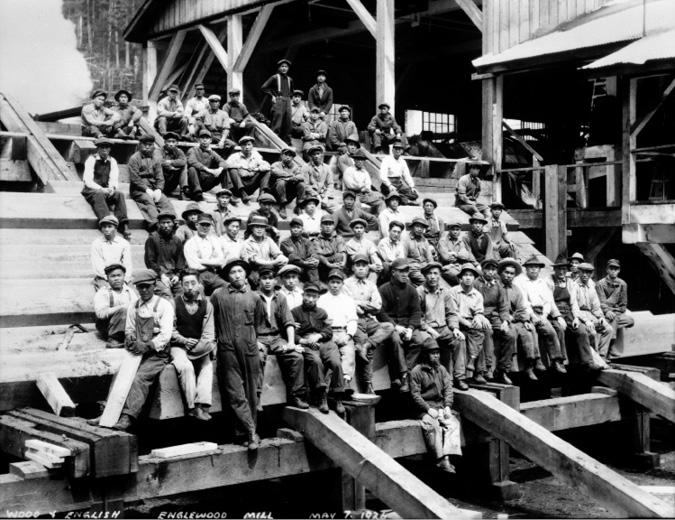
Figure 1. “Group portrait of mill crew at Wood & English Ltd., Englewood,” 1926.
Photograph by A. A. Paull. Acc. no. 1629, Albert Paull Collection, Vancouver Public Library Special Collections, Vancouver, BC.
In the retrospective view provided in the oral histories of organizers like Yoshida, or in the brief mentions of the jcmwu in histories of Japanese immigrants and the labour movement in British Columbia, the union is often either celebrated or condemned, if it is evaluated in any serious way at all. Union executives like Hachiro Miyazawa cast the jcmwu as a groundbreaking organization that defeated Asian exclusion in the labour movement; some labour historians have located it in the heterogeneous lineage of lumber unions that preceded the International Woodworkers of America (iwa); and others who were involved in the union, like Yoshida, have lamented its failure to accomplish anything at all.4 But overall, the jcmwu has rarely been analyzed in English-language publications.5
This article studies the extraordinary activities and ideas of the jcmwu and the way they changed over the course of the union’s existence according to the peculiarities of the Japanese immigrant experience in interwar British Columbia. Rather than trying to fit the jcmwu into the mould of a typical trade or industrial union and judge it by those standards, this article elaborates the structures that the jcmwu innovated to respond to racialized exploitation, exclusion from many labour unions, and repression from within the Japanese immigrant community. In doing so, I argue that the union’s history and its positions on the relationship of race and class, as well as citizenship, nationalism, and imperialism, are instructive for understanding questions of relevance to all labour historians. In its newspapers, the union provided incisive analyses of the intersection of race, class, and national identity in British Columbia and – in contrast to other Japanese immigrant organizations of the day – advocated a labour strategy for combatting racism. At the same time, by studying the union’s concerted efforts to affiliate with the vtlc and tlc, and conflict within the Japanese immigrant left over this and other jcmwu positions, we can examine the promises and pitfalls of the union’s struggle for representation in established labour organizations. Relatedly, the jcmwu’s approach to transforming social relations internal to the Japanese immigrant community may lend insight into contemporaneous struggles among other racialized groups of workers in western Canada.
This article therefore takes the perspectives of leaders of the jcmwu, as they articulated them in editorials in the union’s newspapers and in their oral histories, to grapple with issues of continued relevance to the academic study of labour and to labour organizing proper. Excavating a tradition of Japanese immigrant unionism supplements existing histories of the community, emphasizing the class conflicts that shaped it; provides a different view of Asian exclusion in Canada’s labour movement; and offers new material for theorizing and analyzing the enduring relationship of race, labour, and capital. Ultimately, this article seeks to place the jcmwu in regional histories of labour and the left in accordance with the union’s own understanding of itself – as a force for supporting, critiquing, reforming, and even revolutionizing the British Columbian working class, of which Japanese immigrant workers were a crucial part.
“We Are Workers”: The Founding of the Japanese Labour Union
In May 1920, Japanese and Chinese immigrant workers joined white workers in a strike at the Swanson Bay sawmill in northern British Columbia. Seventy-nine of the Japanese strikers signed a declaration explaining the reasons for coordinating their labour action with white mill workers, despite their experience of racism on the job and exclusion from labour unions:
The reason we attach great importance to an alliance with the white workers’ side this time is that we are keenly aware that the main reason why Asians have been excluded by the white side in the past is because of a lack of mutual will and understanding. Therefore, we take this opportunity to move in step with the white side, which is most necessary for the sake of our fellow Japanese workers in Canada, and for our future progress and development.6
The declaration’s emphasis on an “alliance” with the side of white workers “this time” indicates an innovation in the strategy of Japanese immigrant workers.7 Japanese immigrants had long been excluded from many of the province’s labour unions and were frequently hired as scabs during strikes. Just two months prior, in March 1920, Japanese immigrant workers had been hired as strikebreakers in a Port Alberni logging camp, to the outrage of organized labour. In Swanson Bay, however, the workers were all promptly fired for their participation in the strike. Without employment, nor any means of recourse, the Japanese immigrant strikers “all came down to town [Vancouver] and organized the Labour Union.”8 After weeks of meetings, the union – the first and only organization of its kind in the Japanese immigrant community – was established on 1 July 1920.
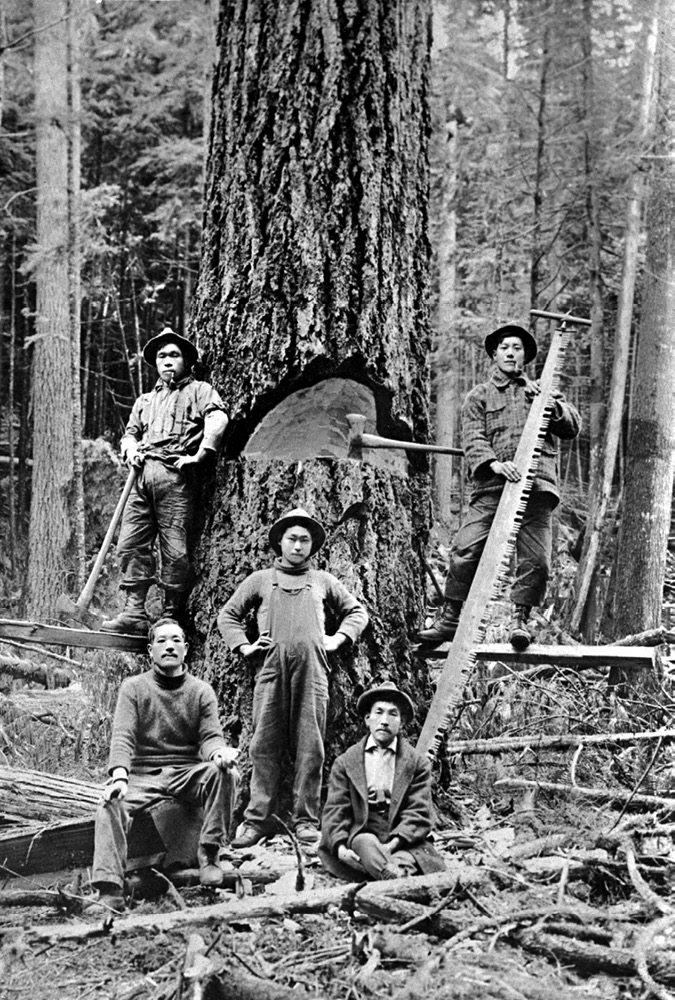
Figure 2. “Outdoor portrait of five men from a logging camp felling a tree; Steelhead, BC,” c. 1920. Photographer unknown. The original source of the photograph is Mrs. Ryukichi Miyake.
2010.23.2.4.201, Canadian Centennial Project fonds, Nikkei National Museum, Burnaby, BC.
The conditions that brought about the formation of the jcmwu extended well beyond the devastating results of the Swanson Bay strike. Japanese immigrant workers had begun arriving in British Columbia in significant numbers in the 1890s, on the heels of thousands of Chinese immigrant workers contracted to build the Canadian Pacific Railway and work in other industries in the 1880s. Even after the completion of the cpr, more than 9,000 Chinese immigrant workers remained in the province, constituting a significant part of the workforce in key industries, including the salmon canneries on the Fraser River, the Vancouver Island coal mines, and sawmills. Japanese immigrant workers, while fewer in number, held prominent positions in salmon fishing and sawmills. Both groups were joined by thousands of European immigrant and Canadian workers arriving in British Columbia and seeking employment in the same resource industries. Gillian Creese has argued that the ensuing conflict between these groups “was a direct result of capitalist employment practices,” wherein Chinese and Japanese workers, and the South Asian immigrants who joined them in the early 20th century, were paid less than half the wages of an “unskilled” Euro-Canadian worker.9 Before the close of the 19th century, labour organizations such as the Knights of Labor began to agitate around Asian exclusion, paving the way for the formation of the Asiatic Exclusion League in 1907, just months before the infamous riots that descended on Vancouver’s Chinatown and the neighbouring Japanese immigrant community on Powell Street. Agitation for Asian exclusion from within the ranks of organized labour also precipitated restrictions on the kinds of jobs that Asian immigrants could hold, shunting many Asian workers into the lumber industry.10 When the Japanese strikers at Swanson Bay explicitly called for an “alliance” with white workers, then, they sought to overcome entrenched hostilities within the working class.
It was from within this context – of a desperate need to improve Japanese immigrant workers’ conditions and to combat racial divisions that limited worker self-organization – that the jcmwu emerged. Japanese immigrants were not alone in deciding to form their own labour organizations to fight the exploitation they faced on the job, which was only exacerbated by their exclusion from unions. Just four years prior to the founding of the jcmwu, Chinese immigrant workers had formed the Chinese Labour Association, which organized a general strike of Chinese shingle weavers in 1919.11 Like Asian immigrant workers, Black sleeping car porters, employed on Canada’s passenger trains beginning in the late 19th century, were excluded from rail unions such as the Canadian Brotherhood of Railroad Employees; in response, they established the Order of Sleeping Car Porters in Winnipeg in 1917 and branches of the US-based Brotherhood of Sleeping Car Porters in 1939. Both unions, like the jcmwu, emphasized political education of their membership and sought to overcome racist exclusion through affiliation with the unions that represented white workers.12 While not always excluded from unions, Indigenous workers also chose to form independent labour organizations to represent their unique needs on the job and to fight for political demands that extended beyond the workplace. Skwxwú7mesh (Squamish) and other Indigenous lumber handlers on Vancouver’s docks formed the Industrial Workers of the World (iww) Local 526 in 1906, and later an International Longshoremen’s Association local colloquially referred to as the “Bows and Arrows” that paralleled the primary longshoremen’s union, ILA Local 38-52. Andrew Parnaby argues that Indigenous lumber handlers, who had a preference for flexibility so that they could combine waged labour with other forms of work and subsistence activities, chose “political separation in order to maintain control over their union affairs.”13 European immigrant workers, also faced with discrimination at work and in the labour movement, formed “extraordinary” labour unions, too. The Ukrainian Labour-Farmer Temple Association blended the principles of a mutual aid society with some of the functions of a union, and much like the jcmwu, it welcomed Ukrainian immigrant workers from any industry and provided political education through the Ukrainian Labour News and other newspapers.14 Italian, Finnish, and Jewish immigrant workers also formed organizations that mixed the functions of mutual aid societies, labour unions, and political education projects to meet the specific needs of workers in their communities.15
It is hardly surprising that, in the late 19th and early 20th centuries – a period of intense labour militancy in western Canada – some of the most immiserated workers in the region would organize themselves. Whether racialized workers understood their organizations as an alternative to the unions that excluded them, carved them out as distinct political spaces, or used them to bring racialized workers into alliance with dominant unions, they responded to the broader movements of organized labour in the region. Sometimes the connections were explicit: the iww, One Big Union (obu), Workers Unity League (wul), and the Lumber Workers Industrial Union (lwiu) all attempted, with varying degrees of success, to organize Asian and other immigrant workers in the lumber industry and elsewhere. The iww’s explicitly antiracist rhetoric took aim at divisions within the working class, and in British Columbia, the union’s focus on previously unorganized and itinerant workers meant concentration in places like logging camps and sawmills, where Asian immigrant workers were overrepresented.16 The radically antiracist programs of the iww and obu attracted leaders of South Asian immigrant political organizations, including the Ghadar movement, whose internationalist politics took aim at racism in North America and British rule in India as part of a continuous system of imperialist exploitation.17 Some South Asian militants also formed relationships with the Socialist Party of Canada.18 As the obu gained traction in the 1920s and the lwiu began organizing workers in logging camps, they established Japanese and Chinese “sections” and made some inroads with South Asian immigrant workers in sawmills.19 Elsewhere in the west, the Métis Association of Alberta successfully agitated for the granting of lands to Métis peoples in that province in the 1930s using “a labour union organizational model” that was clearly influenced by, but not directly related to, left political parties.20
These are only some of the examples of racialized workers’ organizations in western Canada and elsewhere. Yet, as with the jcmwu, we often know little about them. This is the result of two historiographic trends. First, while there are some important exceptions, Indigenous and immigrant workers not readily received by British and Canadian settlers as part of the working class are not the typical subjects of western Canadian labour histories.21 They stand, perhaps, at the fringes of accounts of the unions that did try to organize them, or they are bit players – workers bringing down wages and breaking strikes or, conversely, victims of Asian exclusion campaigns – in the drama of the region’s spectacular confrontations between labour and capital. Second, ethnic histories often focus on the devastating effects of legal and extralegal discrimination and persecution. While we know much about how Asian immigrants were perceived and represented in British Columbia in the late 19th and early 20th centuries, as well as how anti-Asian sentiment animated the region’s political, legislative, and economic spheres, we rarely glimpse the reality of Asian immigrant worker militancy and self-organization.22 Even more rarely do we encounter these workers’ own analyses of the problems that confronted them on and off the job. On this score, the jcmwu left behind an archive with which to counter existing understandings of Japanese and other immigrant worker communities as passive subjects of racialized violence. This archive reveals a group of workers who were – and who understood themselves to be – active participants in their own times: as organizers, critics, reformers, and perhaps even revolutionaries bent on transforming the politics of organized labour in British Columbia.
The jcmwu emphasized its relationship to the broader Canadian labour movement from the outset. The union’s “founding declaration,” published in the inaugural 11 August 1920 issue of Rōdō Shūhō, begins with the line, repeated throughout, “we are workers.” This refrain underscores the shared situation of all workers: “We are workers. Today, the position of workers has not reached the heights that we should rightly enjoy as members of the human race.”23 This “we” invokes the entire working class, not only Japanese immigrants. But in the next sentence, the declaration begins to mark the distinction between “workers in developed Western countries,” who have “improved their standing significantly over the past one hundred years through their own self-awareness and efforts,” and the workers to whom the declaration is addressed: “Our position, as Japanese workers in this country, is still far inferior to that of white workers.” To explain this situation, the declaration posits “that our degree of education or self-study is, in general, superficial is one of the main reasons for this. The other reason is that we are immigrants of the yellow race.” The order of presentation of the reasons for exclusion – first, lack of education, and second, race – is not incidental. The declaration goes on to argue that Japanese immigrant workers’ consciousness of their status as part of the working class must not be subordinated to sensitivity to their racialization, and that both must be tackled together:
These two reasons are intertwined, and not only do they place us lower than the average white worker in this country, but they also make our situation more complex and dangerous than we can find anywhere else. For example, in the case of our fellow workers in our home country [Japan], they can open the gates to improvement by raising their level of self-awareness and education. The doors that were closed to them will open depending on whether they can awaken the employers, the capitalists themselves…. In other words, they can simply follow the same path that European and American workers have walked. However, we in this country cannot secure a stable life by that alone. Before us lies another major problem: Japanese exclusion, which we face as immigrants of the yellow race.
Having anchored the union in a working-class politics, while also delineating the unique obstacles facing Japanese immigrant workers in a country with exclusionary policies aimed at those of the “yellow race,” the declaration proceeds to argue that “the real reason for Japanese exclusion” is rooted in the exploitation of the working class. The declaration points out that immigration restrictions and other racist legislation – including restrictions on employment in government projects, on Crown lands, in the operation of certain machinery, and underground in coal mines – target workers specifically. Therefore, even though “some people will only give ‘racial prejudice’ as the reason for their exclusion,” the declaration insists that this “alone does not constitute a reason to exclude Japanese people.” More importantly,
We must also be aware that these words carry a very dangerous meaning for ourselves – they are a distraction from self-criticism and reflection. Calling it “prejudice” gives the impression that Japanese people are not being seen as we really are, that we are being looked at sideways, or through tinted glasses. Which, on the other hand, means that we feel that, if they would only look at us straight on, there would be no reason to exclude us.24
Countering this point of view, the declaration asks whether it actually serves workers to believe in the primacy of “racial prejudice” as an explanation for their oppression, and points to class as an equally important factor: “Besides racial prejudice, a far more important reason for our exclusion is that our quality of life is so much lower than theirs.” This, the declaration argues, is most obviously the case for Japanese workers, rather than immigrant elites, and “if we investigate the roots of racial prejudice, we can even say that it originates here” – in the immiserated conditions of Japanese immigrant workers within the racially stratified British Columbian labour force. Further, the exclusion movement emerged from and found its greatest support among white workers and labour organizations, who were themselves reacting to the fact that the “the labour market can be disrupted by an influx of cheap labour.” While Japanese immigrant workers often had no choice but to accept wages lower than those paid to white workers, the declaration argues that as long as this was the case, white workers would seek to exclude them.
Finally, the declaration turns to the question of what is to be done and lays out the union’s objectives: “We must educate ourselves and encourage each other to improve our lives while, on the other hand, we must endeavour to earn the understanding of the labour community in this country, and work to build rapport and co-operation with them.” But this would not only be a struggle to win over white workers, or to break into white labour organizations. The unionists foresaw the fierce opposition they would encounter from within their own community:
Within Japanese society in Canada, there is a faction that does everything they can to reject our claims, believing that we will only arouse the animosity of the capitalists in this country. These are the contract bosses and their superiors. They believe that the capitalists in this country are glad to have our cheap and obedient labour, and they say that if we get close to white workers it will only arouse bad feelings on the part of the capitalists. They insist that we rely solely on the kindness of the capitalists.25
The declaration anticipates Japanese labour contractors’ – often referred to simply as “bosses” (bosu) or “contract bosses” – and business owners’ conciliatory orientation to white capitalists, and it responds with two arguments. First, it points out that workers in British Columbia and around the world are partaking of a historic moment of labour organization and militancy, and that bosses will do all that they can to resist them. Indeed, bosses within the Japanese immigrant community chose to “advocate paternalism,” to the point where it is “almost as if they are telling us to be content to live in slavery,” while other workers were liberating themselves. Second, it points out the hubristic imperialism of Japanese government officials, contract bosses, and capitalists. The declaration accuses them of believing that “the only solution to the anti-Japanese problem is force” and that “if anti-Japanese sentiment becomes too strong, they can just invade the province of British Columbia and take it over.” While Japanese imperial expansion did proceed rapidly throughout Asia and the Pacific from the late 19th through the early 20th century, influencing the politics of the jcmwu and the entire Japanese immigrant community, the union viewed the possibility of a successful Japanese invasion of British Columbia as at once ridiculous and reprehensible: “It is not a solution to Japanese exclusion – it will only strengthen it. To offer such an anachronism at this point is to make themselves a laughingstock.”
The declaration concludes with a reiteration of the union’s goals: for workers to educate themselves and struggle for equality with white workers. In the end, the declaration returns to a class-based conception of workers, pointing out that “although there may be times when we face oppression from the capitalists for our actions, this is merely a hardship shared by workers all over the world.”26
In sum, the union understood racial prejudice to emerge from the stratification of the working class; therefore, class struggle was the key strategy for overcoming both labour exploitation and racism. The union – like many other ethnic labour organizations of its time – took the development of the class consciousness of workers through education to be a crucial first step in the struggle. Finally, it viewed class conflicts within the Japanese immigrant community and the broader Canadian context to be continuous parts of a global system of capitalist exploitation. Japanese imperialist ideology was understood as a mystification of the local, material conditions facing Japanese immigrant workers and was therefore viewed as another obstacle the union had to overcome through co-operative class struggle with white workers.
An “Educational Movement”
As a “general union of all Japanese workers,” rather than an “ordinary” union, the jcmwu did not directly represent its members to their employers.27 This was a conundrum, particularly given the degree of exploitation that Japanese immigrant workers experienced. As Yoshida points out, so long as they were excluded from established labour organizations because of their race, Japanese immigrant workers had a limited ability to shift the racist positions of existing unions, but they were not concentrated enough in any single workplace or industry to organize an effective trade or industrial union of their own to represent them. A union was desperately needed, but the formation of the jcmwu in and of itself would not directly alleviate its members’ issues with working conditions and pay, given that neither bosses nor other labour organizations recognized it. They therefore needed to build a “general” union by recruiting membership from previously unrepresented groups of Japanese immigrant workers who may have been unfamiliar with the labour movement and, even more troubling, would reap no short-term benefit and risk repression for signing up. Nevertheless, the jcmwu’s strategy involved building a significant and organized membership in order to affiliate with organizations like the vtlc and tlc, quash their anti-Japanese policies, and, over time, improve the working conditions of its membership. To do this, the union could only begin from below. It would need rank-and-file Japanese immigrant workers to adopt the leadership’s view of the potential of this extraordinary union, not in terms of direct improvement of working conditions but in terms of the overall position of Japanese immigrant workers within the Canadian labour movement. This ambitious political education project was the most robust part of the jcmwu’s activities, such that Miyazawa, Takaichi Umezuki, and other union officials referred to the union as an “educational movement.”28
The union circulated its perspectives through its weekly newspaper Rōdō Shūhō, which also served as a means of recruiting new members. Union leaders frequently penned editorials for the paper, which also covered local and international news and served as a bulletin for the union’s various branches by printing meeting updates, election notices and results, and the like. The paper provided a counterpoint to established Japanese-language newspapers in Canada, such as the Canadian Japanese Association’s Tairiku Nippō (Continental Daily Times), which reprinted articles circulated by news agencies in Japan and tended to follow their “objective, neutral, and commercial style.” Through the influence of Tairiku Nippō and other papers, including Kanada Shinbun (Canada Daily News), “Japanese people in B.C., including those who worked in the forest industry, were subjected to and conscious of the same kind of news as readers in Japan.”29 In contrast, Yoshida, who began editing Rōdō Shūhō in 1920, recalls that the union’s paper “provided information about Japanese workers in every part of B.C., about the white labour movement and about the government policies. Many such articles were translations from white union newspapers.”30 In an editorial published in 1935, on the fifteenth anniversary of the union, Umezuki made clear that the paper and other union activities sought to educate Japanese immigrants not only about their own status as workers but specifically about their relationship to the broader Canadian labour movement:
It is inevitable that, for Japanese people in Canada who are not acquainted with modern liberationist thought, their understanding of the labour movement is lacking…. It is a given that working conditions which favour them are incomparably better than in Japan, but that is the result of the organizational effort of the Canadian labouring class over the last 100 years. And they don’t understand this.31
By translating materials produced by Canadian labour unions, the jcmwu’s newspaper allowed Japanese immigrant workers to learn about the positions and struggles of the unions that excluded them – and perhaps even to appreciate the way their own position, however immiserated, was elevated by the past wins of organized labour in Canada. This was not an uncritical embrace, however. jcmwu editorials also “attacked the Asiatic Exclusion League and the racist politicians in the labour movement,” insisting that “the function of labour unions was to protect the workers from the capitalists,” and “that discrimination was basically against the principles of the labour movement.”32 The newspaper’s core function was, then, to relate Japanese immigrant workers and their union to the Canadian labour movement, while also criticizing elements that prevented interracial solidarity.
Rōdō Shūhō’s emphasis on education and agitation depended, in no small part, on the backgrounds of the union’s leadership, many of whom were university-educated recent immigrants. Etsu Suzuki completed his university studies during Japan’s relatively progressive Taishō era (1912–26), when popular movements for constitutional government, the 1918 “rice riots,” and struggles for universal suffrage punctuated the imperial expansion of the Meiji era (1868–1912), and the early Shōwa era (1926–45), which saw a severe reaction to Taishō reforms and a deepening fascistization of Japanese politics. Suzuki had been an editor of Japan’s Asahi Shimbun before immigrating to Vancouver to work for Tairiku Nippō, from which he was recruited by Taneji Sada, a Swanson Bay striker and first president of the jcmwu, to support the union.33 Miyazawa describes Suzuki’s influence as follows: “Suzuki Etsu provided guidance. Without him, I don’t know if the union could have been, if it could have done so well. He came up with the original philosophy of the union. He concluded that exclusion ultimately comes from among the workers.”34 As Yoshida recalls, though, Suzuki was “not really a socialist, I think. He was more of a liberal of the ‘Taishō Democracy’ period…. He was fighting for justice but he was not a labourer himself.”35 Indeed, Suzuki’s initial response to the status of Japanese immigrant workers in Canada and the United States mixed outrage with disdain. Describing a scene in the Japanese immigrant community on Powell Street shortly after his arrival in Vancouver, he wrote,
Windows look like they have been painted with grime. And in front of the window stands a woman who wears clothing that looks like either pajamas or a sack covered all over with stains, on top of which she puts a grotesque, dirty apron, and on top of her head is a mop of hair with no hat…. Walking by them, I am struck by their disgusting smell, like that of excrement. They lead the lowest lives possible in human imagination. This is not a story about other unknown countries. This is about things in Vancouver. This is a scene that can be found anywhere in a place where a few Japanese gather…. What the rest of their lives must be like makes me shudder.36
Suzuki was not reluctant to express his disgust at the status of Japanese workers in Vancouver, and the above views do not diverge all that much from those of more conservative Japanese state officials and immigrant elites, who were sensitive to North American perceptions of Japanese immigrants, particularly where they impacted Japan’s international reputation as an emerging imperial power. Eiichiro Azuma argues that in the first decades of the 20th century, Japanese officials and elites in the Americas sought to actively convert dekasegi – Japanese migrant workers who ultimately sought to return to Japan with the wages they earned overseas – into “full-fledged settler-colonists with a strong nationalist consciousness.”37 While the jcmwu’s leadership did not partake of the notion that Japanese immigrants would be the vanguard of a growing Japanese empire that extended from Japan’s colonies into the Americas, they did advocate for workers to give up the “sojourner’s mentality,” which they believed only drove a further wedge between them and white workers.38
At the same time, Japanese consulates continuously struggled to fight immigration restrictions in the United States and Canada, partly by trying to differentiate Japanese immigrants from other Asian immigrants, who, in Japan proper, were generally viewed as inferior to Japanese people of any class.39 Indeed, as Japan annexed Taiwan following the First Sino-Japanese War in 1895 and Korea in 1910 following the Russo-Japanese War, the Japanese state and many Japanese citizens increasingly regarded themselves as leaders within Asia and as superior to Chinese immigrants and other Asians they encountered in North America and elsewhere.40 It is therefore unsurprising that I have found no mention of Chinese, South Asian, Indigenous, or other racialized workers in the jcmwu’s materials, even though Japanese immigrant workers often worked in the same sites and lived side by side with other Asian immigrants and Indigenous peoples. The union’s heavy emphasis on solidarity with white workers was, on the one hand, necessary to combat the anti-Japanese racism that sprang from many unions; on the other hand, the union’s seeming lack of interest in taking action with other racialized workers may be understood as a symptom of Japanese immigrants’ desire to distinguish themselves from other Asian immigrants and to be viewed as more “assimilable” to white society. Whether alliances with other racialized immigrants might have overcome the problem of Japanese immigrant workers being, as Yoshida put it, “too few” and “too scattered in most industries” to form trade or industrial unions and take effective action seems not to have been entertained as a strategic question.41 Similarly, Suzuki’s views on Japanese immigrants in Vancouver colour the union’s prioritization of “education,” which comes to sound like a kind of “racial uplift” project – one in which white-collar leaders urge Japanese immigrant workers to “improve” themselves to the standard of white Canadians. It is, however, difficult to either embrace or dismiss the union’s politics on this basis. There was clearly a real need for political education, labour action, and mitigation of anti-Japanese racism – all ends to which the union, through both more and less effective methods, applied itself. And as we will see, the union sometimes countered the imperialist ideology of the Japanese consulate and the Japanese immigrant business class. Finally, while Suzuki was clearly influential in establishing the union’s founding principles, he was not its sole leader, and he returned to Japan in 1932 and died shortly thereafter. Well beyond his sphere of influence, Japanese immigrant workers would initiate their own political education programs and labour actions.
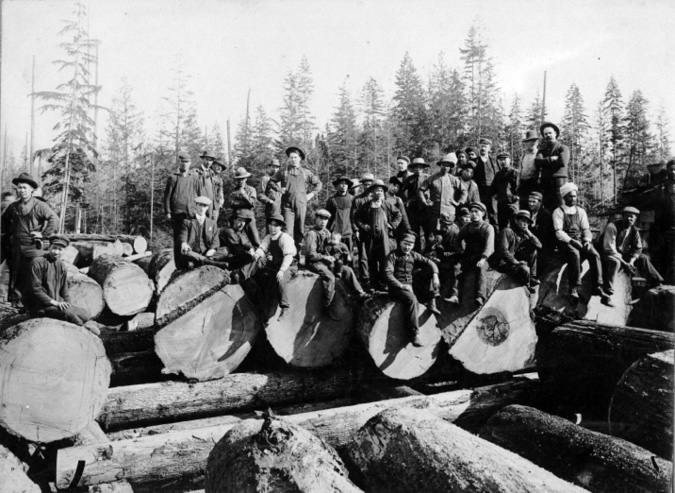
Figure 3. “Seymour Lumber Company workers,” c. 1906. Photographer unknown.
nvma 263, monova: Archives of North Vancouver, North Vancouver, BC.
While Yoshida had studied law at Hōsei University in Tokyo prior to immigrating, when he arrived in Canada he worked in a series of jobs that were typical of any Japanese immigrant worker. From 1910 until 1941, he worked first as a farm labourer, then under a Japanese labour contractor in track maintenance for the Canadian Pacific Railroad, and later in a shingle mill and then a logging operation in Vancouver, and in salmon fishing on the Skeena River in northern British Columbia. Yoshida notes that because of laws restricting Japanese immigrants’ entry into the professions, even university graduates would end up in “sawmill work, gardening, fishing and so forth.”42 And in contrast to Suzuki, and more akin to rank-and-file jcmwu members, it was only after immigrating that Yoshida had his political awakening. It was at a bookstore on Powell Street in Vancouver that he was first exposed to Marxist literature, and as he put it,
When I was at the university I didn’t think about politics very much. Socialism was talked about already in Japan. I read some socialist books like those of Toshihiko Sakai, Abe’s writings, Hajime Kawakami’s books also…. It was only after I came to Canada and worked in camps that I was really influenced by socialism. Seeing how the companies and bosses exploited workers. In Japan I was still a student and I didn’t realize all that oppression, it was just reading and talk. But after I came to Canada and I myself became a labourer, then I realized it, I really felt it.43
Whatever classism was baked into the perspectives of university-educated union executives like Suzuki, the leadership of the union can also be understood, around the time of its formation in 1920, to have been seizing on a period of particular labour militancy in British Columbia that dovetailed with Taishō-era Japanese politics, when democratic, socialist, and communist ideas were circulating nationally and through the diaspora with relative freedom. Whether they had been exposed to those ideas prior to immigrating or radicalized through their experience of labour exploitation in British Columbia, jcmwu leaders intended to spread their own position and analysis to Japanese immigrant workers through the union’s newspaper, among other means.
As members were recruited in remote towns and camps throughout the province, the jcmwu established regional branches within union locals, with councillors appointed by the union’s executive to oversee their activities.44 Many of the branches were short-lived, as plant closures and mass firings in response to labour actions could completely eliminate the small community of Japanese immigrant workers in a given area. This was the case with the first branch in White Rock, which was dissolved just two years after its establishment when the local mill was shut down. Likewise for branches at Englewood, Dollarton, and Shawnigan Lake, each of which lasted just two to four years between 1926 and 1934. Other locals in major logging regions – including at Great Central Lake, Port Alberni, and Sproat Lake, all on Vancouver Island – persisted longer.45 Regardless, as new branches emerged and membership continued to grow, the union extended its political education program by circulating left-wing books, magazines, and pamphlets to branches in remote locations. In the Okanagan Branch, at least, this allowed for the study and discussion of works translated into Japanese, such as Vladimir Lenin’s Imperialism, the Highest Stage of Capitalism and Ferdinand Lassalle’s The Working Man’s Programme. Tamura estimates that by the early 1930s, the union handled 30 magazines and 1,500 books per year, as well as popular “socialist pamphlets published in Japan, including ‘Red Love,’ ‘The Proletarian Jesus,’ and ‘The Story of Socialism.’”46
Branches also actively recruited new members and supported spontaneous labour actions among Japanese immigrant workers, regardless of whether striking workers were members of the jcmwu. Among these were strikes at Terminal Mills in Vancouver in 1928 and in Port Alice, on northwest Vancouver Island, in 1929.47 But more central were the union’s mutual aid programs, which included “everything from the provision of aid to the ill and injured to the securing of land for graves for the deceased, making relief issues a serious theme” in the union as it expanded throughout the province at the end of the 1920s and beginning of the 1930s. At the same time, women’s participation in the union was steadily increasing. In 1926, the “Women’s Support Group for the Labour Union” was established to raise funds for union operations. In subsequent years, a women’s association was formed to support other union operations, particularly the union’s purchasing co-operative, which was established in 1928 in response to backlash from the Japanese immigrant business community. By 1930, enough women were involved in the union that a separate “women’s branch” was established.48 Japanese immigrant women workers were full members who were, according to a 1928 issue of Nikkan Minshū, employed in a range of industries, including dressmaking, hairdressing, laundry, and canneries.49 They were also employed in sawmills in significant numbers in the first decades of the 20th century: some 400 women and children constituted nearly one-third of the 1,500 Japanese immigrant millworkers in British Columbia in 1914, and the number of Japanese immigrants employed in the lumber industry only increased during World War I.50
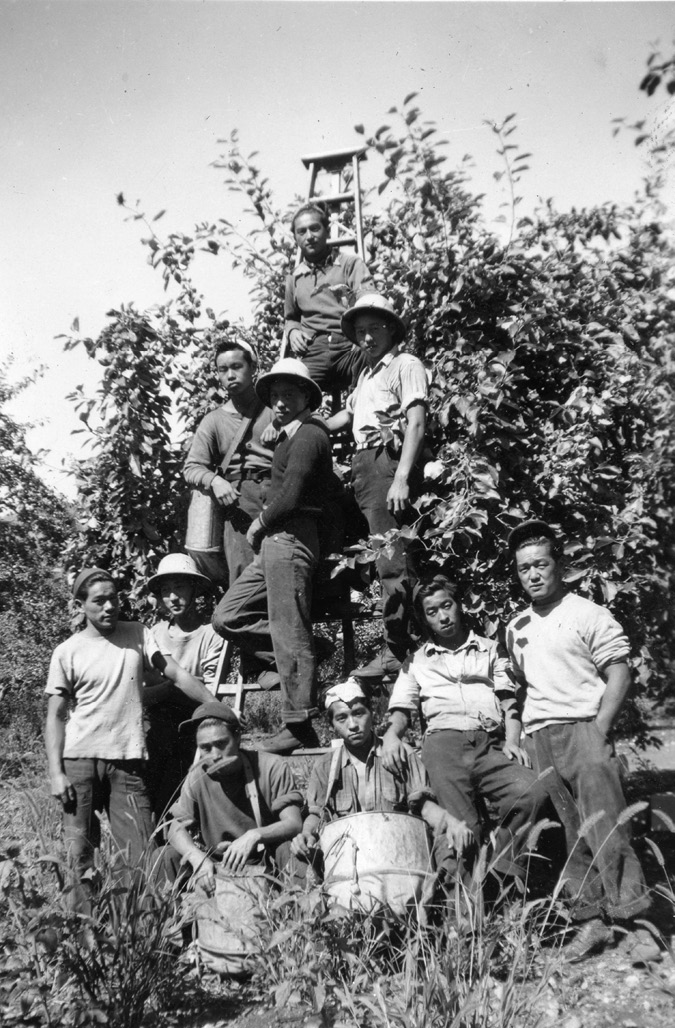
Figure 4. “A portrait of orchard workers; Lavington, BC,” c. 1944. Photographer unknown.
Acc. no. 2012.11.489, Tsutomu Tom Kimoto collection, Nikkei National Museum, Burnaby, BC.
Toshiko Tamura, the partner of Etsu Suzuki, seems to have contributed, at least at the fringes, to the union’s organization of women workers. Already a famous author of the “New Woman” literary movement in Tokyo, Tamura brought a feminist analysis, as well as her own share of disgust at the living conditions of Japanese immigrant women in Canada, to the editorials she wrote for Tairiku Nippō and Nikkan Minshū. In one article, Tamura lamented,
It is no wonder that Japanese are disdained as the nationality that is most behind the times, if Japanese women, who have immigrated to the home of European and American women who stand vigorously on the forefront of society and engage in activities, do not likewise engage in activities at the forefront of society with at least a level of knowledge and power not inferior to that of European and American women.51
Tamura’s editorials are remarkably similar to those published by Suzuki in terms of her focus on Japanese immigrants’ self-education and improvement, which both writers argued must be raised to the level of white Canadians in order to overcome exclusion. Tamura’s involvement in the union and the offices specific to women workers may have sought to address the further intersection of gender with race and class – an issue the union’s exclusively male executive neglected. It seems unlikely, however, that the women’s branch or Tamura were able to persuade their male comrades of the importance of a feminist politics, as changes in the union’s structure stripped women workers of full membership in 1934.52
Beyond providing political education to existing members, the circulation of the union’s newspaper may have also supported the recruitment of new members, particularly in camps that lay beyond the direct influence of leftists in Vancouver’s Powell Street neighbourhood. But the political education program inevitably had blind spots. It was at least inflected, if not entirely provoked, by Suzuki and other white-collar union executives’ classist views of Japanese immigrant workers. Their ability to transcend the ideological trappings of their position, especially attachments to Japanese nationalism and imperialism, may have also shaped the union’s disinterest in the struggles of other racialized workers in British Columbia and its single-minded focus on co-operation with white workers. And it goes almost without saying that the union was not a feminist one. While it acknowledged that Japanese immigrant women were almost always workers in their own right, not just in the home but in some of British Columbia’s key industries, the structure of women’s auxiliaries and branches may have subordinated women workers to a supportive role instead of one to be organized to the same degree of self-consciousness and militancy as the men.
The “Unending Struggles”: Affiliation Outside, Confrontation Inside
As the jcmwu’s membership grew, in 1927 it finally achieved its most concrete goal: affiliating with the Trades and Labor Congress of Canada and the Vancouver Trades and Labour Council. In doing so, the jcmwu hoped to counter the influence of the Asiatic Exclusion League, which was formed by members of the vtlc in 1907. Umezuki called the vtlc the “vanguard of Japanese exclusion,” and it seems jcmwu executives were united in their view that affiliation with the council would provide a viable means for fighting the Asian exclusion movement and, therefore, must take priority in union strategy.
In an editorialized account of a 1921 trip that union organizer Kisaburo Mitarai made to the Ishikawa logging camp in the Fraser Valley that Yoshida wrote for a 1935 issue of Nikkan Minshū, Mitarai makes the following impassioned appeal to the Japanese workers in the camp:
Right now, voices are being raised in Vancouver in favour of excluding Japanese people. This has happened since the Asiatic Exclusion League was formed with the aim of expelling the Japanese. At the centre of this Asiatic Exclusion League is the leadership of Vancouver region labour groups in the Vancouver and District Labour Council. So our union is putting all its efforts into organizing Japanese people and we seek your cooperation in neutralizing the exclusion movement.53
If Yoshida’s story was at all reflective of the conversations union organizers were having with Japanese immigrant workers, then building up the jcmwu in the hopes of “neutralizing” the exclusion movement was one of the things the union offered workers where it could not give them collective bargaining rights or workplace protections. In his oral history, Yoshida says the union “constantly interviewed the executive of the Vancouver Labour Council and expressed our desire to join,” putting its case to the council’s executive this way: “We are workers too and we would like to become part of the labour movement and join the Council. So far, we have been placed between the capitalists and the white workers. Sometimes, this has caused troubles for white unions. You can prevent occurrences of such incidents by letting us join the Council.”54 Umezuki records another version of the union’s argument: “The more forcefully you exclude us, the more we are exploited by the capitalists. In order to survive, we have no choice but to settle for being cheap labour, and endure the shame of being scabs…. We are not just Japanese or Asians, but workers of the world, and we sincerely hope that you will be able to replace exclusion with fraternity.”55
It is unclear why, exactly, after seven years of petitioning, first the tlc and shortly after the vtlc finally chose to admit the jcmwu.56 Ken Adachi offers the following explanation: “The tlc was not acting out of altruism. It had merely come to the conclusion that the solution to the problem of Japanese competition was to invite them to become partners in the fight for higher wages.”57 It is worth noting, however, that the vtlc did not come to a similar conclusion about Chinese or South Asian immigrant workers, who were not represented on the council. Regardless, jcmwu officials maintained an exultant view of the situation. In a retrospective published in a 1937 issue of Nikkan Minshū, Sada wrote, “As expected, our affiliation with the Labour Council has almost completely eliminated the anti-Japanese movement.”58 Umezuki redoubled this sentiment in an editorial celebrating the ten-year anniversary of affiliation, writing that it “was a realization of the international unity of the working class, and it was a complete breakthrough of the difficulty of eliminating the Japanese, as far as workers are concerned…. [W]e broke through the so-called special discriminatory characteristic of the working class, and made it possible to maintain and improve their lives.”59 Miyazawa’s appraisal was even more straightforward: “Exclusion ended. That’s it, our union’s policy was the best.”60 Even Japanese political leaders, such as Social Democratic Party secretary general Isoo Abe, celebrated affiliation as a major win for antiracism and internationalism in the labour movement. When Abe visited Vancouver in June 1929, the Vancouver Sun reported that he gave a speech that included the following: “I myself, and the labour party in Japan, appreciate the unique spirit shown by the Trades and Labour Council of Vancouver and New Westminster when, for the first time in the history of Labour, they admitted a Japanese union to equal status with white unions in their organisation.”61
The policies of the tlc and vtlc do not, however, indicate such a neat triumph over anti-Japanese racism. Following affiliation, the jcmwu proposed numerous changes to the tlc’s and vtlc’s policies, with mixed results. The jcmwu successfully pressured the tlc to amend a resolution that called for the “exclusion of all Asiatics from Canada,” but the amendment by no means signalled the “international unity of the working class” – it simply dropped the specification of “Asiatics” in place of exclusion of “all races that cannot be properly assimilated into the national life of Canada.”62 The jcmwu also pressed the tlc and the vtlc to support Japanese immigrant campaigns for the franchise, but with little traction. In 1928, the vtlc’s newspaper, The Labor Statesman, ran a front-page article with the headline “Unions oppose Oriental franchise programme,” and reported that the question of whether to include an “Oriental Franchise plank” in the provincial labour party’s platform was voted down by 31 delegates, with only three unions besides the jcmwu voting in favour.63 In 1931, the jcmwu succeeded in getting the vtlc to endorse its request to the provincial government to amend the Provincial Elections Act so that second-generation Japanese immigrants would have “equality of treatment and full rights of citizenship.” Still, as Adachi notes, the vtlc “did little to implement its promises” with regards to Japanese immigrant struggles for citizenship and the right to vote.64
However, the Labor Statesman began giving the union favourable coverage almost immediately. In November 1927, just a few months after the vtlc granted the jcmwu’s charter, the paper reported that the jcmwu was “making big gains.” Sharing the proceedings from the council’s regular meeting, this article stated that “Vice-President Bartlett informed the Trades Council on Tuesday evening that the Mill and Camp Workers Union (Japanese) was making rapid progress. Some more enthusiastic meetings had been held and a large number of new members enrolled. In his opinion, this union will soon become the biggest union in the province.”65 This was a generous prediction; while the union would grow to around 1,600 members in the early 1930s, it was no behemoth, and it was on the brink of major conflict internal to the Japanese immigrant community, which would also make headlines in the Statesman and even spill onto the pages of mainstream newspapers.
Several months later, in February 1928, the Statesman reported that “attacks” were being made on the jcmwu by “Japanese merchants” and the Canadian Japanese Association.66 While a number of organizations in the Japanese immigrant community existed prior to World War II, including kenjinkai – organizations of immigrants from the same Japanese prefecture – agricultural co-operatives, and fishermen’s associations, among others, the cja was one of the oldest and largest, and the only one that could claim to represent the entire community. Like the jcmwu, the cja also sought to combat anti-Japanese racism, albeit by different means. During World War I, it encouraged Japanese immigrants to enlist in the Canadian army. It then advocated for the franchise for veterans, and in the 1920s it fought calls for the restriction of fishing licences issued to Japanese immigrant fishermen. In 1934, the cja’s influence grew substantially when, through the intervention of the Japanese consulate, the association was restructured to be a kind of coordinating body for all existing Japanese immigrant organizations, incorporating influential groups such as the Steveston and Skeena River fishermen’s associations and the Japanese Merchants Association, for a total of 3,600 dues-paying members – a number that more than doubled peak jcmwu membership. Adachi notes that the cja’s “prestige and influence stemmed from its close relations with the Japanese consulate, which recognized the Association’s position as a central ‘control agency.’” The consulate went so far as to make the cja its “administrative organ,” with the power to grant legal documents such as visas and the authority to request draft waivers. “That leadership and control of the cja was generally in the lap of the more wealthy businessmen,” Adachi observes, “contributed further to its influence.”67
Even prior to the conflict that exploded between the cja and the jcmwu in 1928, the union viewed the cja as an “obstacle” and worked to build itself up as the alternative.68 Miyazawa recalls that before the founding of the jcmwu, Japanese workers had appealed to the cja and the consul for support in “combatting anti-Japanese sentiment,” but assistance was not forthcoming.69 Yoshida recounts how the jcmwu asked the cja for support again in the early 1920s, to no avail.70 One reason for the initial indifference, and later animosity, of the cja to workers and the union was the fact that the association was, as Yoshida put it, “dominated by the Japanese Consul and run by merchants.” As an umbrella organization, representatives of each affiliated organization constituted the cja’s leadership, such that “an owner of a fish store was in charge of looking after the affairs of the fishermen on the Skeena. Loggers’ affairs were in the hands of a loggers’ boss in Vancouver and agricultural matters were in the hands of a fertilizer merchant,” a structure that meant the workers in a given industry or organization were not represented to the cja. Yoshida corroborates Adachi’s account of the cja’s power as a kind of administrative body for the Japanese consulate:
As long as the Japanese Association followed the Consul’s ideas it had “guarantor authority,” it could give “authorized approval” for legal documents. For instance, there were many Issei living here who were still liable for the draft in Japan. If you did not get the Consul’s permission you would have to return to be drafted in Japan. The Consul had control over visas. On applying to bring wives to Canada one needed the Association’s approval. On many things that needed the Consul’s approval one had to apply to the Japanese Association. But they did nothing for the Japanese worker here.
Yoshida and Suzuki, while working closely on Rōdō Shūhō in the early 1920s, therefore reached the conclusion that “it was absolutely necessary to break [the cja’s] control over the Japanese here.”71
In the first years of the union’s organizing, this was no easy task. In Yoshida’s account of Mitarai’s 1921 organizing trip, he describes at length the resistance that Mitarai encountered by Japanese workers who were already dues-paying members of the cja. One worker told Mitarai that “the Japanese Association is a large organization, and it looks after our interests. What’s more, the Consul keeps close watch of things.” Another explained that he would not become a dues-paying member of the jcmwu because “I joined the Japanese Association this year at the time of my conscription deferral.” If workers had to join the cja in order to complete basic tasks to do with their immigration status, they would be reluctant to pay dues to another organization, let alone risk running afoul of the leaders of the cja. Yoshida writes that Mitarai, upon realizing all this, was deeply discouraged and thought to himself, “What can the consul do about the exclusion of labour organizations? The more that organizations like the Japanese Association do, they just increase the discrimination!” That night, Yoshida’s dramatized Mitarai lay in bed unable to sleep, with “a feeling of lonely misery suffusing his heart.”72
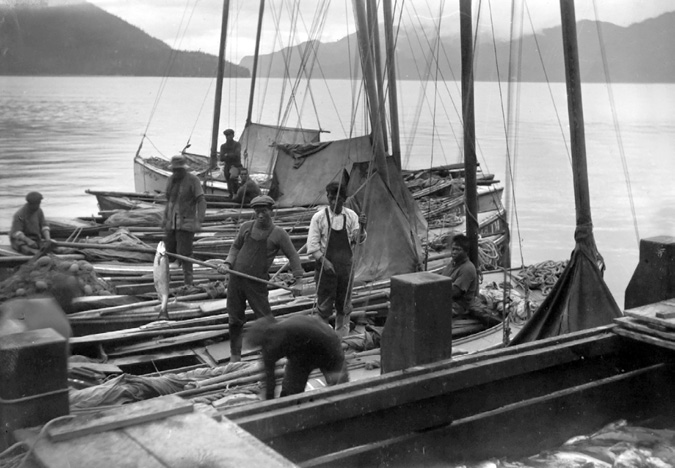
Figure 5. “Japanese fishermen in their boats,” c. 1929. Photograph by Senjiro Hayashi.
C140-002, Senjiro Hayashi Photo Studio fonds, Cumberland Museum and Archives, Cumberland, BC.
Nevertheless, in the same year that Mitarai was hiking between remote work camps in the Fraser Valley, Yoshida was working as a fisherman on the Skeena River and was able to convince other Japanese fishermen that they needed an organization independent of the cja “to negotiate with the canneries and with the white fishermen’s union on various matters.” Yoshida and his co-workers formed a “liaison council” of all Japanese fishermen, which voted to abolish their membership in the cja. Because fishermen constituted a majority of the cja’s membership, this was a major blow to the association, whose executive were forced to resign. Leaders of the fishermen’s liaison council and supporters of the jcmwu took over the cja and made the organizations under them independent – all of which allowed the jcmwu to greatly increase its own membership. The jcmwu maintained its influence over the cja for some years in the early 1920s, “but when the Labour Union started attacking Japanese bosses, they began to fight back.”73 Former cja executives, the Japanese Merchants Association, contract bosses, and even the consulate were inflamed by the jcmwu’s first campaign against a specific Japanese labour contractor, turning what had been a relatively peaceful rift into a bitter conflict that would change the shape of the jcmwu in the years to come.
Around 1923, according to Yoshida, a group of Japanese railroad workers employed on a contract of the Furuya Company complained to the jcmwu that the company was charging a 30 per cent commission on room and board, which workers had no choice but to pay. Yoshida publicized their struggle in Rōdō Shūhō, at least until the general manager of the Furuya Company complained to the owner of Tairiku Nippō, whose printing press Rōdō Shūhō used. When the jcmwu sought an alternative, business owners threatened to boycott any printer that published Rōdō Shūhō. The newspaper was therefore discontinued until the union raised enough money to purchase its own press and relaunch the paper as Nikkan Minshū in 1924. The Minshū, while now at liberty to print numerous articles that criticized “Japanese bosses who exploited workers, and merchants who charged high food commissions,” became all the more dependent on advertising revenues, especially as a daily, rather than weekly, paper.74
Umezuki would later write that
Officials sent from Japan involved themselves in the movement to obstruct the Japanese labour union. In the year after the great advance of affiliation of the union with the labour Congress (1928), the interference became more and more open, going to the extent of a boycott of advertising in the union organ [Nikkan Minshū] … and raising a ruckus against stores and businesses which were friendly to the union and with which the unionists had united in solidarity.75
Yasutaro Yamaga, a leader of a Japanese farmers’ co-operative in Haney, referred to this period of struggle, from roughly 1927 to 1930, as the “white versus red war.”76 Making reference to the Bolshevik Red Army and the anti-communist White Army, Yamaga’s account renders the cja, Japanese merchants and bosses, and the Japanese consulate as the “white” side and the union and its supporters the “red” in a kind of Japanese immigrant civil war. On 10 February 1928, the Labor Statesman reported that the surge in jcmwu membership during the previous year had “created a great deal of antagonism among the anti-union and patriotic interests. Attacks were being made on the union through the medium of the Canada Daily News [Tairiku Nippō] which represents the reactionary elements … and members of the union were being threatened and discharged.” Further, “The Canadian Japanese Association is also alleged to be taking action against members of the union which interferes with the privilege of having their conscription service postponed.” While the jcmwu was advised that the vtlc executive “would take the matter in hand immediately,” it is unclear what, if anything, the vtlc could do about the advertising choices of Japanese businesses or the coercive pressure of the Japanese consulate and cja.77
As the jcmwu reported its struggle to the vtlc, the Japanese immigrant elites also sought external support by way of mainstream English-language media. In a letter to the editor of the Vancouver Sun, printed in its 1 March 1928 issue, the president of the Japanese Merchants Association disputed the jcmwu delegate’s account of the conflict to the vtlc, which had also been reported in the Sun. President I. Ide wrote that the Merchants Association
Had been complaining for some time because the Daily People [Nikkan Minshū], the union’s newspaper, was in the habit of publishing articles which were very radical and which were causing disturbance of the peace and order of the Japanese community here in this province. And it was for this reason that withdrawal of advertisements was considered necessary, not for the one given by the delegates. It was ridiculous, and most regrettable from our point of view, for the delegates of the union to have made such a false and groundless report at the council meeting, as if the Powell Street merchants had withdrawn their support in consequence of the union’s affiliation with the [vtlc].78
The jcmwu fired back in a long letter to the Sun’s editor the following week. Directing its account to the Sun’s white readership, the letter stated,
In order to amplify your understanding we want to explain briefly … the Japanese Association problem. The executive of the Canadian Japanese Association amended the constitution and bylaws improperly at the general meeting of 1927 and also cut away the right respecting what we called “Associated Associations” by means of a barbarous manner, which right the Canadian Japanese Association had no power to do, and destroyed flatly the social justice and democracy, throwing the Japanese community into the greatest confusion. These executives of the Canadian Japanese Association are also the executives of the Japanese Merchants Association.
Countering Ide, the jcmwu’s letter to the Sun claims that the union had only used Nikkan Minshū to criticize “those kinds of violent manners and actions of the executive of the Canadian Japanese Association,” and that this was the content the Merchants Association deemed “radical and causing the disturbance of the peace and order of the Japanese community.”79 It is difficult to imagine that the average reader of the Sun would have had adequate context to understand the nuances of the conflict over democracy, nationalism, and class that was playing out between the jcmwu and the cja, but the fact that the Sun’s editor chose to publish the impassioned letters alongside coverage of the conflict reflects a growing interest in the jcmwu following its affiliation with the vtlc. In any case, regardless of the reactions (or lack thereof) of the broader Vancouver public, the jcmwu would have to deal with the issue on its own.
In the spring of 1928, the union established a purchasing co-operative so its members could boycott the businesses that had themselves boycotted its newspaper, and to provide an alternative to the kinds of food costs that contract workers under the Furuya Company had faced, which were commonplace in many remote logging, fishing, and mining camps.80 Umezuki identified the co-operative as a crucial part of “the union’s struggle within Japanese society in Canada,” which included the following goals: “reforming the boss system and conditions in the work camps,” resistance to “unfair merchants and others who exploit the working class,” fighting “interference in the union movement from Japanese government officials,” and “rectification of violations … regarding draft deferment.”81 The co-operative, which supplied a variety of food and other goods to union members, was so successful that it quickly moved from its first location on Main Street to a larger warehouse on Powell Street. The move gave the additional benefit of locating the co-operative at the core of Vancouver’s Japanese immigrant community, as well as placing it closer to the union’s office and its independent employment agency, which was also intended to provide an alternative to the services of the contract bosses.82
As with the establishment of an independent press for Nikkan Minshū, the formation of the purchasing co-operative did as much to inflame contract bosses, business owners, and the cja as it did to alleviate the persecution of union members. Just a year after the co-operative was established, a labour dispute that centred on its existence broke out in the company town of Port Alice. In March 1929, the president of jcmwu’s Port Alice Branch, Tomisaburo Ideta, was fired by the contract boss who oversaw Japanese workers in the BC Pulp and Paper Company mill. When pressed by workers to give a reason for the firing, the contract boss stated that Ideta had been “soliciting orders for the Japanese Union Co-operative Store in Vancouver.”83 In the wake of the firing,
A meeting was called and a committee appointed to ask the manager to reinstate the president, but the manager stated that it was entirely up to the Japanese foreman. The Japanese foreman was then approached to reinstate the union president, but the foreman informed the men that he would not, and that he was opposed to having union men in the camp and was determined to exterminate all union men from the job.
When jcmwu members tried to confront the contract boss again, seven of them were fired, and when the wives of fired workers tried to approach the manager’s wife, she turned them away. Even when vtlc vice-president W. J. Bartlett and jcmwu executives arrived in Port Alice,
The manager refused to reconsider his action, although the delegation promised that no more orders would be sent to the co-operative. The delegation was followed all over the place by the company policeman and, during the interview with the manager, a stenographer took down all conversation of the delegation. While the manager evaded the subject, it seemed as though he was using the Japanese foreman to break the backbone of the union men, and told the delegation that the foreman was given entire authority to hire and fire whoever and for whatever he pleased.84
Ultimately, a total of 60 jcmwu members and their families left Port Alice, returning to Vancouver to seek new employment in other camp towns.85 Concerning these events, Umezuki would later write that “this was the first big dispute that the union itself faced, but it was just one of the unending struggles, large or small, against the anti-union element which, from the founding of the union, in shadow or in sunlight, inevitably came to the fore as a parasite feeding off the Japanese Canadian society.”86 Umezuki’s representation of the contract bosses and other “anti-union elements” as a “parasite feeding off the Japanese Canadian society” was, according to Yoshida, typical of the jcmwu executive. While Yoshida himself had exposed the exploitation of the Furuya Company in the pages of Nikkan Minshū, he describes how he resigned from his position as editor of the paper and drifted from the core of the union’s leadership because he disagreed with its hardline position against Japanese contract bosses:
I disagreed with the policy of attacking all Japanese “bosses.” Certainly there were some really vicious bosses who exploited workers with a lot of kickbacks and abused their power. But there were some who were helpful to workers too…. I insisted that we had to be careful about attacking Japanese bosses as a whole. I knew very well that many Japanese working outside of town would not be able to find a job without the help of a Japanese boss. I knew this better than Suzuki because I had worked in the camps for ten years and I was quite familiar with what was happening in them. The executive of the Labour Union did not agree with me and I became isolated.87
As someone who had come to the union through camp work, Yoshida did not feel that the union’s purchasing co-operative and independent employment office could supplant the role that contract bosses played in the lives of so many resource industry workers – seeking out jobs; arranging transportation; providing cash advances, room, and board; and liaising between companies and Japanese immigrant workers, many of whom did not speak English. Yoshida’s comments point to larger conflicts within the jcmwu between white-collar leadership, who might have no familiarity with the conditions of camp life, and the rank-and-file members who had no choice but to depend on the contract boss. In a perverse way, the contract bosses did what the union, even after affiliating with the tlc and vtlc and growing its membership, could not. They were the representatives of Japanese workers to the companies, albeit for their own profit.
While the jcmwu was mired in conflicts to do with funding its newspaper and running its purchasing co-operative, the politics of the Japanese immigrant community as a whole were swinging rightward owing to the influence of the Japanese consulate and the cja. Adachi writes that the cja – despite its campaigns for the franchise and its interests in assimilating Japanese immigrants to white Canadian society – was “essentially oriented toward Japan, stressing the superiority of Japanese ethics and culture.”88 As early as the publication of its founding declaration in 1920, the jcmwu had criticized the conservatism of Japanese businesses, bosses, and the consulate, but the grip of imperial ideology was only tightening as the Shōwa era began. Yoshida recalls that during the Japanese immigrant “white versus red war,” a new Japanese consul, Tatsuo Kawai, arrived in Vancouver.89 Kawai was “very conservative and imperialistic. He thought he should convert the Vancouver Japanese to become ardent nationalists.” When Kawai warned Suzuki that the jcmwu “should be more respectful” of his office, Suzuki pushed back, and “supporters of the Labour Union soon started to suffer from pressures by the Consul. For instance, he did not give permission to union members to bring their families from Japan.”90 Shortly thereafter, the consul stated that the cja was “not an autonomous group” and sought further control over it. Through the consul’s pressure, the jcmwu lost control of the cja and also lost nearly 400 of its own members, such that the union’s membership declined to 1,200 by 1941.91 Throughout the 1930s, the backlash against social democracy taking place in Japan extended its reach, via the consul and the cja, through the Japanese community in Canada: “Japanese militarism became even more influential following the Manchuria incident and the war with China. Publications from Japan became very nationalistic so that there was no trace of progressive thought to be seen in them anymore.”92 This much was clear from a 1937 cja pamphlet that Adachi calls an “apologia for the Sino-Japanese War,” which “blamed the ‘arrogant’ Nanking government for fomenting the war and whitewashed Japan’s patently aggressive role.”93 The jcmwu’s coverage of the escalating conflict in China, while initially more balanced, was not entirely free of the imperialist zeitgeist sweeping Japan and its diaspora. Norio Tamura notes that in the first years of the war, Nikkan Minshū “reported on the fighting from China’s side,” and that “this stance was markedly different from the Japanese columns of the major Japanese-language newspapers published throughout North America.”94 By the end of the war, however, the paper had swapped progressive and independent coverage for more conservative articles distributed by the Japan-based Alliance News Agency.95 The union executive chimed in with their perennial editorials, too. Umezuki published a tepid piece titled “China” in 1937, in which he wrote that “people seem to be so engrossed in the Sino-Japanese war that they neglect their studies.” Admitting “it is natural that people cannot remain indifferent to the war,” Umezuki counselled that Japanese immigrants should read about China instead of simply believing everything they heard about it.96 Needless to say, this was hardly the critique of imperialism the jcmwu had expressed in its founding statement. Both the local and international political situation and the union itself had shifted significantly during the interceding years.
From the late 1920s through the 1930s, there were organizers within the jcmwu who agitated for the union to take a more staunchly anti-imperial and communist position. Taking the “white versus red war” into the jcmwu offices, in 1928 some members of the executive council also adopted leadership roles in the new Vancouver branch of the All-Japan Proletarian Youth League (pyl), itself an offshoot of Japan’s Young Communist League. When Takeshi Uchida, chairman of the Proletarian Youth League, and Genshichi Takahashi, the league’s secretary general, used the jcmwu’s channels and offices to organize pyl activities and circulate their own newspaper, conflict arose within the jcmwu executive. Umezuki described the problem as follows:
Gradually, the League took on a communist colouring, and in the inaugural issue of the league’s journal, “Proletarian Youth,” published in June of [1928], it declared its support for the Third International in its platform. It was fundamentally different in ideology and position from the Camp and Mill Workers Union, which was affiliated with the Second International through the Trades and Labor Congress [tlc], and its distinct leadership principles inevitably produced differences in collective action.97
Uchida, Takahashi, and members of the pyl criticized a number of the jcmwu’s positions without reservation. According to Yoshida, they “started attacking the Labour Union from the inside.” They accused the union of being “too mild” and objected to the energies it directed toward the purchasing co-operative and especially to the fact that the union sold shares in the co-operative to its members. Yoshida states that “they also said that the Labour Union’s activity should not be to fight against discrimination.”98 While the union had been compelled by repression from the Japanese immigrant capitalist class to diversify its activities beyond the purview of most labour organizations, the pyl may have viewed these measures as simply a distraction from the most basic function of a union: building worker power. Yoshida does not elaborate on what the pyl thought the union should have been doing instead of “fighting against discrimination,” but it is clear that the majority of union executives found the contradiction within its ranks untenable, and in 1929 they expelled Uchida and Takahashi. Umezuki would later call this “the first major ideological rift” within the union. In a ten-year retrospective published in a 1930 issue of Nikkan Minshū, Tamezo Kitano wrote that the union overcame not only the “obstruction of corrupt government officials and selfish elements within the Japanese Association” but also “the infantile disorder of left-wing communists.”99 Nevertheless, later Japanese workers’ organizations would continue to echo the criticisms of the pyl, which seemed always to stem from the jcmwu’s inability to represent workers in their workplace.
Tamura argues that, inspired by the success of the Communist Party of Canada’s Workers Unity League, an explicitly communist faction grew within the Japanese immigrant working class in the 1930s.100 During this period, Japanese immigrant workers formed “Japanese sections” of the National Unemployed Workers Association (nuwa) and the lwiu, affiliates of the wul. The Japanese sections published a Japanese-language newsletter under the English title Workers’ Voice and used it to fiercely criticize the jcmwu. One such article charged the jcmwu with “directly opposing workers” and with “becoming pawns of Japanese imperialism” by working with other Japanese immigrant organizations to “unify the Yamato people in order to support the invasion of China by the Japanese imperialist thieves and their war to destroy Soviet China and the Soviet Union.” Even more damning, the article concludes that jcmwu leaders
Have completely given up on the labour movement and have brandished their swords in its opposition. They could not trust the masses, and the Camp and Mill executives gave mocking handshakes to the little people who had started a fire under their feet, spouting off about winning the right to vote and improving the welfare of their fellow countrymen, but they never said a word about declining wages or the daily bread of the unemployed.101
Unsatisfied with political education, a purchasing co-operative, and the white-collar, reformist sensibilities of officials like Suzuki, whom they called “lazy,” the nuwa’s and lwiu’s Japanese sections urged Japanese immigrant workers to break with the jcmwu and attempt to join other, more militant labour and political organizations.
Even if they were accused of suffering from the “infantile disorder of left-wing communism,” these critics of the jcmwu had an undeniable point. Because the jcmwu was not an ordinary union, it could do little to directly improve the conditions of Japanese immigrant workers on the job, let alone those who had lost their jobs to the Depression. This had always been the core issue at the heart of the jcmwu: Would workers share the leadership’s view that through the indirect means of affiliation with the tlc and vtlc, the union could ultimately change the shape of race relations within the BC labour movement and thereby finally improve the day-to-day conditions of Japanese immigrant workers? The pyl and the Japanese sections disagreed, but what of the rank and file? In the absence of oral histories or other accounts from rank-and-file jcmwu members – at least that I have found – we are left without a satisfactory answer. While membership numbers rose and fell throughout the union’s existence, they remained substantial enough that we might infer that many Japanese immigrant workers did indeed find value in the jcmwu’s objectives and activities, even if they did not transform the conditions of their work. And even after the union was destroyed by mass incarceration, Japanese immigrant worker militancy persisted under the most brutal conditions in wartime work camps and incarceration camps. Whether some of these struggles might be attributed to the political education and experience of jcmwu members is another open question. What is absolutely clear is the richly heterogeneous and contested terrain of Japanese immigrant politics in the interwar period, which engaged both local conditions and international political ideologies and events in conflicts over issues of racism, capitalism, nationalism, and democracy.
The “Elimination” of Japanese Exclusion, the End of the Union
At the conclusion of his oral history, Yoshida shares the following reflection on his work as a union organizer, and on the jcmwu as a whole:
Speaking for myself, I don’t think I ever accomplished anything very useful. For example, I was a member of the Labour Union and did a lot of work. But it wasn’t very successful. All the things we did to free ourselves from discrimination, also without success. It only changed after the war. We didn’t stop that. So I don’t know what we had been doing.102
However we may evaluate the union’s ability to fight anti-Japanese racism in organized labour, it did not stop major labour organizations from supporting the expulsion of Japanese immigrant workers from the West Coast in 1942. The removal, confinement, and dispossession of more than 21,000 Japanese Canadians during World War II, and their continued exile from the 100-mile coastal “exclusion zone” until 1949, repudiated the triumphant declarations in Nikkan Minshū in the 1930s about a new “Japanese-white joint economic struggle” and affiliation with the tlc and vtlc having “almost completely eliminated the anti-Japanese movement.”103 Japanese exclusion, long called for by the Asiatic Exclusion League and unions that closed their doors to non-white workers, was finally realized when all Japanese Canadians were removed from the coastal industries they were concentrated in.
As jcmwu leaders and members were scattered to roadwork and incarceration camps in British Columbia’s interior, or further east to sugar beet fields in Alberta and Manitoba, some unionists tried to organize workers to improve the back-breaking conditions in the camps and the “sugar beet projects.” Seiku Sakamoto, the English-language secretary for the jcmwu, established an association of Japanese Canadian sugar beet workers in Alberta’s northern irrigation district, which agreed to sign the contracts drafted between the British Columbia Security Commission and the Alberta Sugar Beet Growers’ Association only after Japanese Canadian workers were permitted to reunite separated family members on the same farm.104 The communications of roadwork camp superintendents are studded with accounts of worker resistance and militancy, albeit with seemingly little coordination or durability.105 At the New Denver incarceration camp, Yoshida was involved in a labour stoppage to protest working and living conditions.106 Indeed, Mikhail Bjorge documents the “intense self-activity and confrontation – including strikes, protests, riots, and mass non-compliance” – of incarcerated Japanese Canadians and attributes this degree of resistance in part to the fact that many of those incarcerated “had experience in unions, community organizing, and political formations.”107 The fact that these actions occurred on a wide and underappreciated scale may signal two things: first, the necessity of resistance in the face of the combined displacement, dispossession, and labour exploitation that so many incarcerated Japanese Canadians experienced; and second, where they occurred with the contributions of jcmwu members, that the union’s political education and (albeit limited) past experience with labour actions supported further organizing in the context of mass incarceration.
Still, the jcmwu was destroyed. Everything the union had was seized, its charter stripped, its membership scattered, and perhaps worst of all, the accomplishments of the past twenty years seemingly overturned in just a few months. No comparable organization would succeed it in the wake of Japanese Canadian mass incarceration. On this point, and as the last words in his life history, Yoshida says,
We didn’t improve the working conditions of Japanese workers either, really. I feel that all the things we did were useless. The things we did brought no benefit. Maybe I would have felt the same way whatever I did. Of course, when I was doing those things I always felt that my work was going to do some good eventually. But it makes me feel empty now. I feel I might have compromised too much. My life has been sort of trivial. I feel sorry for the readers. Maybe the fact that this sort of person existed could be interesting now. But, for myself, I don’t think I had a particularly unusual life.108
Yoshida’s plangent conclusion is dispiriting, but it also gives me pause. It expresses a sentiment that may be familiar to organizers who have poured hours, even years, into campaigns and actions that fail to win their demands – and who struggle afterward to make sense of it all. By so many standard measures, Yoshida is right – the union won no contracts, no pay raises, and no safety protections. It did not eliminate the control of contract bosses, the cja, or the Japanese consulate over the Japanese immigrant community. Ironically, the architectured dispossession and dispersal of Japanese Canadian people and their businesses during World War II did far more than the union to undermine the network of Japanese contract bosses, and in the wake of incarceration the cja would be supplanted by new national organizations that were, in contrast to their predecessors, far more oriented toward Canadian politics in their struggle for redress for mass incarceration. The jcmwu’s affiliation with the tlc and the vtlc – one of its most celebrated accomplishments – was not enough to prevent so many unions from passing resolutions in favour of the removal of Japanese Canadians from the West Coast.
But I do not “feel sorry” for the readers of Yoshida’s life history any more than I feel sorry for the workers who participated in the jcmwu. The fact that “this sort of person existed” can and should be interesting now. The successes and failures of the union offer valuable lessons. They raise questions about the possibilities of workplace organizing in political struggles that extend well beyond the shop floor. While the jcmwu was compelled to focus much of its energies on circumventing oppressive structures within the Japanese immigrant community, the union linked these struggles to local class relations and international imperialist dynamics. The history of the jcmwu reminds us also that racism can be a hard external limit on the self-organization of any single group of workers, and that this limit will only become more insurmountable if all workers are not invested in dismantling it – and indeed, that institutional recognition is not in and of itself a shield against racism internal to the working class.
As a political education project, the jcmwu left behind thousands of pages of rich and prescient analysis of the relationship of race and class. This is an archive I have barely scratched the surface of in this article. The union’s analysis was imperfect, but it provides surprising and previously unexplored details about the vibrant and contested terrain of progressive thought and action in the lives of interwar Japanese immigrant workers, who were a crucial part of the working class in British Columbia. Produced regularly to meet the questions and issues of each day’s moment in an era of rapidly changing local, national, and international politics, this archive can and should be analyzed further for the insight it gives into the ways the labour movement might orient itself around enduring issues to do with racism, imperialism, and internationalism. Like the jcmwu, the other ethnic labour organizations that abounded in western Canada in the pre–World War II period are also in need of such critical attention and historiographical recuperation. In the end, I am most moved by records of workers themselves, in the Okanagan Branch and elsewhere, who took the books, magazines, and pamphlets that the jcmwu circulated to hand and to debate in their locals’ meetings. Here is a reminder that workers can take up Suzuki’s project of “self-education” as a means of understanding the world and their place in it, and as fuel for the fire of labour struggles.
The jcmwu, as Yoshida himself pointed out, could never have been an “ordinary” union. That it did not carry out the functions of an ordinary union should not, therefore, come as a surprise. It is perhaps a failure of our own that it is difficult to grasp its successes today, even as it continuously innovated strategies to meet formidable challenges that still cling to the labour movement. Yoshida’s life, and the life of the jcmwu, was extraordinary, as any worker’s may turn out to be when given its due. May there be more, and may they hold our attention.
I gratefully acknowledge Ayaka Yoshimizu’s review of my translation of the jcmwu’s “founding declaration.” I would have far less confidence in this work if not for her generous attention. I also thank Norio Tamura for his encouragement in engaging with his research and the archives he has compiled. Laura Ishiguro and Nicole Yakashiro have been of great inspiration and support in pursuing this and other research about our community. Jack Davies gave crucial insight while reading numerous drafts. Beyond providing incisive feedback, Kirk Niegarth and three anonymous reviewers made me aware of potential connections between the jcmwu and other ethnic labour organizations. Henry John and Mallory Marrs at the Kaatza Station Museum and Archives; Jacky Lai, Kristine Laszlo, and Claire Malek at the University of British Columbia’s Rare Books and Special Collections; and Daien Ide at the Nikkei National Museum were inimitably helpful with this research, which was also supported by the Social Sciences and Humanities Research Council and the Japanese Canadian Legacies Society.
1. Rolf Knight and Maya Koizumi, A Man of Our Times: The Life-History of a Japanese-Canadian Fisherman (Vancouver: New Star Books, 1976), 39.
2. I use the term “Japanese immigrants,” “Japanese immigrant workers,” and occasionally just “Japanese” throughout this article. Because World War II mass incarceration was justified by representations of Japanese immigrants and their descendants as aliens, potential foreign agents, and as otherwise inassimilable to the Canadian and American bodies politic – in spite of the fact that significant numbers of those incarcerated were citizens – the terms “Japanese Canadian” and “Japanese American” are increasingly preferred for referring to the pre– as well as post–World War II Japanese diasporic communities. I therefore use the term “Japanese Canadians” when referring to those incarcerated during World War II and to refer to the postwar community. However, the Japanese Camp and Mill Workers Union understood the struggles of its membership to be specific to their status as immigrants. Some members would have been naturalized citizens, and younger members of the union may have been Canadian-born citizens, but the majority were issei, or first-generation immigrants, and this was a significant part of their experience as workers. My use of the term “Japanese immigrants” is for fidelity to the jcmwu’s own analysis and is not intended to imply anything about the citizenship status of individual workers, let alone the legitimacy of mass incarceration, which is self-evidently a contemptible episode of racism in North America’s history.
3. Norio Tamura, “‘The Daily People’ in the Depression Years: The Camp and Mill Union between 1929 and 1936,” Jinbun Shizen Kagaku Ronshū 82 (July 1989): 27, trans. Donald Burton in “Japanese Canadian Labour History,” iwa Collection, iwa Canada, iwa History, Clay Perry History Files, 118.8, Kaatza Station Museum and Archives, Lake Cowichan, BC (hereafter ksma). I am grateful to Henry John and Mallory Marrs at the Kaatza Station Museum for pointing me to this file, through which I was introduced to Norio Tamura’s research, which has since become crucial to my own.
4. Hachiro Miyazawa, interview by Maya Koizumi, 1976, Landscapes of Injustice Research Collective, tape 1, track 1, 15:32, Provincial Archives of British Columbia Audio Interviews, 1974–1992, Landscapes of Injustice Archive, University of Victoria, Victoria, BC; translation my own. For an example of a brief treatment of the jcmwu as part of a tradition of lumber worker organizing, see Andrew Neufeld and Andrew Parnaby, The IWA in Canada: The Life and Times of an Industrial Union (Vancouver: iwa Canada/New Star Books, 2000); Knight and Koizumi, Man of Our Times, 96.
5. The most extended treatment is in Ryuichi Yoshida’s life history, recorded in Knight and Koizumi’s Man of Our Times. Knight and Koizumi’s book is, however, an edited and translated version of the oral history interviews that Koizumi conducted with Yoshida, and it therefore gives a very particular view of the union as just one part of Yoshida’s full life history. Foundational works of Japanese Canadian history, such as Ken Adachi’s The Enemy That Never Was: A History of the Japanese Canadians (Winnipeg: National Japanese Canadian Citizens Association, 1976) and Ann Gomer Sunahara’s The Politics of Racism: The Uprooting of Japanese Canadians during the Second World War (Toronto: James Lorimer, 1981), make brief mention of the union – Adachi in the context of its rivalry with the Canadian Japanese Association in the 1920s and 1930s, and Sunahara in the context of union members’ efforts to organize incarcerated Japanese Canadian workers in the Alberta sugar beet industry during World War II.
Audrey Kobayashi and Peter Jackson also note the existence of the jcmwu in their research on the racialization of Japanese immigrant workers in British Columbia’s sawmills; see “Japanese Canadians and the Racialization of Labour in the British Columbia Sawmill Industry,” BC Studies, no. 103 (1994): 33–57. Kobayashi and Jackson’s account draws primarily from Knight and Koizumi’s A Man of Our Times and Peter M. McLoughlin’s “The Japanese and the Labour Movement of British Columbia” (ba thesis, University of British Columbia, 1951). McLoughlin’s thesis, while a thorough and important study of Japanese immigrant labour prior to World War II, gives very little detail about the jcmwu. The jcmwu is also not featured in most general accounts of BC labour history, or of organized labour in the lumber industry. In iwa in Canada, Neufeld and Parnaby cite Kobayashi and Jackson briefly to name the jcmwu as a kind of predecessor, alongside the Industrial Workers of the World and Lumber Workers Industrial Union, to the International Woodworkers of America.
This article, therefore, draws heavily on Japanese-language research and the jcmwu’s Japanese-language newspapers, as well as oral histories and other documents. In particular, I rely on Norio Tamura’s articles about the jcmwu. Tamura helpfully reproduces articles from 1920s and 1930s editions of the union’s newspaper, which are not presently available in archives in Canada or online. That many of the union’s records, including copies of its newspaper prior to 1941, were lost during the mass incarceration of Japanese Canadians presents a unique challenge in the study of the jcmwu. Editions of the union’s newspaper, such as those that Tamura draws on, survive in repositories and personal collections in Japan most likely because of the jcmwu’s relationship to Japanese unions and political parties.
6. The strikers’ declaration and the jcmwu’s founding declaration are reproduced in full in Norio Tamura, “Umezuki Takaichi and the Nikkan Minshū: Japanese Canadian Camp and Mill Union’s Newspaper Activities,” Tokyo Keidai Gakkaishi 151 (June 1987): 241. With the exception of the translation by Donald Burton, which is noted throughout this article, all translations of Tamura and the articles from the jcmwu’s newspapers that he reproduces are my own, as are translations of Japanese-language oral histories and other archival materials. I use the modified Hepburn system of transliteration, with macrons to indicate a long vowel (e.g. Rōdō Shūhō). There are discrepancies in the available literature on the date of the Swanson Bay strike that initiated the formation of the union. Yoshida dates it to 1919, as do Kobayashi and Jackson; however, I defer to Tamura’s dating here, since his account draws from extensive citation of editorials and retrospectives published in the union’s own Rōdō Shūhō and Nikkan Minshū. Regardless, there is consensus on two facts: that the union was initiated by workers who were fired for striking at the Swanson Bay pulp mill, and that the Japanese Labour Union was established on 1 July 1920.
7. I use the term “white workers” where and when it accords with the jcmwu’s own usage. From 1920 to 1941, the jcmwu frequently referred to hakujin rōdō-sha (白人労働者),or “white workers.” It is unclear precisely which groups of workers the jcmwu would have included in this category – that is, whether or not it considered all European immigrants and their descendants to be “white” in the same way as British, Canadian, and American-born workers. The jcmwu makes no mention that I have found of Italian, Scandinavian, or eastern European workers, so it is difficult to know whether it perceived them as “white.” We do know these groups of workers were often subject to racialized exploitation on the job and marginalization within the labour movement, in a way that is not entirely dissimilar from the experiences of Asian immigrant workers. On this, see Donald Avery, “Dangerous Foreigners”: European Immigrant Workers and Labour Radicalism in Canada, 1896–1932 (Toronto: McClelland and Stewart, 1979).
8. Knight and Koizumi, Man of Our Times, 39. When the union was established, it simply went by the name Nihonjin Rōdō Kumiai, or “Japanese Labour Union.” After successfully affiliating with the Trades and Labor Congress of Canada and receiving a charter from the Vancouver Trades and Labour Council in 1927, the union changed its name to “Japanese Camp and Mill Workers Union Federal Union Number 31.” For clarity, I refer to the union as the Japanese Camp and Mill Workers Union, or the jcmwu, throughout this article.
9. Creese uses the term “Euro-Canadian” in “Class, Ethnicity, and Conflict: The Case of Chinese and Japanese Immigrants, 1880–1923,” in Rennie Warburton and David Coburn, eds., Workers, Capital, and the State in British Columbia (Vancouver: ubc Press, 1988), 61.
10. Creese, “Class, Ethnicity, and Conflict,” 67. On the series of laws passed to limit Asian immigrants’ possibilities for employment, political power, and immigration, see the Government of British Columbia’s helpful overview, “Discriminatory Legislation in British Columbia 1872–1948,” n.d., accessed 20 December 2024 https://www2.gov.bc.ca/assets/gov/british-columbians-our-governments/our-history/historic-places/documents/heritage/chinese-legacy/discriminatory_legislation_in_bc_1872_1948.pdf.
11. Winnie Ng, “Early Chinese Worker Militancy in BC: Excavating Narratives of Resistance,” Our Times: Canada’s Independent Labour Magazine, Fall 2020, https://ourtimes.ca/article/early-chinese-worker-militancy-in-bc.
12. For a history of the sleeping car porters and their struggles, see Sarah-Jane Mathieu, North of the Color Line: Migration and Black Resistance in Canada, 1870–1955 (Chapel Hill: University of North Carolina Press, 2010).
13. Andrew Parnaby, “‘The Best Men That Ever Worked the Lumber’: Aboriginal Longshoremen on Burrard Inlet, BC, 1863–1939,” Canadian Historical Review 87, 1 (2006): 70. Another important example is the Native Brotherhood; see Philip Drucker, The Native Brotherhoods: Modern Intertribal Organizations on the Northwest Coast, Smithsonian Institution Bureau of American Ethnology Bulletin 168 (Washington, DC: Government Printing Office, 1958); Percy Gladstone, “Native Indians and the Fishing Industry of British Columbia, Indian Participation and Technological Adoption,” Canadian Journal of Economics and Political Science 19 (1953): 20–34; Chantal Norrgard, “Indigenous Labor, Settler Colonialism, and the History of the Fraser River Fishermen’s Strike of 1893,” Native American and Indigenous Studies 7, 2 (2020): 114–144.
14. Avery, “Dangerous Foreigners,” 79.
15. See Avery, “Dangerous Foreigners.”
16. See Mark Leier, Where the Fraser River Flows: The Industrial Workers of the World in British Columbia (Vancouver: New Star Books, 1990).
17. Donna Sacuta, Bailey Garden, and Anushay Malik, Union Zindabad! South Asian Canadian Labour History in British Columbia (Abbotsford: South Asian Canadian Studies Institute, 2022).
18. See Peter Campbell, “East Meets Left: South Asian Militants and the Socialist Party of Canada in British Columbia, 1904–1914,” International Journal of Canadian Studies 20 (Fall 1999): 35–65.
19. Sacuta, Garden, and Malik, Union Zindabad!, 39. Little research exists on the Japanese and Chinese sections of the lwiu. It appears there were also Japanese and Chinese sections of other unions affiliated with the obu and the wul. Some newspapers produced by these sections exist in the “Japanese and Chinese labour newspapers” file in the Vancouver Police Department fonds, Police Department subject files, 199.10, City of Vancouver Archives, Vancouver, BC. One such newspaper, the Japanese-language Worker’s Voice, is discussed later in this article.
20. Through prominent leaders such as Jim Brady, who gained his organizing experience through involvement in the Communist Party and the Co-operative Commonwealth Federation, the Métis Association of Alberta drew from the principles and strategies of the organized left, adapting them to fight the disenfranchisement and poverty that Métis people in the province were experiencing. See Nicole C. O’Byrne, “‘No Other Weapon Except Organization’: The Métis Association of Alberta and the 1938 Metis Population Betterment Act,” Journal of the Canadian Historical Association 24, 2 (2013): 311; Joe Sawchuck, The Dynamics of Native Politics: The Alberta Metis Experience (Saskatoon: Purich Publishing, 1998), 54.
21. Recent works provide a corrective by centring labour and resistance: see, for example, Ng, “Early Chinese Worker Militancy”; Sacuta, Garden, and Malik, Union Zindabad!.
22. A classic work on representations of Asian immigrants in British Columbia is Peter Ward, White Canada Forever: Popular Attitudes and Public Policy towards Orientals in British Columbia, 3rd ed. (Montréal and Kingston: McGill-Queen’s University Press, 2002); another is Kay Anderson, Vancouver’s Chinatown: Racial Discourse in Canada, 1875–1980 (Montréal and Kingston: McGill-Queen’s University Press, 1995). For a detailed analysis of the policies and politics of Asian exclusion, see Patricia E. Roy, A White Man’s Province: British Columbia Politicians and Chinese and Japanese Immigrants, 1858–1914 (Vancouver: ubc Press, 1989).
23. “Declaration of the Founding of the Labour Union,” Rōdō Shūhō, 11 August 1920, reproduced in Tamura, “Umezuki Takaichi,” 267.
24. “Declaration of the Founding,” Rōdō Shūhō, in Tamura, “Umezuki Takaichi,” 268.
25. “Declaration of the Founding,” Rōdō Shūhō, in Tamura, “Umezuki Takaichi,” 269.
26. “Declaration of the Founding,” Rōdō Shūhō, in Tamura, “Umezuki Takaichi,” 270.
27. Knight and Koizumi, Man of Our Times, 39.
28. Miyazawa interview, tape 1, track 1, 02:29, quoted in Tamura, “Takaichi Umezuki,” 242; translation my own.
29. Tamura, “‘Daily People’ in the Depression Years,” trans. Burton, 7, 12.
30. Knight and Koizumi, Man of Our Times, 43.
31. Takaichi Umezuki, “Fifteen Years of the Camp and Mill Union,” Nikkan Minshū, 15 October 1953, reproduced in Tamura, “‘Daily People’ in the Depression Years,” trans. Burton, 30.
32. Knight and Koizumi, Man of Our Times, 43.
33. Miyazawa interview, tape 1, track 2, 15:30.
34. Miyazawa interview, tape 1, track 2, 15:30; translation my own. In Japanese, surnames typically precede first names. When translating from Japanese I have retained that order; otherwise, names are listed according to English convention.
35. Knight and Koizumi, Man of Our Times, 41.
36. Quoted in Noriko Jane Horiguchi, “The Body Politic in Modern Japanese Women’s Literature: Bodies of Women and of the Japanese National Empire in Yosano Akiko, Hayashi Fumiko, and Tamura Toshiko’s Writings,” PhD thesis, University of Pennsylvania, 2003, 89.
37. Eiichiro Azuma, In Search of Our Frontier (Oakland: University of California Press, 2019), 49.
38. Umezuki Takaichi, “Fifteen Years of the Camp and Mill Union,” Nikkan Minshū, 15 October 1935, reproduced in Tamura, “‘Daily People’ in the Depression Years,” trans. Burton, 32.
39. For an account of the efforts of the Japanese consulate to combat Japanese exclusion in Canada, see Roy, White Man’s Province.
40. Azuma argues that “as much as Japanese practitioners of migration and agricultural colonization were keen students of America’s past frontier development, they were also victims of its race politics, and they developed a peculiar sensitivity and an aversion to the problem of white settler discrimination. Yet once back in their home empire or under its influence, they could and did victimize other ‘colored’ people as colonizing settlers by referencing the practice of the US racial empire.” Azuma, Our Frontier, 10–11.
41. Knight and Koizumi, Man of Our Times, 39.
42. Knight and Koizumi, Man of Our Times, 19–20.
43. Knight and Koizumi, Man of Our Times, 41.
44. Tamura, “‘Daily People’ in the Depression Years,” trans. Burton, 27.
45. Tamura, “‘Daily People’ in the Depression Years,” trans. Burton, 27.
46. Tamura, “Umezuki Takaichi,” 247, 245, 261.
47. Knight and Koizumi, Man of Our Times, 55; Tamura, “‘Daily People’ in the Depression Years,” trans. Burton, 36–37.
48. Tamura, “‘Daily People’ in the Depression Years,” trans. Burton, 8, 28.
49. Tamura, “Umezuki Takaichi,” 261.
50. McLoughlin, “Japanese and the Labour Movement,” 141–142; see also Kobayashi and Jackson, “Japanese Canadians,” 44–45.
51. Quoted in Horiguchi, “Body Politic,” 119.
52. Tamura, “‘Daily People’ in the Depression Years,” trans. Burton, 28.
53. Tamura, “‘Daily People’ in the Depression Years,” trans. Burton, 25.
54. Knight and Koizumi, Man of Our Times, 56.
55. Quoted in Tamura, “Umezuki Takaichi,” 243–244.
56. “Trades Council Notes,” Labor Statesman, 5 August 1927.
57. Adachi, Enemy, 126.
58. Taneji Sada, “A Review of the Track Record of the Past Ten Years,” Nikkan Minshū, 8 September 1937, reproduced in Norio Tamura, “The Daily People during the Sino-Japanese War,” Jinbun Shizen Kagaku Ronshū 89 (1991): 155, in “Japanese Canadians Labour History,” iwa Collection, iwa Canada, iwa History, Clay Perry History Files, 118.8, ksma.
59. Quoted in Tamura, “Daily People during the Sino-Japanese War,” 148.
60. Miyazawa interview, tape 1, track 1, 15:32; translation my own.
61. “Nippon Labour to Govern,” Vancouver Sun, 10 June 1929.
62. Adachi, Enemy, 126. See also Tamura, “Daily People during the Sino-Japanese War,” 148.
63. “Unions Oppose Oriental Franchise Programme,” Labor Statesman, 4 May 1928.
64. Adachi, Enemy, 125.
65. “Making Big Gains,” Labor Statesman, 18 November 1927.
66. “Attacks Being Made on Japanese Union,” Labor Statesman, 10 February 1928.
67. Adachi, Enemy, 123.
68. Knight and Koizumi, Man of Our Times, 45.
69. Gordon Nakayama, The Issei: Stories of Japanese Canadian Pioneers (Toronto: Britannia Printers, 1983), 89–90.
70. Tamura, “‘Daily People’ in the Depression Years,” trans. Burton, 26.
71. Knight and Koizumi, Man of Our Times, 45.
72. Tamura, “‘Daily People’ in the Depression Years,” trans. Burton, 26.
73. Knight and Koizumi, Man of Our Times, 45, 46.
74. Knight and Koizumi, Man of Our Times, 47.
75. “Fifteen Years of the Camp and Mill Union,” Nikkan Minshū, 15 October 1935, reproduced in Tamura, “‘Daily People’ in the Depression Years,” trans. Burton, 34.
76. Yasutaro Yamaga, “Suzuki etsu shi no kaiko – Recollections of Mr. Etsu Suzuki,” 1952, Yasutaro Yamaga fonds, box 3, file 13, Landscapes of Injustice Archive, University of Victoria, Victoria, BC; translation my own.
77. “Attacks Being Made,” Labor Statesman.
78. “Japanese Merchants Deny Report of Japanese Millworkers’ Union,” Vancouver Sun, 1 March 1928.
79. “Japanese Union Explains Dispute with Japanese Merchants’ Association,” Vancouver Sun, 8 March 1928.
80. Tamura, “‘Daily People’ in the Depression Years,” trans. Burton, 34; Knight and Koizumi, Man of Our Times, 47.
81. Tamura, “‘Daily People’ in the Depression Years,” trans. Burton, 34.
82. Tamura, “Umezuki Takaichi,” 259.
83. “Sixty Japanese Forced to Leave B.C. Company Town,” Labor Statesman, 5 April 1929; Tamura, “‘Daily People’ in the Depression Years,” trans. Burton, 7.
84. “Sixty Japanese Forced to Leave,” Labor Statesman.
85. Tamura, “‘Daily People’ in the Depression Years,” trans. Burton, 7.
86. Takaichi Umezuki, “A Ten-Year History of the Labour Union,” Nikkan Minshū, July 1930, reproduced in Tamura, “‘Daily People’ in the Depression Years,” trans. Burton, 7.
87. Knight and Koizumi, Man of Our Times, 61.
88. Adachi, Enemy, 124.
89. See also Horiguchi, “Body Politic,” 99.
90. Knight and Koizumi, Man of Our Times, 58.
91. Horiguchi, “Body Politic,” 99.
92. Knight and Koizumi, Man of Our Times, 62.
93. Adachi, Enemy, 124.
94. Tamura, “Umezuki Takaichi,” 263.
95. Tamura, “Daily People during the Sino-Japanese War,” 147,
96. Umezuki Takaichi, “China,” Nikkan Minshū, 8 September 1937, reproduced in Tamura, “Daily People during the Sino-Japanese War,” 154.
97. Quoted in Tamura, “Umezuki Takaichi,” 256.
98. Knight and Koizumi, Man of Our Times, 61.
99. Quoted in Tamura, “Umezuki Takaichi,” 257-58. This is a reference to Vladimir Lenin, “Left-Wing” Communism, an Infantile Disorder (London: Executive Committee of the Communist International, 1920).
100. Tamura, “Umezuki Takaichi,” 265.
101. Workers’ Voice, 18 June 1932, reproduced in Tamura, “Umezuki Takaichi,” 266.
102. Knight and Koizumi, Man of Our Times, 95–96.
103. Tamura, “Daily People during the Sino-Japanese War,” 149, 155.
104. Sunahara, Politics of Racism, 74.
105. See, for just one example, the reports contained in the British Columbia Security Commission file of correspondence from the Jasper roadwork camp, which reference “menacing” behavior on the part of Japanese Canadian workers and “agitators” among the workers. “Jasper,” MSC-140-0-0-0-0-5, JC Blue River Road Work Camp Collection MSC-140, Special Collections and Rare Books, Simon Fraser University, Burnaby, BC.
106. Knight and Koizumi, Man of Our Times, 77.
107. Mikhail Bjorge, “Destroying the Myth of Quietism: Strikes, Riots, Protest, and Resistance in Japanese Internment,” in Rhonda L. Hinther and Jim Mochoruk, eds., Civilian Internment in Canada: Histories and Legacies (Winnipeg: University of Manitoba Press, 2020), 180. For a compelling account of Japanese American incarceration that includes analysis of resistance, see Connie Y. Chiang, Nature behind Barbed Wire: An Environmental History of the Japanese American Incarceration (New York: Oxford University Press, 2018).
108. Knight and Koizumi, Man of Our Times, 96.
How to cite:
Jane Komori, “‘It Could Not Be an Ordinary Labour Union’: Race, Class, Exclusion, and the Japanese Camp and Mill Workers Union, 1920–1941,” Labour/Le Travail 95 (Spring 2025): 15–54, https://doi.org/10.52975/llt.2025v95.004.
Copyright © 2025 by the Canadian Committee on Labour History. All rights reserved.
Tous droits réservés, © « le Comité canadien sur l’histoire du travail », 2025.