Labour / Le Travail
Issue 95 (2025)
Note and Document / Note et document
Henry Orenstein’s Mine Mill Local 598 (1956): A Correction and Reproduction
The cover of volume 93 of Labour/Le Travail featured a reproduction of a mural thought to be lost in a fire. The 39-foot-long mural, Mine Mill Local 598, painted by Henry Orenstein (1918–2008), was commissioned by Local 598 of the Mine, Mill and Smelter Workers union in 1955 as one of the local’s many initiatives to build a working-class culture.1 For years, the mural – oil on burlap mounted on five 41-inch-high plywood panels – hung in the beverage room of the local’s union hall on Sudbury’s Regent Street, a favourite destination for the members coming off shift.
In the early 1960s, the local’s 14,000 members employed by International Nickel Company (Inco) voted to be represented by United Steelworkers of America (uswa). With the Inco workers lost to uswa, Local 598 shrunk to the 3,000 members who worked for Inco’s competitor, Falconbridge. The subsequent merger of Mine Mill’s Canadian and US locals with uswa in 1967 was viewed as an unacceptable surrender by the 3,000 Falconbridge members, who chose instead to continue as an independent union, maintaining Mine Mill’s unabashedly militant politics.
While uswa established its own union hall in Sudbury to serve the Inco workers, the surviving solo Mine Mill local, consisting of the Falconbridge workers, won the legal right to retain the assets of the Regent Street union hall and Richard Lake properties that it had purchased in the late 1940s and early 1950s. In 2008, the uswa hall burnt down. When news of the fire spread, those who assumed the uswa had taken over use of the Mine Mill hall thought that the destroyed building was the one that housed the mural. The legend of the forever-lost mural was born.
Henry Orenstein was born in Midland, Ontario, and grew up in Toronto. An activist and pacifist, Orenstein held a lifelong interest in politics and human rights. He served in World War II as a foot soldier and later studied painting at the Art Students League in New York. In the 1950s, he and his wife, accomplished film and stage actor Joan (Travell) Orenstein, moved to Halifax, where Henry worked at the cbc as a graphic designer and continued to paint privately well into his last years. He also taught animation and drawing at the Nova Scotia College of Art and Design. Some of his work is part of the permanent collection of the Art Gallery of Nova Scotia.
Prior to completing the mural for Mine Mill in 1956, Orenstein spent three and a half months in Sudbury, touring the area and meeting the workers and their families after receiving the following direction from the union on the mural’s content: “it should not be too serious, that is long-faced or sober in quality, that its strength should be in its wit.”2 Orenstein painted the mural in situ in the beverage room from a ladder while his drawings were projected onto the burlap surface. In a 1985 interview with Rosemary Donegan, Orenstein recalled the bar patrons “freely offering their opinions about the mural and their experiences of working in the mines while he painted.” Donegan describes the resulting mural:
At the centre of the mural is the modernist front door of the Regent Street Union Hall with union members standing outside the hall, shaking hands and gesturing. The mural attempts to convey the intense bonds of a militant union movement through these central figures of workers and their wives. To the left are the communities of Gatchell and Copper Cliff and the Creighton headframe. To the right is a view of Sudbury, showing families at the Mine Mill Camp on Richard Lake and the Falconbridge smelter and mine shafts…. It is in the minor details, the cars covered with grey ash, the foreground figure of a woman gardening and the men returning from work, that Orenstein captures the experience of living and working in Sudbury.3
This exquisite rendition of life in the one-industry mining community lives on and graces the front entrance of the new Mine Mill Unifor Local 598 union hall at Richard Lake, southeast of Sudbury.
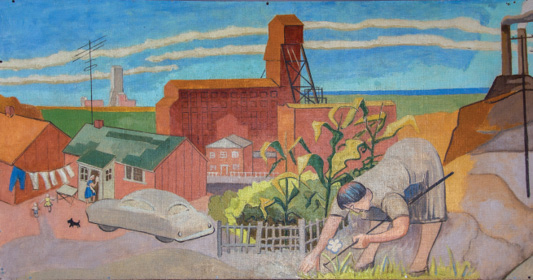
Mine Mill Local 598, panel 1. (Copper Cliff community, Creighton headframe, woman gardening.) Henry Orenstein, 1956, oil on burlap mounted on plywood panel, 104.1 x 191.4 cm.
Collection: Mine, Mill and Smelter Workers’ Union / Unifor Local 598. Photo by Jerry Arbs.
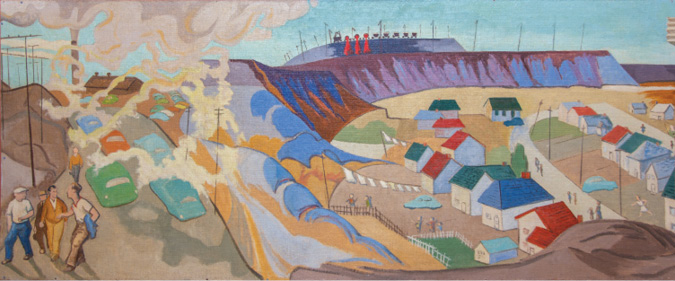
Mine Mill Local 598, panel 2. (Men returning from work, Gatchell neighbourhood.) Henry Orenstein, 1956, oil on burlap mounted on plywood panel, 104.1 x 243.8 cm.
Collection: Mine, Mill and Smelter Workers’ Union / Unifor Local 598. Photo by Jerry Arbs.
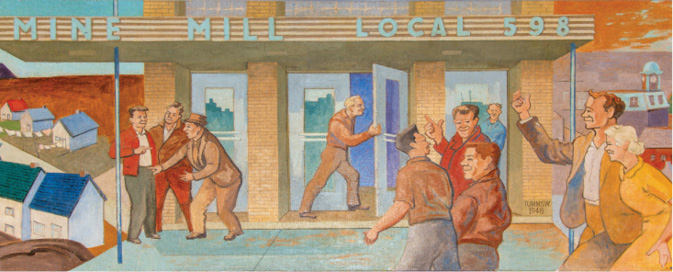
Mine Mill Local 598, panel 3. (Mine Mill Union Hall on Regent Street.) Henry Orenstein, 1956, oil on burlap mounted on plywood panel, 104.1 x 243.8 cm.
Collection: Mine, Mill and Smelter Workers’ Union / Unifor Local 598. Photo by Jerry Arbs.
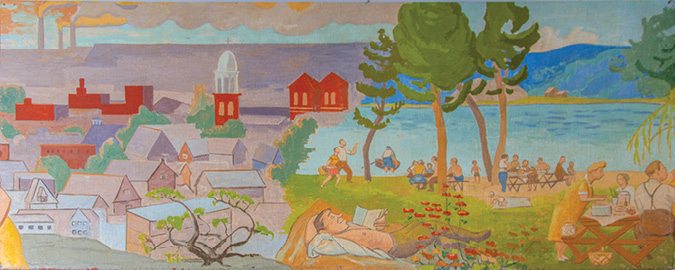
Mine Mill Local 598, panel 4. (Sudbury and Mine Mill Camp at Richard Lake.) Henry Orenstein, 1956, oil on burlap mounted on plywood panel, 104.1 x 243.8 cm.
Collection: Mine, Mill and Smelter Workers’ Union / Unifor Local 598. Photo by Jerry Arbs.
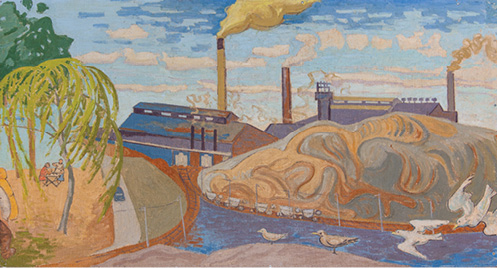
Mine Mill Local 598, panel 5. (Falconbridge smelter.) Henry Orenstein, 1956, oil on burlap mounted on plywood panel, 104.1 x 174 cm.
Collection: Mine, Mill and Smelter Workers’ Union / Unifor Local 598. Photo by Jerry Arbs.
1. See Elizabeth Quinlan, “Making Space for Creativity: Cultural Initiatives of Sudbury’s Mine-Mill Local 598 in the Postwar Era,” Labour/Le Travail 93 (Spring 2024): 223–245.
2. Weir Reid, director of recreation, mmsw 598, to Henry Orenstein, 13 January 1956, Joan and Henry Orenstein fonds, box 1, folder 26, MS-2-774, Dalhousie University Archives, Halifax.
3. Rosemary Donegan, Sudbury: The Industrial Landscape (Sudbury: Art Gallery of Sudbury, 1998), 11–12.
How to cite:
Elizabeth Quinlan, “Henry Orenstein’s Mine Mill Local 598 (1956): A Correction and Reproduction,” Labour/Le Travail 95 (Spring 2025): 237–240, https://doi.org/10.52975/llt.2025v95.011.
Copyright © 2025 by the Canadian Committee on Labour History. All rights reserved.
Tous droits réservés, © « le Comité canadien sur l’histoire du travail », 2025.