Labour / Le Travail
Issue 95 (2025)
Note and Document / Note et document
“Red Haggis”: A Depression-Era Comic Strip in the Young Worker
Keywords: comics; Communists; Depression; Scots; “hard man”; popular culture
Mots clefs : bande dessinée; communistes; dépression; Écossais; culture populaire
In his debut instalment, Red Haggis is shown disembarking in Halifax and promptly tossing into the harbour the rcmp officer attempting to prevent him from coming ashore while exclaiming, “Hoot Mon!”1 The humorous intent of the comic strip is established at the outset, as is the main character’s Scottish origins – indicated by the arriving vessel’s name, The Empress of Scotland, and by the character’s surname. As early as Robert Burns’ poem “An Address to a Haggis” (1786), the Scottish dish comprised of sheep’s organs mixed with oatmeal and encased in the animal’s stomach had been employed for humorous effect. Indeed, the ritual “stabbing of the haggis” every January Burns Night was a well-established ritual among Scottish societies across Canada when the comic strip first appeared on 18 June 1934. The appellation “Red” is revealed in later instalments to refer to the main character’s hair colour, another Scottish allusion, but was also clearly meant as a double entendre since the first instalment makes it clear that Red Haggis has made his transatlantic journey to join the staff of the Young Worker – the weekly newspaper of the Young Communist League of Canada (ycl).
Political cartoons have been employed in the Canadian press since the 19th century, with the work of J. W. Bengough attracting particular notice from historians. The left-wing press, too, has often made use of the form. Contemporary with the appearance of “Red Haggis,” the work of Avrom Yanovsky featured frequently in The Worker, the newspaper of the Communist Party of Canada (cpc).2 The serial comic strip, however, in which a story is developed over multiple adjoining drawing panes and recurring instalments, was much less common in Canadian left-wing interwar publications despite being a popular feature of many newspapers at the time.3
“Crawford,” the artist responsible for “Red Haggis,” appears to have been something of an anomaly, authoring two serial strips in the Young Worker in 1934.4 “Red Haggis,” which ran for fourteen instalments ending in September, followed “Jack and Bill,” a narrative strip that charted the experience of two unemployed youths over eleven weekly instalments from 19 March to 11 June 1934. Although the paper would continue to publish political cartoons, “Red Haggis” would be its last serial comic strip. Of Crawford’s two Young Worker strips, only “Red Haggis” was intended to be funny. This introduction to the strip, reproduced in entirety below, will endeavour to contextualize its publication and examine the contemporary cultural references that may have underpinned the central character’s comic appeal.
By June of 1934, the Young Worker had been in publication for a decade, first as a bi-monthly and then as a weekly newspaper.5 The paper was established in 1924 by the ycl, two years after the founding of the organization. A member of the Young Communist International headquartered in Moscow and in some ways independent of the cpc – though in others subordinate to it – the ycl was a Communist alternative to “capitalist” youth organizations, such as the ymca.6 Former organizer Dave Kashtan recalled that the goal of the ycl was to educate “young workers and students” in the “spirit of socialism.”7 It was an organization for teens and young adults, between the ages of 15 and 23. Younger children, between the ages of 8 and 14, could participate in the Young Pioneers in lieu of the Girl Guides or the Boy Scouts.
The ycl served as a training ground for young revolutionaries, many of whom would attend the Lenin School in Moscow and go on to occupy important positions within the cpc. Nevertheless, the party’s leadership often feared that many ycl members were insufficiently “ideological” and were merely attracted to the league as a site of “association and entertainment.”8 Yet, if their degree of commitment varied, Kashtan recalled that during the Depression years, ycl members shared a common belief that “socialism offered the only remedy for unemployment and poverty.”9
As of 1931, the ycl’s constitution committed it to an effort to “penetrate the mass of the working-class youth” with “communist agitation and education” as part of a “militant campaign against capitalist militarism.” Members were also expected to “link up with the militant section of the working class” to work toward the conversion of weak craft unions into “strong industrial unions” while paying special attention to the “economic needs of working class youth” and demanding, specifically, that no children should be employed before the age of sixteen and that young workers should “receive the same wages as adult workers for the same work.”10
This program was in keeping with the Third Period goals of the Sixth World Congress of the Communist International (Comintern), which had sought to hasten a worldwide confrontation with capitalism through the establishment of “red” unions.11 “Red Haggis,” however, appeared during a period of transition as Moscow moved toward a policy of co-operation with other labour organizations and parties to defeat Fascism, which was increasingly viewed as an existential threat to the Soviet Union. The new policy was made official in the summer of 1935 with the launching of the Popular Front.12 The ycl anticipated this shift with the founding of the Canadian Youth League Against War and Fascism in Toronto during the summer of 1934. Indeed, “Red Haggis” shared the page with appeals for participation in the league’s national congress, which would meet in Toronto on 4 August 1934. Delegates would come from across Canada and from a range of political and religious organizations, including the Young Socialist League and Jewish Labour League as well as members of Co-operative Commonwealth Federation clubs. Indeed, organizations formerly branded by the ycl as “capitalist,” such as the ymca and ywca, also sent representatives.13 While the run of the “Red Haggis” strip in the Young Worker coincided with reports on youth involvement in workplace organizing and industrial action in Canada, the paper emphasized the wider international struggle against Fascism, reporting on the conflict between Nazis and Communists in Germany and on the imprisonment of the German party leader, Ernst Thälmann. Parallels were explicitly drawn between the behaviour of Fascists in Europe and the Bennett government’s use of Section 98 to outlaw the cpc and imprison eight of its leaders.14
Crawford’s earlier comic strip, “Jack and Bill,” had highlighted the condition of Canada’s unemployed youth with the goal of encouraging readers to join the ycl, echoing the Third Period goals; in contrast, “Red Haggis” was designed to encourage subscriptions to the Young Worker rather than to explicitly promote the aims of the Popular Front. The strip appeared as the paper launched a major subscription drive that ended shortly after the last instalment in September.15 At the outset of the storyline of the strip, Red Haggis arrives in Canada to support the paper, and in subsequent instalments, his actions are clearly intended to boost circulation. In the 23 July instalment, he arrives at the Young Worker office and finds the staff overwhelmed by bills. In the following week’s strip, he has climbed atop the pile to address readers directly, calling on them to rush in “More Subscriptions Fast!!!” (Figure 1).
![A comparison of two black-and-white images. On the left is a cartoon of a character named Red Haggis, depicted shouting and pointing directly at the viewer with the caption: It’s yon bonnie bairn that’s at fault, take that grin off an’ rush in more subscriptions, fast!!! The character stands amid scattered papers, emphasizing urgency and frustration. On the right is a famous British World War I recruitment poster featuring Lord Kitchener in military uniform. He points directly at the viewer with the words: BRITONS. [Kitchener] WANTS YOU. JOIN YOUR COUNTRY’S ARMY! GOD SAVE THE KING. The side-by-side layout highlights the visual and rhetorical similarity in the pointing gesture.](https://lltjournal.ca/index.php/llt/article/download/6396/version/2213/7665/12392/fig-1.png)
Figure 1. While the ycl opposed militarism, Red Haggis’ finger pointing echoes that of Lord Kitchener in the widely circulated and much imitated British recruiting poster, which first appeared on 5 September 1914 in the London Opinion.
“Red Haggis,” Young Worker, 30 July 1934, p. 3, Library and Archives Canada; Alfred Leete (1882–1933), “Britons (Kitchener) wants you,” Victoria House Company, London, 1914 (public domain).
Using the device of a finger pointed directly toward the viewer – ironically, a gesture made famous in World War I recruiting posters – Red Haggis directs his intended reader, a “bonnie bairn” who needs to “take that grin off” and get busy hawking the Young Worker. If the apparent ages of the lazy newsboys depicted in the strip are any guide, the paper would have been counting on younger members of the ycl, or perhaps even of the Young Pioneers, to mobilize for its subscription drive. These readers, presumably, might have been the most inclined to turn to a comic strip first, before engaging with the weightier political content of the paper they were tasked with selling.
Nevertheless, the Communist bona fides of Red Haggis are clearly established early in the strip. In the series’ second instalment, he alters a men-at-work sign to highlight the red flag flying over it – “The only flag under which ALL men work.” This act of creative vandalism attracts the attention of a figure in black holding a magnifying glass, his face masked by a pair of infant’s underpants. Subsequent instalments show Red Haggis being shadowed and arrested by the masked man and fellow members of the “Red Squad.” Sentenced to 30 days for spreading “red propaganda” and having “red hair,” Red Haggis avoids being assaulted by the squad armed with truncheons and rubber hoses by breaking out of jail.
The strip that appeared on 13 August 1934 made clear that Crawford intended the masked man to be a caricature of Detective William Nursey – called “Defective Nursery,” hence the underpants face covering.16 While Crawford was obviously ridiculing Nursey and his colleagues, depicting them as unwitting walking advertisements for the Young Worker in subsequent August instalments, the Toronto Police “Red Squad” was known for its officers’ violent behaviour – particularly during the crackdown on the cpc after the renewed enforcement of Section 98 in 1931. The squad was accused of using excessive force when raiding party offices and interrogating suspected “Reds,” and its attacks against unemployed organizers and demonstrators were widely reported.17 By the time “Red Haggis” appeared, however, Detective Nursey and the Red Squad had been rebuked by the Toronto Police Commission and ordered to refrain from its tactic of indiscriminate arrests.18 The broad unpopularity of Section 98 had also resulted in the Bennett government initiating the release from Kingston Penitentiary of the party leaders who had been convicted under the law.19 All of this made Detective Nursey and the Red Squad an opportune target for Crawford’s dismissive humour.
If Detective Nursery and his goons are objects of ridicule in the strip, the hero – Red Haggis – was also intended to be a comic figure. Although the identity of Crawford remains unclear, the cartoonist’s inspiration for Red Haggis was apparently multi-faceted; the character appears to reflect contemporary American popular culture and the Scottish musical hall tradition, as well as prevailing Scottish working-class stereotypes. Red Haggis’ physical appearance bears a strong resemblance to Popeye, the popular contemporary American comic strip character, while his dialogue draws heavily on the stage Scots that was prevalent since the end of the 19th century. The character’s physicality also reflects the “hard man” stereotype that emerged in lowland Scotland’s heavy industries between the world wars.
When the features of Red Haggis are compared with contemporary representations of Popeye, the similarities are striking (Figure 2). Both have bulging forearms and diminutive lower bodies. Their facial features are also closely parallel, with Popeye’s squint echoed in Red Haggis’ broken nose. Red Haggis is always depicted with a cigarette hanging from his mouth, and Popeye is never without his pipe. Popeye was already a well-established newspaper comic strip character when his solo animated film debut, I Yam What I Yam, was released by Fleischer Studios months before Red Haggis first appeared in the Young Worker. In his short film debut, Popeye comes ashore as a pioneer to North America who immediately engages in physical battle with the “Indians,” while Red Haggis in his debut steps ashore and physically assaults an rcmp officer.20 Richard Fleischer has pointed out that the Popeye films of the 1930s were a huge success for Fleischer Studios and that by the end of the decade they were more popular than Walt Disney’s Mickey Mouse films. In accounting for this success, Susan Honeyman has suggested that in an era of mass unemployment, with its emasculating effect on the breadwinner self-image, an everyman hero who always prevails by using his fists had a cathartic effect on audiences.21 Given Popeye’s wide distribution, Crawford would have likely seen the Fleischer Studios films and adopted many of the American animated hero’s characteristics for Red Haggis. Although Crawford’s protagonist uses his wits to undermine the “Red Squad,” like Popeye, his physical strength and potential for violence are hinted at throughout the series.
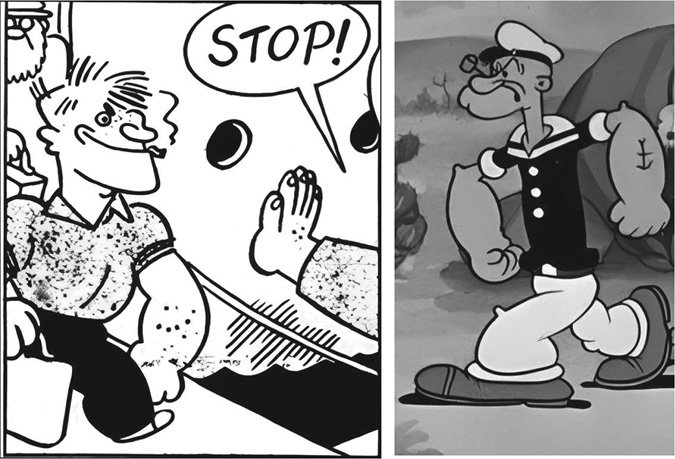
Figure 2. The physical similarities between the characters of Red Haggis and Popeye are striking.
Red Haggis in Young Worker, 18 June 1934, p. 3, Library and Archives Canada; Popeye in I Yam What I Yam, 29 September 1933, Fleischer Studios, https://archive.org/details/i-yam-what-i-yam-1933 (public domain).
Popeye is clearly identified by his peculiar idiom, “I yam what I yam,” and Red Haggis is also marked out by his speech. His use of vernacular expressions, such as “d’ ye ken,” “bonnie bairn,” and “get awa,” not only identifies him as a Scot but links him to the “Scotch Comic” music hall character that emerged in Scotland in the last half of the 19th century. Touring performers, like W. F. Frame and, especially, Sir Harry Lauder, brought the “Scotch Comic” to North America, where migrant Scots eagerly embraced their performances. The kilted singer, speaking a stage version of lowland vernacular, became a familiar comedic figure on both sides of the Atlantic. Unlike Red Haggis, by the interwar period Scottish performers tended to present a romanticized, sentimental view of rural Scotland that Lauder was still using to entertain North American audiences in the early 1930s.22 In Scotland, however, Tommy Lorne was performing a different version of the character that was much closer to its Glasgow working-class origins. As Paul Maloney has noted, Lorne satirized the kilted persona in both his dress and the content of his act, which was less about “braes and glens” and more reflective of the urban experience of the impoverished Gorbals where his career had been established.23 Lorne used specific Glasgow vernacular in his performances, and the city’s working-class dialogue is also evident in “Red Haggis,” where Crawford employs “ye canna stopit” as a refrain throughout the series. Glasgow “patter” can also be found in the contemporary “Lauder and Lorne” comic strip that ran in the Daily Record from 1933 to Lorne’s death in 1935.24 Crawford may, or may not, have seen the strip that paired the two giants of the Scottish music hall, but in giving Red Haggis his distinctive dialogue, the cartoonist was not only using a well-worn device to signify Scottish identity but also linking the character to the “working class performing tradition” of industrial Scotland.25
In his 1935 memoir, David Kirkwood, a “Red Clydesider,” claimed that to outsiders, Glasgow’s working-class men appeared to be “abrupt and rough and uncouth at all times. Even in their friendly chaff, they seem as if at any moment they would exchange fun for fists.”26 Kirkwood, a veteran of the intense labour strife that characterized industrial relations from World War I to the 1920s, could have been describing Red Haggis. The character’s combination of fun and physical violence is apparent in the first instalment and in the last. In the final strip, Red Haggis is shown emptying a bag of “lazy birrd” paper boys whom he had vacuumed up in the previous instalment. A frame containing only text follows, indicating a “very mysterious pause of three minutes,” followed by a final frame revealing an enthusiastic group of Young Worker salesmen eagerly promoting the paper. The reader is invited to guess Red Haggis’ secret, but from the previous instalment it is made clear that he intended to take the boys “hame for a treat” – violence, or the threat of it, being clearly implied.
Unlike the sleeping paper boys, the strip’s main character is always actively confronting authorities, either physically or with his intelligence. These aspects of Red Haggis’ representation echo the “hard man” image that emerged in industrial Scotland between the world wars. As Ronnie Johnson and Arthur McIvor have argued, the “hard man” was the product of socialization in the heavy industries of the west of Scotland that had encouraged male bravado and indifference to dangerous working conditions. The persona – which also emphasized smoking, heavy drinking, and emotional restraint – assisted men in coping with the constant threat of injury or death in the workplace.27 As union leader Jimmy Reid put it in 1971, “We don’t only build ships on the Clyde, we build men!”28 Ewan Gibbs and Rory Scothorne argue that the “hard man” came to signify the archetypal labour leader, who, like Reid, would fight and defy capitalists and Westminster politicians alike, and that such men would dominate the Scottish radical left well into the 20th century. The preponderance of “hard men,” however, also meant that the vital role that women played both in Red Clydeside and in the Scottish branches of the Communist Party was largely ignored; this neglect is also reflected in the Red Haggis strip, which does not contain a single female image.29 The masculine ideal left little room to acknowledge women other than in a supportive role. Indeed, in Scotland, failure to adhere to the “hard man” ideal often meant being ridiculed for being effeminate – a charge also often laid against “idle” business owners, politicians, and civil servants. In this light, the last instalment could be seen as Red Haggis transforming lazy, indolent boys into “hard men” ready to work vigorously for the Young Worker.30
The cartoonist must have expected that a Scottish working-class character would have been readily understood by the paper’s readership. That expectation would have been encouraged by the presence of large numbers of immigrant Scots in the interwar Canadian labour force. The majority of the nearly 200,000 Scots who emigrated to Canada between the world wars came from industrial occupations in lowland Scotland. As Marjory Harper has shown, most arrived in the 1920s, and instead of becoming western farmers, as the Canadian government had desired, they remained in urban centres and pursued working-class vocations.31 The postwar depression was particularly acute in Scotland’s heavy industries, and the accompanying widespread unemployment that had contributed to the Red Clydeside protests encouraged others to emigrate. Those industrial workers who left Scotland after 1918 joined the pre-war migrants who had already established themselves in Canadian industries, increasing the overall number of Scots in the workforce.32
By the 1930s, several working-class Scots had become prominent trade union leaders in Canada. Many of these individuals, such as J. B. McLachlan in the Cape Breton steel industry and George Millar in the BC fishing fleet, were also members of the cpc.33 The first leader of the Canadian party was John L. MacDonald, a patternmaker from Falkirk. Tom Ewen, a blacksmith from Stonehaven, had led the Third Period “red” union movement as national secretary of the party’s Workers Unity League. He was also one of the eight party leaders imprisoned under Section 98, along with Malcolm Loughlin Bruce, a Prince Edward Island–born carpenter descended from Scottish settlers.34 Peter Hunter, who was born in Dalmuir and emigrated with his family to Hamilton, Ontario, in 1922, was another prominent party member in charge of organizing the Canadian Youth League Against War and Fascism at the time Crawford was drawing “Red Haggis.”35 If the majority of ycl members were more likely to claim other ethnicities – as of 1929, Finnish, Ukrainian, and Jewish Canadian youth made up 94 per cent of the ycl’s membership – readers might well have been accustomed to seeing Scottish Canadians taking up prominent positions in unions and left-wing parties to champion the workers’ cause.36
The disproportionate role of Scots in trade union and Communist Party leadership likely encouraged the creation of a Scottish working-class protagonist for the Young Worker strip, but the widespread popularity of the music hall “Scotch Comic” would have also provided inspiration for Red Haggis. While his physicality echoes the Glasgow “hard man” stereotype, this aspect of his character is also reflective of indomitable Popeye. It can be argued that Red Haggis transformed the heroic common man figure of the Depression-era United States into a Scottish worker’s champion promoting the Communist cause in Canada. The comic strip can be viewed as an amalgam of American popular culture and Scottish stereotypes that reflected the presence of Scottish immigrants in the Canadian industrial labour force as well as their outsized role in the radical left-wing politics of the 1930s. The appearance of “Red Haggis” in the Young Worker reminds us that, in addition to class, ethnicity and ethnic representation play a considerable role in the cultural history of labour in Canada.
The research for this article was undertaken during the winter of 2024 while I was a visiting professor in the Department of History and Classical Studies at McGill University. I am grateful to John Manley for his invaluable work on the Canadian Communist Party and for drawing my attention to the “Red Haggis” strip. I am also indebted to Kirk Niergarth’s attentive editing and suggested additions to this discussion. All errors or omissions, however, are mine alone.
Document: The “Red Haggis” Series
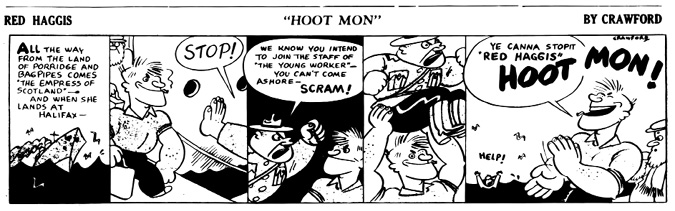
Young Worker, 18 June 1934, p. 3
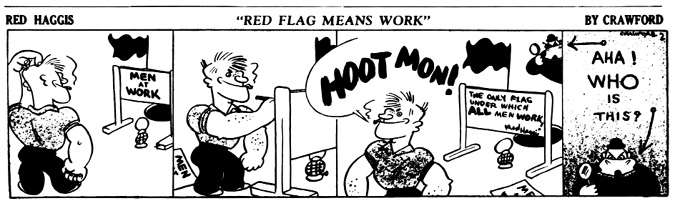
Young Worker, 25 June 1934, p. 3
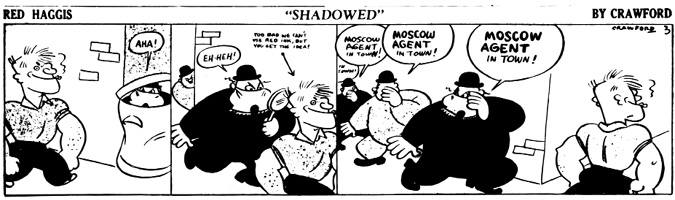
Young Worker, 2 July 1934, p. 3
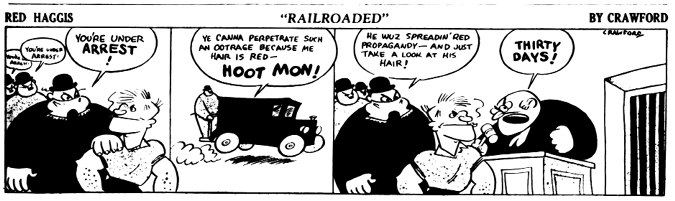
Young Worker, 9 July 1934, p. 3
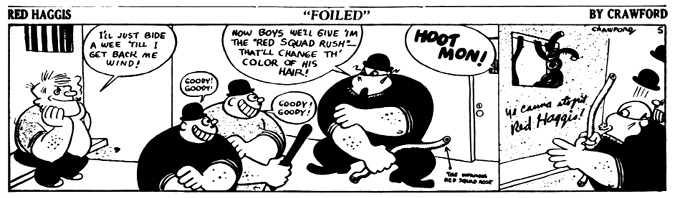
Young Worker, 16 July 1934, p. 3
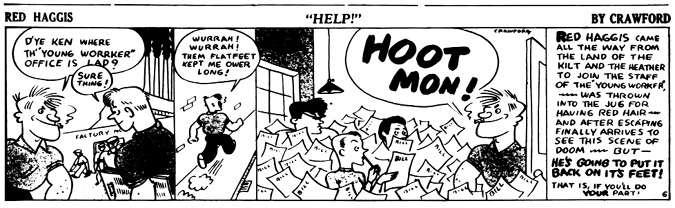
Young Worker, 23 July 1934, p. 3
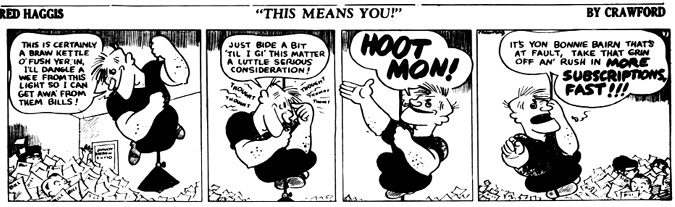
Young Worker, 30 July 1934, p. 3
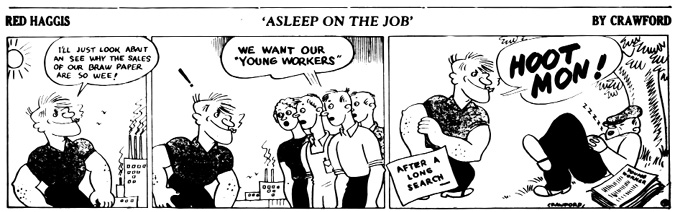
Young Worker, 6 August 1934, p. 3
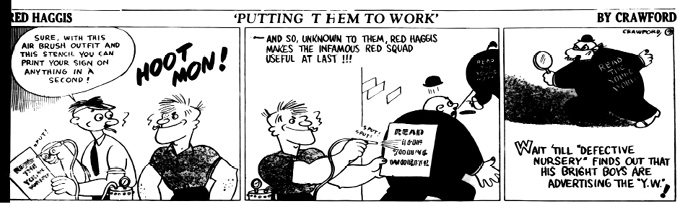
Young Worker, 13 August 1934, p. 3
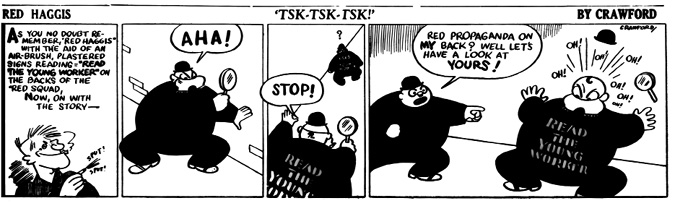
Young Worker, 20 August 1934, p. 3
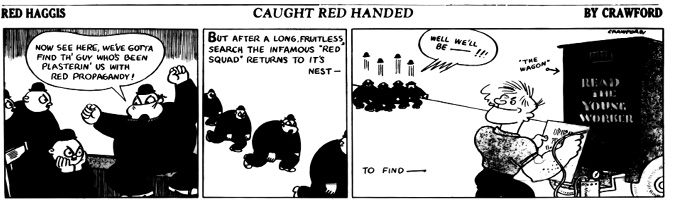
Young Worker, 27 August 1934, p. 3
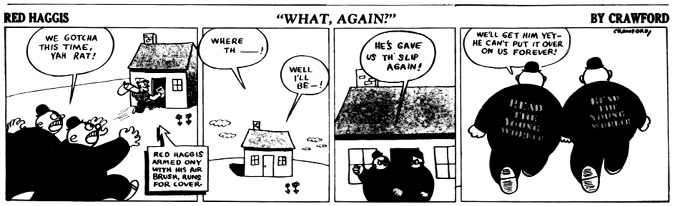
Young Worker, 3 September 1934, p. 3
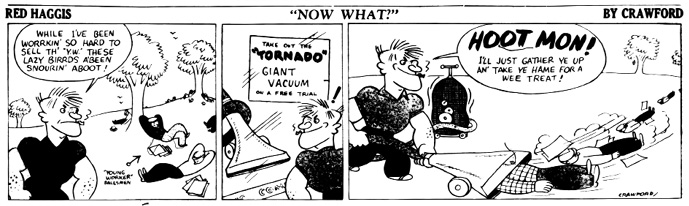
Young Worker, 10 September 1934, p. 3
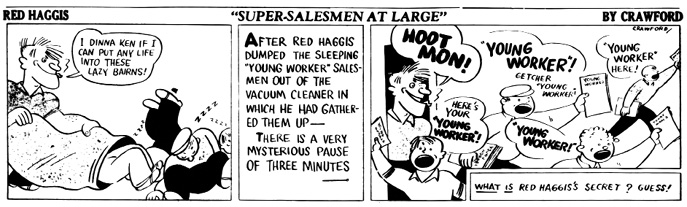
Young Worker, 17 September 1934, p. 3
1. “Hoot” is an exclamation in Scots expressing dismissal, annoyance, or disgust. It appears in works of Scottish literature as early as the 18th century. By the 20th century, “Hoot Mon” or “Hoots Mon” had become a stereotypical phrase in music hall and film performances to denote Scottish ethnicity. Dictionary of the Scots Language, s.v. “hoot,” accessed 18 November 2024, http://www.dsl.ac.uk/entry/snd/hoot_interj_v_n.
2. David Frank’s study of Yanovsky, who signed his caricatures using the nom de plume “Avrom,” traces the artist’s life and career and also indicates the influence of Bengough on Yanovsky. Frank, “Looking for Avron Yanovsky: An Exploration of the Cultural Front,” Left History 22, 1 (2018): 37–88; see also Christina Burr, “Gender, Sexuality, and Nationalism in J. W. Bengough’s Verses and Political Cartoons,” Canadian Historical Review 83, 4 (2002): 505–571.
3. The Young Worker had published a one-time strip in 1927 that satirized the contemporary “Red Scare” by showing a range of characters blaming Moscow for their flat tires, baseball strikeouts, and even the arrival of twins (Young Worker, January 1927). Earlier in the century, the Industrial Workers of the World had run a strip whose central character, “Mr. Block,” refused to see that his own self-interest meant organizing against his employers. Graphic History Collective, with Paul Buhle and Iain McIntyre, eds., Mr. Block: The Subversive Comics and Writings of Ernest Riebe (Toronto: Between the Lines, 2023).
4. To date, it has not been possible to definitively identify “Crawford.” A possible candidate is Lawrence Crawford, who was a member of the Students’ League of Canada and worked on The Student newspaper in Toronto, earning him mention in an rcmp security bulletin in 1934. Since the Young Worker was also published in Toronto, it is possible that Lawrence Crawford was the caricaturist, but without other evidence, a confident attribution cannot be made. Gregory S. Kealey and Reg Whitaker, eds., rcmp Security Bulletins: The Depression Years, Part I, 1933/1934, (St. John’s: Canadian Committee on Labour History, 1993), 392.
5. The Young Worker ceased publication in 1936, when it was replaced by the illustrated monthly magazine Advance. That publication was superseded by New Advance: Canada’s National Youth Magazine, published from 1937 to 1943 (oclc no. 1080362103, Library and Archives Canada). While the magazine continued to publish individual cartoons along with its photo essays, it did not contain comic strips.
6. The ycl was originally called the Young Workers’ League but became the Young Communist League in February 1923. See Daria Dyakonova, “‘Young’ and ‘Adult’ Canadian Communists: The Question of Nationhood and Ethnicity in the 1920s,” in Oleksa Drachewych and Ian McKay, eds., Left Transnationalism: The Communist International and the National, Colonial, and Racial Questions (Montréal and Kingston: McGill-Queen’s University Press, 2019), 318.
7. Dave Kashtan, “Living in One’s Own Time: A Memoir from the Left,” as reproduced in Kirk Niergarth, ed., “‘Fight for Life’: Dave Kashtan’s Memories of Depression-Era Communist Youth Work,” Labour/Le Travail, no. 56 (Fall 2005): 215.
8. Dyakonova, “‘Young’ and ‘Adult’ Canadian Communists,” 320, 329–330.
9. Kashtan, “Living in One’s Own Time,” 215.
10. Department of Labor, Twenty-First Annual Report on Labour Organization in Canada (for the Calendar Year 1931) (Ottawa: F. A. Acland, 1932), 163.
11. The Sixth Congress was held in the summer of 1928. On the Third Period in Canada, see John Manley, “Red or Yellow? Canadian Communists and the ‘Long’ Third Period,” in Matthew Worley ed., In Search of Revolution: International Communist Parties in the Third Period (London: I. B. Tauris, 2004), 220–246; Manley, “Canadian Communists, Revolutionary Unionism, and the ‘Third Period’: The Workers Unity League, 1929–1935,” Journal of the Canadian Historical Association 5, 1 (1994): 167–194; Manley, “Moscow Rules? ‘Red’ Unionism and ‘Class against Class’ in Britain, Canada and the United States, 1928–1935,” Labour/Le Travail, no. 56 (Fall 2005): 9–49.
12. The Popular Front was announced at the Seventh Congress of Communist International, which met in July and August of 1935. John Manley, “‘Communists Love Canada!’ The Communist Party of Canada, the ‘People’ and the Popular Front, 1933–1939,” Journal of Canadian Studies 36, 4 (2002): 58.
13. Young Worker, 6 August 1934; Peter Hunter, Which Side Are You On, Boys: Canadian Life on the Left (Toronto: Lugus, 1988): 52–53.
14. See, for example, Young Worker, 2 July 1934, p. 3; 6 August 1934, p. 3; 20 August 1934, p. 3. On Section 98, see Dennis G. Molinaro, An Exceptional Law: Section 98 and the Emergency State, 1919–1936 (Toronto: University of Toronto Press, 2017). Five of the prisoners – Sam Carr, Matt Popovich, Malcolm Bruce, Tom Hill, and John Boychuck – were released during the run of the “Red Haggis” strip; the remaining two, Tom Ewen and party leader Tim Buck, were freed shortly after. Manley, “Red or Yellow,” 231–234.
15. Young Worker, 24 November 1934.
16. William Nursey, along with William Simpson and Daniel Mann, formed the core of the Toronto Police “Red Squad.” All three were heavy-set men over six feet tall with reputations for excessive drinking. The squad was established by Brigadier General Denis Draper shortly after the World War I veteran was appointed chief of police in 1928. The Red Squad was modelled after the unit of the same name in Los Angeles that had employed the tactics of mass raids and arrests along with police brutality to disrupt Communist activities. Nursey and his colleagues used the same approach in Toronto. Lita-Rose Betcherman, The Little Band: The Clashes between the Communists and the Political and Legal Establishment in Canada, 1928–1932 (Ottawa: Deneau, 1982), 15, 19, 24, 26, 46, 63, 113; see also Hunter, Which Side, 65–66.
17. Nursey’s actions were highlighted in the press, with the Globe portraying him as a “minor hero” and the Toronto Star as a “minor villain.” Betcherman, Little Band, 14, 60–67, 112.
18. Barbara Roberts, Whence They Came: Deportation from Canada 1900–1835 (Ottawa: University of Ottawa Press, 1988): 170. Prosecutors complained that Nursey’s strong-arm tactics and disregard of proper procedure in making arrests had undermined their cases. Betcherman, Little Band, 167, 214.
19. Nursey provided testimony at the trial of the party leaders in 1931. He later attended the performance of Eight Men Speak, the agitprop play that portrayed the trial and the attempted murder of Tim Buck by a prison guard. His report on the play was used to supress further performances. Molinaro, Exceptional Law, 104; C. Scott Eaton, “‘A Sharp Offensive in All Directions’: The Canadian Labour Defense League and the Fight against Section 98, 1931–1936,” Labour/Le Travail, no. 82 (Fall 2018): 68. On the significance of the play in Canadian theatre, see Eugene Benson and L. W. Conolly, The English-Canadian Theatre (Toronto: Oxford University Press, 1987), 58–59.
20. I Yam What I Yam, film, 6:04, 29 September 1933, Fleischer Studios. The film is now in the public domain. Its racist depictions have long kept it out of public view, but it is now widely available on the internet. In addition to this debut of the character, eight other Popeye animated films were released before “Red Haggis” appeared.
21. Richard Fleischer, Out of the Inkwell: Max Fleischer and the Animation Revolution (Lexington: University Press of Kentucky, 2005), 55; Susan Honeyman, “Muscle and Greens,” in Consuming Agency in Fairy Tales, Childlore, and Folkliterature (New York: Routledge, 2010), 156, 160–162. Honeyman also notes that Popeye’s use of spinach to enhance his strength, highlighted in the Fleischer films, contributed to his appeal since it was an everyday canned product that all could obtain to improve their own health.
22. John Ritchie, “Sir Harry Lauder and the Scots Diaspora: Cementing Identity through Stage and Screen,” Visual Culture in Britain 20, 3 (2019): 280–281, 290. See also Alasdair Cameron and Adrienne Scullion, “W. F. Frame and the Scottish Popular Theatre Tradition,” in Cameron and Scullion, eds., Scottish Popular Theatre and Entertainment (Glasgow: Glasgow University Library Studies, 1996), 39–61.
23. Tommy Lorne (1890–1935) was the stage name of Hugh Gallagher Corcoran. Although born in Kirkintilloch, Lorne grew up in the Garngad area of Glasgow. He started performing in nearby Cowcaddens before appearing in productions at the Princess’s Theatre in the Gorbals. On Lorne’s performance persona, see Paul Maloney, “‘Wha’s like us?’ Ethnic Representation in Music Hall and Popular Theatre and the Remaking of Urban Scottish Society,” in Ian Brown, ed., From Tartan to Tartanry: Scottish Culture, History and Myth (Edinburgh: Edinburgh University Press, 2010), 137–141.
24. The Daily Record targeted the Glasgow working-class reader. Its “Lauder and Lorne” comic strip ran from May 1933 to April 1935 (Daily Record, accessed 13 November 2024, British Newspaper Archive, British Library).
25. Maloney, “‘Wha’s like us?,’” 130–131. See also Ian Brown, “Language and Resistance in Theatre, Music Hall and Variety,” in Performing Scottishness: Enactment and National Identities (Basingstoke: Palgrave Macmillan, 2020), 167–184.
26. David Kirkwood, My Life in Revolt (London: George Harrap, 1935), 76, quoted in Ronnie Johnson and Arthur McIvor, “Dangerous Work, Hard Men and Broken Bodies: Masculinity in the Clydeside Heavy Industries, c. 1930–1970s,” Labour History Review 69, 2 (2004): 138. For a succinct overview of the Red Clydeside protests and key participants, see Alastair J. Reid, “Red Clydesiders (act. 1915–1924),” Dictionary of National Biography (Oxford: Oxford University Press, May 2006).
27. Johnson and McIvor, “Dangerous Work,” 138–141.
28. Ewan Gibbs and Rory Scothorne, “Accusers of Capitalism: Masculinity and Populism on the Scottish Radical Left in the Late Twentieth Century,” Social History 45, 2 (2020): 236.
29. Gibbs and Scothorne, “Accusers of Capitalism,” 244; See also Neil C. Rafeek, Communist Women in Scotland: Red Clydeside from the Russian Revolution to the End of the Soviet Union (London: I. B Tauris, 2008). The focus on the eight male cpc leaders imprisoned under Section 98 has also tended to obscure the important role that women played in Canada. An exception to this neglect is Andrée Lévesque’s Red Travellers: Jeanne Corbin and Her Comrades, trans. Yvonne M. Klein (Montréal and Kingston: McGill-Queen’s University Press, 2006).
30. I am grateful to my colleague R. Blake Brown for this observation.
31. Marjory Harper, Emigration from Scotland between the Wars: Opportunity of Exile? (Manchester: Manchester University Press, 1998), 7–10, 135–146.
32. Between 1900 and 1918, approximately 240,000 Scots emigrated to Canada. According to the census data, people of Scottish origin represented 12.1 per cent of the total Canadian population by 1941. J. M. Bumsted, The Scots in Canada (Ottawa: Canadian Historical Association, 1982).
33. David Frank, J. B. McLachlan: A Biography (Toronto: James Lorimer, 1999); Michael E. Vance, “Scots in Early Twentieth-Century British Columbia: Class, Race and Gender,” in Bryan S. Glass and John M. MacKenzie, eds., Scotland, Empire and Decolonisation in the Twentieth Century (Manchester: Manchester University Press, 2015), 90–91; Vance, “‘Mon he’s a Gran Fish’: Scots in BC’s Inter-war Fishing Industry,” BC Studies, no. 158 (Summer 2008): 47–52.
34. Ewen changed his name to McEwen later in life. Tom McEwen, The Forge Glows Red: From Blacksmith to Revolutionary (Toronto: Progress Books, 1974), 207–217; see also Stephen L. Endicott, Raising the Workers’ Flag: The Workers’ Unity League of Canada, 1930–1936 (Toronto: University of Toronto Press, 2012), 70–77, 93–99. Scotswomen, such as Elsie Munro and Flora Hutton in British Columbia, also took on leadership roles but were not well known. See Vance, “Scots,” 89, 99–100; “‘Mon he’s a Gran Fish,’” 53–54. Malcolm Bruce’s origins can be traced in the Canadian census. He first appears as a one-year-old in the 1881 census along with his father James, mother Sarah, and elder brother Alexander – all identified as “Scotch.”
35. Hunter, Which Side, 1–3, 52–56.
36. Dyakonova, “‘Young’ and ‘Adult’ Canadian Communists,” 319.
How to cite:
Michael E. Vance, “‘Red Haggis’: A Depression-Era Comic Strip in the Young Worker,” Labour/Le Travail 95 (Spring 2025): 241–256, https://doi.org/10.52975/llt.2025v95.012.
Copyright © 2025 by the Canadian Committee on Labour History. All rights reserved.
Tous droits réservés, © « le Comité canadien sur l’histoire du travail », 2025.