Labour / Le Travail
Issue 95 (2025)
Article
Navigating Streets, Restaurants, and Algorithms: A Study of Young Immigrant Food Delivery Couriers in Montréal and Toronto
Abstract: Major Canadian cities have seen an overrepresentation of young and immigrant workers delivering meals in their food delivery industries. This type of labour is increasingly done via online digital platforms. The objective of this article is to use interviews to analyze the working conditions and experiences of food delivery workers in Toronto and Montréal, highlighting the elements of precariousness that characterize this type of work. The degree to which customers perform managerial functions through digital platforms is only one of the various forms and aspects of algorithmic control experienced by delivery workers. Through 30 semi-structured interviews with delivery riders, and notes collected through participatory observation, this article presents commonly experienced negative aspects of platform work among young and immigrant delivery drivers.
Keywords: food delivery; digital economy; platform labour; precarity; algorithmic control; urban spaces
Résumé : Les grandes villes canadiennes ont connu une surreprésentation des jeunes et des travailleurs immigrants dans le secteur de la livraison de repas. Ce type de travail s’effectue de plus en plus via des plateformes numériques en ligne. L’objectif de cet article est d’analyser, à l’aide d’entrevues, les conditions de travail et les expériences des livreurs de repas à Toronto et à Montréal, en mettant en évidence les éléments de précarité qui caractérisent ce type de travail. Le degré auquel les clients exercent des fonctions de gestion via des plateformes numériques n’est qu’une des diverses formes et aspects du contrôle algorithmique vécus par les livreurs. À travers 30 entrevues semi-structurées avec des livreurs et des notes recueillies par observation participative, cet article présente les aspects négatifs communément vécus par les jeunes et les livreurs immigrants dans le cadre du travail sur plateforme.
Mots clefs : livraison de repas; économie digitale; travail de plateforme; précarité; contrôle algorithmique; espaces urbains
The development of new information and communication technologies has given rise to the so-called digital platform economy, which has grown significantly since the 2000s. This type of labour can take various forms, ranging from micro-work (activities and services carried out online) to work via mobile applications (activities ordered online but carried out locally, including transport services of people and meals). Flexible work arrangements using digital platforms are quickly becoming a new employment standard at many companies and are taking over markets and industries that were rarely imagined to be “platformizable” twenty years ago.1 In recent years, major cities have seen a growing part of the platform food delivery work taken on by young and immigrant delivery drivers.2 The platform economy first marketed itself as quick extra cash for people with a car or a bike and some free time. Following the covid-19 pandemic, the rise in unemployment and the degradation of working conditions led many to turn to platform food delivery as a second or third income.
Platform labour in Toronto and Montréal is built on a large pool of largely racialized young immigrant workers needing to make ends meet. Due to the increasing costs of housing, food and transportation, many find themselves in need of another job. International students represent a large part of this workforce. They are often lured to Canada by private colleges but need to pay very high tuition fees that can be up to $35,000 per year. Also, because of the current housing crisis in both cities, many need to work multiple jobs to afford living in Toronto or Montréal. The systemic trend toward hyper-precariousness is comparable and connected to a longer history in Canada of racialized immigrants taking on dangerous jobs for low pay and no benefits.3 This pattern has led some researchers to describe the current urban platform labour markets as “racial platform capitalism.”4 It is built on decades of racial discrimination within capitalism, resulting in inequitable labour practices that persist from historical colonialism to today.
In this article, we analyze the work experiences of young delivery riders and drivers and their relationship to new forms of work connected to digital platforms in the Canadian context. We compare two workforces, from two large urban areas, Toronto and Montréal, using semi-structured interviews with principally young immigrant delivery workers. We examine their work experiences under platform labour in relation to three main aspects of the job: (1) the role of clients who, increasingly, perform managerial responsibilities – this process, among other everyday challenges, can further racialize workers because of the potential racism of the customers; (2) forms of algorithmic control, an opaque technology that makes it difficult to recognize and challenge systemic biases; and (3) other negative aspects of platform labour, including differential gender relations that foster more dangerous working conditions for women-identified workers, unpaid waiting time at restaurants leading to sub-minimum wages, and over-recruitment causing hyper-competition among co-workers and potential allies. In each of these aspects, migration conditions and racialization play a role in the everyday experiences of food delivery couriers. This form of work is clearly a part of what has been aptly dubbed racial platform capitalism.
Political Economy of Platform Labour in Canada
The rise of platform food delivery labour parallels two global phenomena of economic restructuring. First, in recent decades, there has been a growing commodification and commercialization of social reproduction. We know from feminist scholars how unpaid work carried on privately inside the home is essential for economic growth.5 Over time, as these services became available commercially, households started to hire individuals or firms (of course, mainly the more privileged households could do so). Commercialization of these social tasks has led to an increasingly important role for private companies in a plethora of markets such as home cooking, home cleaning, personal assistance services, private passenger transport, and meal production and delivery.6 Second, and more recently, there has been a generalized “platformization” of society. Relationships are managed within a platform’s digital infrastructure, such as the buying and selling of labour. This digital space simulates a market – an illusion of supply and demand where customers, restaurants, workers, and third parties meet.7 The national branches of these global companies are anchored and operate in national states and local institutions.8 The various commercialized tasks of social reproduction listed above cannot be analyzed without taking into account the platformization of work, along with its corollary, the automation of employer-employee relations through algorithms of task distribution.9
A digital platform is commonly defined as a technological infrastructure that connects providers and users of various services and/or goods for distribution. The business model of labour platforms (e.g. Uber, DoorDash, Taskrabbit) is focused on reducing the costs of labour and continuously growing their user base. In this article, we use the term “labour platforms” to refer to place-based applications that offer a service to a local customer base (e.g. food delivery). The labour is done in a specific location, for those customers only, and is governed by local, provincial and national laws and regulations. Labour platforms are able to generate revenues through various fees to customers, restaurants, and riders, notably through the use of data collection. As Niels van Doorn and Adam Badger observe, the platform allows companies to extract rent on each transaction they orchestrate via service fees.10 Moreover, they argue, platforms capture valuable data from workers – for example, tracking a food delivery courier’s path, pace, and acceptance rate. This data is used to optimize their software, boost productivity, and individualize the fares offered to workers. They can algorithmically offer the lowest price a worker is most likely to accept, in what Veena Dubal has called “algorithmic wage discrimination.”11 Using behavioural patterns to modulate riders’ pay and offer the lowest fare possible has made platform work even more precarious. The platforms extract rents and fees on each transaction from customers and restaurants. However, the data collected from workers also contributes to the smooth functioning of racial platform capitalism. Most platforms will also try to boost productivity through various practices reminiscent of video games (e.g. points and rewards, colourful interfaces, sparkly on-screen celebration when completing a fare), which is commonly known as “gamification.” This algorithmic management of work includes several problematic practices, such as information asymmetry, lack of transparency in decision-making, arbitrary deactivation, and sustained pressure from the rating systems.12
With the recent covid-19 pandemic, restaurants needed to close their dining rooms and people had to stay inside. Many workers lost their jobs. Food delivery platforms managed to act as intermediaries between restaurants in need of sales, people wanting prepared meals, and workers needing a job. Labour platforms such as Uber Eats, DoorDash, and Skip (previously SkipTheDishes) experienced exponential growth in both sales and number of workers enrolling on the app. This type of platform-mediated gig work attracted, among others, young people and immigrants looking for much-needed additional income.13 In Canada, many of the Canada Emergency Response Benefits (cerb) programs were not offered to immigrants in precarious situations, such as immigrants on work permits or study permits, or refugees and asylum seekers. Moreover, low barriers to entry, flexibility in the time and hours required, and the possibility of earning money quickly were all elements that made this job attractive to young, racialized immigrants.14 It is, however, an unstable and poorly paid job, especially for those doing it as their main or only source of income. A saturation of riders enrolling on these labour platforms allowed companies to cut the pay rates of riders, while increasing fees for customers and restaurants. In Uber’s case, this was part of a deliberate corporate strategy to increase profitability launched in 2018–19 by the then newly appointed ceo, Dara Khosrowshahi.15
Working conditions on platforms vary widely from one country to another, depending on sectoral regulations and employment law.16 Compared with traditional models of employment (where a person works for an employer in a subordinate relationship on the company’s premises and for an indefinite period), food delivery riders are considered self-employed by the platforms. Because they are misclassified as independent contractors, riders cannot access benefits and protections that employees typically receive. Around the world, riders are fighting for better pay and for recognition as employees in order to get protections and benefits. They have shown that platforms engage in traditional employment relationships, notably through control of pay, surveillance, and disciplining.17
As Eric Tucker writes, given the competition between platforms for monopoly control over customers and restaurants, extracting profit through minimizing delivery workers’ pay and optimizing their productivity is key.18 The generally low pay and poor working conditions of the bottom end of the labour markets in Canada, particularly among young workers, international students, and new immigrants, are exploited by platforms. Platforms claim to be offering the best jobs available to many of these workers – that is, the best of the worst. The number of people available to work, or who wish to deliver, fluctuates. The same is the case for the number of hours people want to be online or the type of order they might accept. Therefore, platforms must flood the pool of workers on the platform to ensure that customers always get fast deliveries. Food delivery platforms compete against one another in very busy urban markets. They must attract not only customers and restaurants but workers to their platform infrastructure. This is a three-way relationship in which the platform charges restaurants a fee for a delivery service and also charges customers for the delivery costs. It is through two types of income that the platform company pays the delivery workers.
Based on data from December 2023, the number of Canadians providing delivery services through an app was up from the previous year, rising by 45,000 (+19.2%) to reach 278,000.19 Permanent residents accounted for nearly 6 in 10 (57.5%) of the 365,000 people who provided either personal transport or delivery services through an app or platform in the twelve months before the end of December 2023. The majority of transport and delivery service workers belong to racialized groups (70.5%), with South Asian (30.2%) and Black (10.3%) being the largest groups. Most newcomers live in Québec and Ontario, and the majority hold a work permit (61%) or study permit (25%). Ontario receives almost half of international students arriving in Canada, compared with 17% for Québec.20 In Montréal, Mircea Vultur and Lucie Enel carried out an inquiry using the Société de l’assurance automobile du Québec (saaq) registry, which contains information about drivers who are registered with a platform for transporting people and/or delivering meals.21 The database “Drivers and vehicles registered in the register of paid passenger transport by automobile” contains information on drivers registered as of 10 October 2020. Vultur and Enel identified 21,309 drivers and 8,638 vehicles offering personal transportation and/or meal delivery services. There is a clear male predominance among drivers, with men making up 94% of the total, or 5,564 drivers; women represent only 6% of the total, or 356 people. The vast majority (58%) of these Québec delivery workers come from the Greater Montréal region. Finally, in this region, 30% of the drivers are between 20 and 34 years old. A report from the Canadian Centre for Policy Alternatives estimated in 2017 that 19% of self-employed platform workers in Toronto were food delivery workers. According to Angus-Reid in 2019, the figure was closer to 6%.22 We can only assume that this number has been growing since the pandemic, which exploded the number of meals delivered.
Provincial governments have put forward several initiatives to supervise delivery work via platforms. The two provinces chosen for this study have taken different approaches: in particular, those developed in 2018 by the collaborative economy working group in Québec and in 2021 by the Ontario Workforce Recovery Advisory Committee.23 In Québec and Ontario, the platforms treat their workers as independent contractors rather than waged employees. This was successfully contested in court by Foodora couriers in 2020, when the Ontario Labour Relations Board ruled that the workers were “dependant contractors,” opening the door to unionization. In Canada, we have seen a growth in scholarly interest in platform labour on both the anglophone side and the francophone side.24
In this article, we engage in an analysis of two Canadian cities that are key spaces for migration and urban labour in the country. Urban comparisons, both international and infranational, have gained popularity in recent years within platform labour studies.25 Relationships between platforms and local, provincial and national governments are key to ensuring the implementation or the dismantling of certain laws and regulations that these companies sometimes come up against. These laws and regulations are specific to each context. The leak of confidential documents known as the Uber Files, which recently made headlines in most major newspapers around the world, revealed how relations between Uber’s national managers and several politicians and senior officials allowed the company to get around laws and regulations in Canada and elsewhere.26 Our analysis of two Canadian cities shows how the everyday experiences of local Uber Eats riders are intertwined with a variety of different levels of government, from city regulations (e.g. parking, bike lanes, restaurants’ delivery fees) to provincial labour laws regarding employment to national migration policies. In major Canadian cities, including Montréal and Toronto, workforce composition is indirectly linked to the current immigration situation. Toronto attracts new platform companies that wish to establish a presence in Canada not only because of its size, but also for its entrepreneurial climate – for example, Uber Eats in 2015 and Lyft in 2017. Uber chose Toronto in 2015 to launch a pilot project for Uber Eats, making the city the first place in the world with the stand-alone delivery app.27 Before then, Uber Eats was a feature within the traditional Uber interface. Its success in Toronto paved the way for the company to go global with the project. Julie-Anne Boudreau and colleagues described Toronto as an entrepreneurial city, governed by a coalition of actors and elites whose interests favour economic growth above all.28 Montréal, for its part, is a city oriented toward technological development, attracting a growing number of digital work platforms and fostering a dynamic environment for innovation and digital transformation. The Québec government is a strong influence, exercising control through interventionist strategies, reflecting the province’s social democratic tradition.
In Toronto and Montréal, international students, permanent residents, and refugees work in platform food delivery work for many reasons. They must juggle certain restrictions or migration conditions when carrying out their work. International students must pay tuition fees of up to $35,000 per year; however, they are limited to a maximum of 24 hours of work per week during the semester. As a result, during the summer (or other scheduled academic breaks), international students must work as many hours as possible to earn enough to cover their expenses during the rest of the year. For permanent residents, Canada’s non-recognition of diplomas and training in their country of origin is one of the many barriers to landing a better job, pushing many toward platform work such as food delivery and ride sharing. They can do this work temporarily and independently while waiting to finish new training or diploma recognition processes.
Methodology
Our methodology for this research is based primarily on analysis of semi-structured interviews with young delivery riders who operate in Toronto and Montréal for various platforms (Uber Eats, Skip, and DoorDash), sometimes even multi-apping – that is, being logged in on multiple apps simultaneously. One of the authors, Émile Baril, also worked as a food courier for Uber Eats in Toronto during the summer of 2021. The method of participant observation (informal discussions with delivery people, field notes, photos, etc.) was used during this work experience, which allowed us, the researchers, to directly understand the algorithmic distribution and pace of work. It also gave us better tools to understand and interpret what the delivery riders talked about during the interviews.
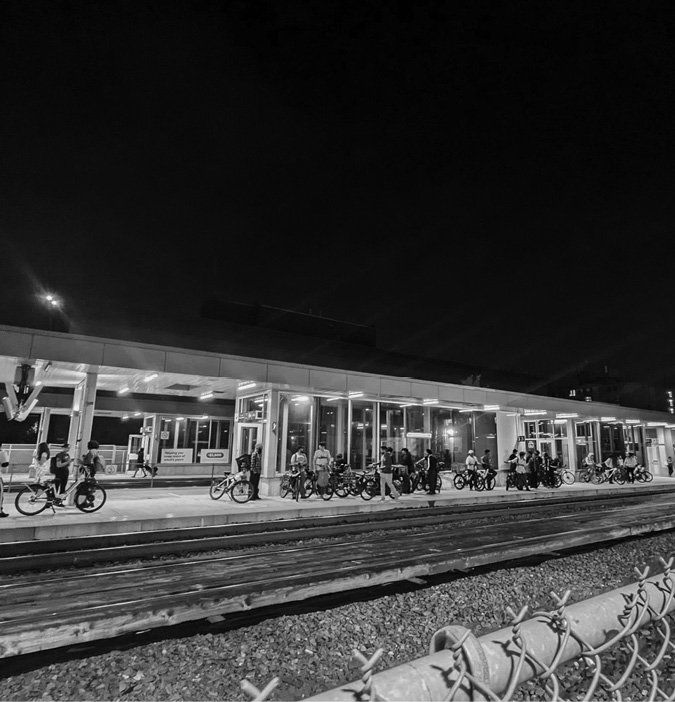
Figure 1. Food delivery riders returning home at 11 p.m., at UP Express Bloor Station in Toronto.
Photograph by Émile Baril, 2023.
In Montréal, we conducted semi-structured interviews with sixteen young delivery workers aged 20 to 34 (thirteen men and three women). The random sample was constructed from several Facebook solidarity groups of Uber Eats delivery drivers. The first half of the interviews were conducted via Zoom because of covid restrictions during the pandemic; the remaining eight interviews were conducted in person during the summer of 2022. Of the sixteen Uber Eats delivery drivers working in Montréal, half were from northwest Africa (Morocco, Algeria, Tunisia). Regarding their migration status, five were international students and six were permanent residents. In Toronto, we conducted semi-structured interviews with fourteen delivery workers during the spring and summer of 2022. Participants were recruited in person, at several waiting locations in a central Toronto neighbourhood. Of the fourteen Uber Eats delivery drivers in Toronto, eight were international students, two were permanent residents, one was a refugee, and the remaining three were Canadians. The migrant delivery drivers came from a variety of countries, including Argentina, India, Nepal, Jordan, and Kurdistan.
The main themes of the interviews included the workers’ migratory trajectories (in the case of international students, permanent residents, and refugees) and relationships with work, with the algorithm, with the company, with colleagues, and with customers. We also examined relationships among delivery people in online groups and waiting points. We carried out the analysis of the data collected through the interviews following the emerging theory (grounded theory) approach of Glaser and Strauss,29 which allowed us to construct social reality from the point of view of the actors. The grounded theory method was used to conceptualize and relate qualitative empirical data, analyzed using NVivo software. Migration status is a dominant element of the sociodemographic profile of the participants. It greatly influences the everyday lives of the riders as well as how, when, and for how long delivery work can be conducted. We thus join several contemporary works focusing on “racial platform capitalism” in our analysis of the intersection of global migration, racism, and platform capitalism.30
Analysis
Material collected during fieldwork via semi-structured interviews offers insight into several aspects of workers’ experience of platform capitalism. One feature of this form of work is the rider-customer relationship, in which certain punitive and remunerative roles, traditionally established between the boss and the employee, are transferred by the platforms to customers. A second key theme is algorithmic control, particularly the asymmetry of information available within the platform.31 From our interviews, we learned how delivery riders act based on their guesses about how the algorithms work. However, when facing day-to-day problems in their work, they intuitively try to turn to a human to solve their issues.32 A third common theme to emerge from the interviews is that this kind of work has many negative aspects for young immigrant delivery riders. Some of the problems identified by the workers are related to gender, their relationships with restaurants, and the over-recruitment of riders by the platforms.
Rider-customer relations
The evaluation of delivery riders by customers is a key characteristic of platform labour. This is presented as a simple and transparent way to control the quality of services provided on the platform. However, it is also conferring a form of authority to customers that was traditionally held by bosses. The platforms allow users, by giving the rider a rating, to evaluate the service provided by the workers. As the ratings are automated and reintegrated in the algorithmic distribution of orders, this creates pressure for workers that further intensifies working conditions. In doing the evaluation, it is the customers who act as managers. Thus, the platforms redistribute certain dimensions of control to customers, who become intermediary managers responsible for evaluating the delivery riders and their performance.
Redistribution of responsibilities is part of the history of platform labour. A major part of this, clearly, involves putting the expenses necessary to carry out the work into the hands of “self-employed” workers. In the food delivery industry, the rider is responsible for getting the tools necessary to complete the work (e.g. e-bike, food bag, helmet, smartphone). The redistribution and automation of management responsibilities to customers has been studied in the literature on platforms mainly in regard to rating systems, but its importance in the everyday life of the workers may be underestimated.33
Our analysis shows that within the platform delivery process, customers have a “referee” type of role, while the platforms have an “executive” role. The distribution of responsibilities to clients takes many forms. In their role as arbiter, customers can be punitive or recompensing. The punitive role materializes in various ways, including not tipping, giving a bad rating, carrying out real-time geosurveillance, making a direct complaint, and sending angry in-app messages. In opposition, the recompensing role refers to tipping, leaving good ratings, and sending nice in-app messages. As is the case in many other forms of labour, platform workers face racial and gender discrimination. The platform as a workplace is not exempt from this, and this discrimination can affect the customer rating system. There has been significant research on hidden racial bias within algorithmic exploitation, as well as on uneven and racialized working conditions in the platform economy.34
The first punitive role for customers is the avoidance of tipping, which is an issue that came up often in our interviews with delivery riders. Multiple reports from Gig Workers United and RideFairTO show that the base pay for an order has significantly decreased since 2020 in both food delivery and ride sharing.35 However, and as per several interviewees, the amount tipped by clients has stayed roughly the same. This means the relationship with customers has intensified, because as pay for orders lowers, tips become increasingly more important. This gives the customer significant power in determining whether a rider can make a profit. Before the pandemic, tipping made up only 5% to 15% of the total pay for an order. Now, the tip comprises around 30% to 50% of the total amount. Many riders noted this shift toward the importance of tipping:
We say to ourselves, “Will we also succeed in being financially stable?” Because we depend on orders, we depend on people, on customers, we depend on demand. (Female, 26 years old, Canada, Uber Eats, Montréal)
With tips, each delivery does not pay the same. I try not to stress too much about money, because then if I don’t get a tip or something, I don’t want to be upset about that. But it’s stressful. (Male, 25, Canada, Uber Eats, Montréal)
[With] Uber Eats, you do the service, then you wait an hour or an hour and a half for the customer to give a tip or not. (Male, 34, Tunisia, Uber Eats/DoorDash/Skip, Montréal)
Salary decreases as cost of living increases. (Male, 25, Indonesia, Uber Eats/DoorDash/Skip, Toronto)
The pay structure has changed and we are so much more dependent on tips. (Male, 28, Ethiopia, Uber Eats, Toronto)
Financial stability, in the context of an increased cost of living, is hard to achieve with food delivery work as the only income source. This comes with stress, long waiting times for tips to arrive, and greater dependence on tips.
The second important role for clients is through the rating system. This is also an object of tension between workers and customers, since the infrastructure that governs the platform allows clients to rate the work of a delivery rider. The method put in place by platforms creates a tense situation. Rising prices for meals purchased through Uber Eats have already increased frustration among customers. If an order takes extra time to arrive, often as a result of factors beyond the delivery rider’s control, the customer may give a bad rating, which, as many workers pointed out, influences drivers’ rankings and hence the quality and quantity of orders they receive in the future:
The rating system for the delivery service is not good. Sometimes something gets out of control. There are things we can’t fix. If you find yourself in a traffic jam, well, you can’t fly with your car, you have to wait. Sometimes people don’t understand that and [they give] us a bad grade. (Male, 22, Morocco, Uber Eats/DoorDash/Skip, Montréal)
Some customers take it [in] hand, then declare that they did not take it. It’s to get free food that they do this, because Uber will reimburse them. We’re the ones who are going to be hurting with the thumbs down. Thumbs down is not a good thing, because it really takes a while [for our rating] to come back up. (Female, 27, Algeria, Uber Eats, Montréal)
What we want to avoid as much as possible is having bad reviews, bad ratings. This could harm the drivers, their orders, and especially their account, which could be blocked. (Male, 25, Algeria, Uber Eats, Montréal)
Many workers told us that Uber Eats will often take the customer’s side when an issue arises. In a market with very strong competition, such as Toronto, even taking a photo of the order left at the door might not suffice. This is coupled with the fact that if a rider’s rating goes down, it takes some time to go back up. If a rider’s rating falls too low, their account might be suspended or blocked.
The third role for clients is in the use of geolocation, another mechanism that can be used as a punitive power. Several delivery drivers indicated they are subject to real-time surveillance carried out by customers, as in this comment: “The customer can follow you on the application. He can see where you are” (Female, 27, Algeria, Uber Eats, Montréal). By geolocating the delivery person, the customer can also exert a form of psychological pressure through the chat found in the application interface. A delivery worker from Montréal noted, “Customers send me a message: ‘You are close, how long will it take you? You’re not going to get a tip if you don’t get here quickly!’” (Male, 34, Tunisia, Uber Eats/DoorDash/Skip, Montréal).
Delivery riders are also sometimes collateral damage of customers’ scams or mistakes. Various ordering techniques can be used to save on delivery costs or to get a free meal. According to one rider,
There are certain customers who have a strategy. They put an address in the application that is very close to the restaurant. They just pay $3 for delivery and when the driver picks up the order, the customer automatically sends a message to the driver to say, “Sorry, I moved and my address is here now.” You have to travel 10 km or more to get there, otherwise he can call Uber and say, “The driver refused to deliver the order to me,” and that automatically deactivates the account. (Male, 27, Senegal, Uber Eats, Montréal)
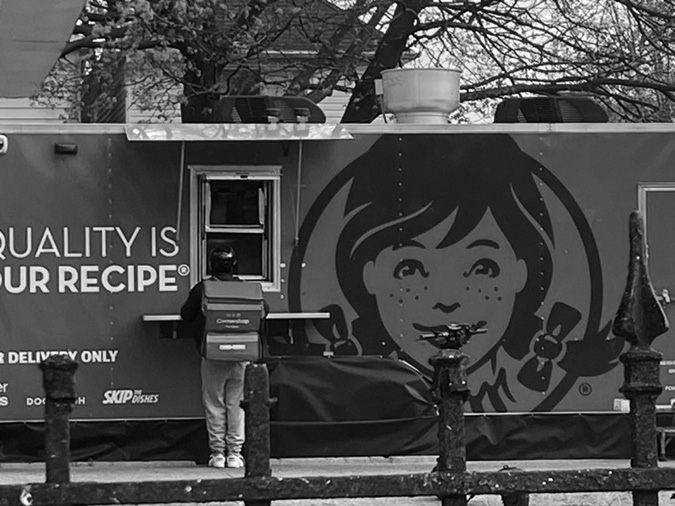
Figure 2. A Wendy’s delivery-only food truck in downtown Toronto.
Photograph by Violaine Jolivet, 2023.
The loss of employment without any recourse is significant, and we see how the threat of deactivation always hovers over the food delivery riders. The more direct way for an account to be deactivated is through a complaint filed by a customer. A customer complaint or report to Uber Eats carries weight and constitutes sufficient evidence for the deactivation of a delivery rider’s account. Some linked this aspect with racism:
In this job, you will meet all types of people. There are racists; there are people who don’t give the tip. You’re going to take the stairs to the eighteenth floor and he doesn’t give [you] the tip. (Male, 34, Tunisia, Uber Eats/Skip/DoorDash, Montréal)
The customer did not make a formal complaint to me, but he wrote a negative review and gave me a bad rating; he said that I wasn’t efficient and that I was taking too long when it wasn’t even my fault. (Female, 24, Luxembourg, Uber Eats, Montréal)
Our interviews revealed how punitive and recompensing roles have been taken on by clients in the food delivery markets of Montréal and Toronto. Both roles are coupled with in-app messaging, which can be tainted with gender and racial discrimination. We now turn to the algorithm to understand the everyday lives of food riders.
Algorithmic control and information asymmetry
Several studies have addressed the effects of algorithmic mediation and have demonstrated the relevance of opening the “black box,” with the goal of deconstructing the idea of a neutral algorithm.36 As Tarleton Gillespie points out, algorithms are codified procedures guided by desired outcomes. It is not a question of conceiving of them as “abstract technical achievements,” but of “revealing the human and institutional choices which are hidden behind these cold mechanisms.”37 This puts into context the ways in which tasks are managed by platforms. The platform has the power to define the rules of work. Not only does the algorithm bring together offers and requests, but it prioritizes them in a way to maximize its turnover, minimize its costs, and improve customer satisfaction. By favouring certain suppliers to the detriment of others – in a way that appears completely random from the perspective of delivery workers – the allocation of work is, in this sense, “black boxed.” Many of the riders we met mentioned that they have difficulty understanding how it works:
I think the algorithm gives you a perimeter of two kilometres. I don’t know. If there are no commands in there, then you wait. It’s not frequent enough. But with the bicycle, orders are frequent, because, perhaps, the perimeter is wider, eight kilometres or ten kilometres, I don’t know. (Male, 34, India, Uber Eats, Toronto)
The mode of delivery – with a car, with an e-bike or regular bicycle, or on foot – is indicated in the app during sign-in. Some workers mentioned that while multi-apping (being logged in on multiple platforms simultaneously), they sometimes pretend to be doing “walking deliveries” while in reality they are using a regular bike. This is what many called “gaming the system” – a type of resistance and resilience strategy. Multi-apping, as Cosmin Popan suggests, is the intensification of work and entrepreneurship, where self-employed riders actively engage in “resilience” in order to make ends meet.38 The strategy is used to reduce the “unpaid” time, which is a source of frustration for many riders.
The lack of transparency in algorithmic work management causes confusion for many delivery workers. Whether in regard to geographic distribution, the number of deliveries per hour, or the way remuneration works, delivery workers try to figure out the algorithm:
… the algorithm lacks transparency. In theory, for the algorithm, you are not paid from your point where you are currently until the moment you arrive at the restaurant. If the restaurant is very far from your delivery, it’s not worth it, so you have to decline it. (Male, 29, Canada, Uber Eats, Montréal)
We’re trying to understand a little what the Uber algorithm is, but we don’t really get it. What I noticed is that the closer you are to a restaurant, the more likely you are to get an order from that restaurant. For Uber, it costs them less to get you. I’ve also often heard people say that they do several platforms, which I find a little difficult because if you have two orders, two platforms that don’t go to the same place, that can cause delays. I think those who are well rated will be among the first to receive orders. The rating is integrated into the algorithm and influences the distribution of orders. If two delivery men are both parked in front of the same restaurant, one of the two will be chosen. I think it’s the one who will have the best statistics at that time. (Male, 34, Cameroon, Uber Eats, Montréal)
In these interview excerpts, we can see riders are guessing how the algorithm works. To many, a worker’s proximity to restaurants seems to be the most important factor in attaining priority. The second quotation addresses the downside of multi-apping. If a driver takes too much time delivering because they have multiple orders on multiple apps, their rating might go down and thus they would lose priority. It is a no win situation for riders, who must either accept unpaid time or risk losing priority because of multi-apping.
We note that these forms of algorithmic opacities are accompanied by surveillance. As some researchers note, the platformized “panoptic-type” surveillance of platform workplaces aims at making the workers more productive.39 The intangible, all-seeing surveillance by the algorithm is sometimes felt by riders. An Uber Eats delivery rider in Toronto stated,
If you do something wrong, if you cancel too many orders, the app realizes this and stops giving you orders. We can feel it. It’s like someone is constantly watching you and when you do something wrong, something changes, but you can’t prove it. (Male, 34, Kurdistan, Uber Eats/DoorDash, Toronto)
The difficulties of platform work can, however, lead to worker solidarity. We found forms of mutual assistance and solidarity among riders who try to understand how the algorithm works, to compensate for its opacity:
It took me a little while to understand. I figured out how it works. Sometimes, when you are waiting for an order [and] there is another delivery person, you can chat with him. You ask him, and with your experience and the experience of the other, you manage to understand things. (Male, 22, Morocco, Uber Eats/DoorDash/Skip, Montréal)
For example, at McDonald’s, sometimes you find around fifteen delivery men talking and making jokes. We talk, all the time. It’s mutual work. (Male, 34, Tunisia, Uber Eats/DoorDash/Skip, Montréal)
It’s the algorithm that does everything. I don’t really know how it works. Is it by priority or the closest to the restaurant? I don’t know, but I noticed from my experience: my friend and I, we were both in the same places and I received the orders and he did not. (Male, 29, Morocco, Uber Eats, Montréal)
Information asymmetry and automation are also felt at the customer service level. In a recent study of Foodora delivery work in Norway and Sweden, Gemma Newlands notes that riders tend to seek a human interaction when facing an issue, which she calls “anthropotropism.”40 The automated customer service available to riders eventually leads to an outsourced call centre. The experiences of delivery workers with Uber Eats “customer service” are varied. Some highlighted positive elements of this service:
Uber assistant quickly resolved the problem. They take care of the problem directly; they won’t leave you for hours. (Male, 26, Morocco, Uber Eats, Montréal)
Uber, you can contact them while you are making a delivery. You have direct telephone access to Uber. I had to do it once, I dropped a customer’s drink in my car and I didn’t know what to do. I called Uber and said, “I’m on my way, but I lost the drink. What do I do?” They told me, “Don’t worry about that, we’ll contact the customer.” (Male, 28, Tunisia, Uber Eats, Montréal)
I called Uber. I said, “This is what happened, but for this particular order, I actually don’t want to deliver it anymore.” Uber assigned it to someone else. (Male, 34, Cameroon, Uber Eats, Montréal)
Positive experiences with human customer service are not universal. Other workers point to negative experiences – notably, those involving out-of-country customer service operators:
I call Uber, [and] the person says, “Oh well, it’s a technical problem, we’ll take care of it.” It seems like you’re talking to someone from the end of the world, you hear noises, someone who has trouble speaking to you in French, makes it hard to communicate, and then often doesn’t understand or you don’t understand. (Female, 32, Canada, Uber Eats, Montréal)
Customer service in general is bad. I know that customer service in French is in Morocco. The service in English is India or Pakistan or in Asian countries like Bangladesh. I’m not saying that people are less competent, they may be as competent as people here, but it’s just that they may not know the reality here. (Male, 27, Morocco, Uber Eats, Montréal)
I have called Uber customer service several times but they are automatic responses. They just memorize certain answers. If you call them, they repeat the same answers. (Male, 27, Senegal, Uber Eats, Montréal)
The opacity of the algorithmic workplace, as described by many riders, is hard to navigate. A lot of riders try to guess how the algorithm works, in hope of getting more orders and cutting unpaid waiting time. Some engage in multi-apping, which can lead to a drop in their rating. We also note the presence of anthropotropism, or the reflex of seeking human interaction, when facing issues. This is not uncommon in platform labour, which has automated most aspects of work to cut labour costs.
Negative aspects of platform work
While assembling our empirical data for Montréal and Toronto, we noticed several recurring negative aspects in the riders’ responses. Specifically, three key areas emerged: gender relations, restaurants, and over-recruitment.
Questions regarding gender relations in platform work are still little explored by researchers.41 We were able to talk to a few women-identifying food riders. In several interviews, women highlighted safety as an important criterion for engaging in delivery work:
As soon as you arrive in a place where you smell marijuana, you know that you have to protect yourself as a girl. You can fall into a group of boys. … Once, someone took me by the hand and said to me, “Come and have a drink.” I said, “Sir, here is your food. You’re drunk, don’t make me call the police.” To tell you the truth, since that day I told myself that I would never deliver to this area. (Female, 27, Algeria, Uber Eats, Montréal)
I said to myself, “I’m still a woman. There are sectors I find more risky.” I agreed to do it during the day, but I don’t do it at night, for example. (Female, 32, Canada, Uber Eats, Montréal)
Gender relations impact the areas female riders will deliver to or the times of the day they will engage in delivery work. Gender is an important, and not often discussed, negative element of platform labour, as it is generally assumed that most of the workers are men.
The second negative aspect concerns the relationship between delivery workers and restaurants. Waiting time at restaurants can make the difference between a productive trip or a money-losing trip. Additionally, if the food is delivered cold because of a long wait time, it is the delivery person who risks not receiving a tip or is given a negative rating. One Montréal rider mentioned this problem:
What annoys me the most is the wait at the restaurant. There are restaurants where I feel they do business with Uber Eats, but they don’t mind making us wait. It doesn’t pay enough if I have to wait ten or fifteen minutes. (Male, 28, Tunisia, Uber Eats, Montréal)
Moreover, the platformization of the food delivery industry extends further than the simple delivery. Fast-food chains like McDonald’s also use platforms as an infrastructure where customers can have an account, order food, and get discounts and points or rewards. When an order is placed with McDonald’s through its partnership with Uber Eats,42 it makes it possible to automate payment and delivery. However, most of the delivery workers stated that it is difficult for them to make money on orders with this fast-food chain:
McDonald’s employees, their behaviour toward delivery people, it’s deplorable. If you try to talk with them, they may give you a bad rating in their system. Restaurants can give a bad rating and so can customers, while the delivery person cannot defend himself. (Male, 27, Senegal, Uber Eats, Montréal)
McDonald’s is the worst. They put the delivery guys last, even though the customer ordered 30 minutes ago. People who come in receive their order before the delivery guy. Real restaurants prepare the food when you arrive, no problem, but McDonald’s takes forever and the employees just ignore the delivery guys. We don’t get paid enough to wait for just $6.00 and peanuts. (Female, 34, Argentina, Uber Eats, Toronto)
Waiting at fast-food chains like McDonalds is the worst. Management tells them they have to serve the drive-thru first, then the customers inside, then the delivery riders are served last. Long waits for food and it’s very poorly paid. (Female, 34, Nepal, DoorDash, and Skip, Toronto)
When you start, you receive orders from McDonald’s. Normally, McDonald’s deliveries are not within a large area, it is always between 600 m up to 4 km at most. I received orders up to 15, 20, or 25 km. I don’t know how they work because it remains the top secret of the algorithm. (Male, 29, Morocco, Uber Eats, Montréal)
The fastest restaurant chains and the fastest meal delivery services, such as McDonald’s and Uber Eats, are built on a precarious workforce. Acceleration of the delivery process through the complete platformization of both the ordering and the delivery is to the detriment of working conditions. Uber Eats can afford to offer poor working conditions given the number of delivery workers competing for orders in big urban markets. As Uber Eats does not cap the total number of riders, there is constant competition among riders. For the youngest immigrant platform workers, those newly arrived and international students, decent job opportunities are scarce. For the latter group, given exorbitant tuition fees and the high costs of living, this can be part of what some have described as “survival-oriented” labour.43
This saturation of riders is a third dissuasive factor that several participants in our research mentioned during the interviews. Nowadays, over-recruitment for platform delivery is an integral part of urban life in both Québec and Ontario. Through various over-recruitment tactics by Uber Eats, the number of workers has exploded since the covid-19 pandemic. With the reopening of restaurants, and given Uber Eats’ business model, which imposes no limit on the number of delivery people on the platform, average revenues for workers are decreasing. Some young workers mentioned that competition among delivery workers leads to very long waiting times between orders, sometimes up to an hour. This makes the work unprofitable:
We see that Uber is trying to discourage a lot of drivers during the day, except in downtown Montréal. They put more boost, it becomes more and more complicated to have orders that are higher than $3. (Female, 32, Canada, Uber Eats, Montréal and Laval)
As they recruited a lot of people, the demand fell…. It equals a drop in income for me and for a lot of delivery people. Mass recruitment is a bad thing for the delivery workers. Mass recruitment, I understand the policy, it is to always have delivery guys, but when you really have an excess of delivery guys, it really leads to a drop in income for most. When I go a really long time without an order, it drives me crazy. Sometimes you come home with nothing, you just wasted money, gas. You have to buy a bottle of water, sometimes you have to eat. Expenses that go out, but in return, there is nothing that comes in. (Male, 22, Morocco, Uber Eats, Montréal)
The last quote illustrates how the downloading of the costs of tools to workers collides with over-recruitment. Taken together, this means platform delivery is becoming more difficult and puts those who do it full-time in even more precarious situations. Resulting from this process of market saturation, we observed, there is a tension between the “old” riders and the “new” riders. Old-timers see each new person on the app as a future competitor:
There are too many delivery men and women. It’s a competition, but I prefer fewer people so that the orders remain for me. (Male, 25, Canada, Uber Eats, Toronto)
There are more and more people on the application. The more delivery people there are, the less work there is for me. (Male, 34, Tunisia, Uber Eats/DoorDash/Skip, Montréal)
I know that Uber has an infinite number of delivery people so if there are a few drivers who stop working, the others will continue. There is no union that can speak on behalf of the drivers. Even if there is a group that decided to take action, the chances of achieving anything are minimal. (Male, 27, Morocco, Uber Eats, Montréal)
As the first two quotes suggest, platform gig work is seen by many as a competition. This aligns with an overall “branding” of platform gig work as a game. Gamification – or adding video game–like features in the app such as points, rewards, celebrations, and playful design – is paired with promoting a competitive feeling among riders so they see one another as competition. Platform work is also branded as “playbour” – that is, labour you can enjoy doing for fun in your spare time – even if the working conditions are difficult. Cyclists and e-bikers in downtown Toronto and Montréal face dangerous conditions. Some might be doing the work to “get in shape,” but the majority of immigrant and racialized workers have no choice despite all the negative aspects listed above. Moreover, organizing on-demand labour is a difficult task. Delivery workers face pressure to always be present on the roads and available for delivery. This will be a challenge to tackle in the upcoming years both for traditional unions and for the labour movement in general.
Conclusion
In both Montréal and Toronto, laws and regulations governing platform delivery work have been the subject of extensive debate in mainstream media. The main goal of this article is to contribute to a growing body of research on platform gig work by making the voices and the everyday concerns of food delivery workers heard. In recent years, proposals for regulating platform labour in Ontario and Québec have sparked discussions not only on current working conditions but also on migration conditions. The everyday lives of young and immigrant food delivery riders are fraught with challenges. Their interactions with a multitude of actors – including customers, restaurant owners and employees, call centre employees, fellow riders, and law enforcement officers – are crucial components to consider when analyzing platform labour. Some aspects of the work lead many riders to view this job as a temporary solution in their migration journey. Based on analysis of semi-structured interviews with young and immigrant workers engaged in platform food delivery in Montréal and Toronto, we have highlighted three significant characteristics.
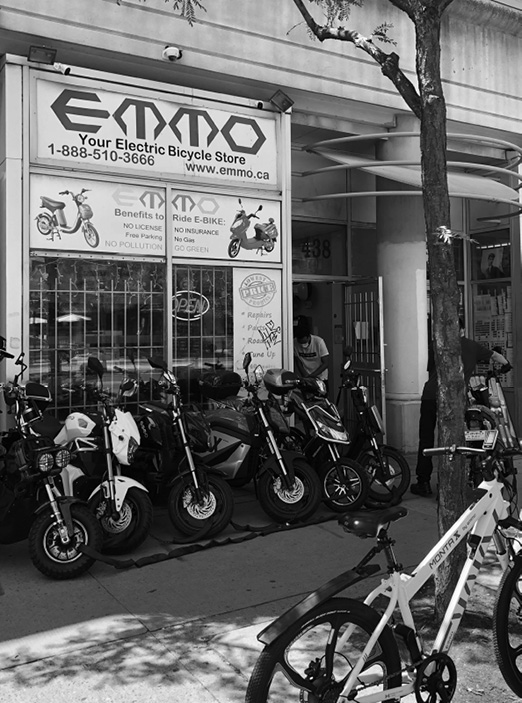
Figure 3. An e-bike rental and repair business in Toronto.
Photograph by Émile Baril, 2022.
First, we noted a rewarding role and a punitive role for customers, as part of a general downloading of management responsibilities by platforms. While some delivery workers engage in this work to escape hierarchical pressures of conventional wage labour, the platforms delegate certain responsibilities to external parties – customers, restaurants, third party call centres, and so on. Through an app’s rating system, tipping, complaints, and geolocation, customers play an important role in structuring management and power within platform work. They partly replace managers and have a strong role to play in the labour process. This power is conferred by the platform, which maintains an executive role. Second, we identified an asymmetry in the information available to delivery workers. Algorithmic control means that many workers can only guess at certain hidden facets of the platform’s infrastructure. At the same time, there is a tendency among workers to turn to a human when a problem arises, which is experienced both positively and negatively. Third, the negative aspects of gender relations, unpaid waiting times at restaurants, and over-recruitment act as obstacles for young people wanting to engage in platform labour.
The various deterrents identified in this article make this type of work difficult and poorly paid, leading to even more precarity for its workforce. Over the years we conducted this research, we have seen a process of growing precarity among delivery workforces in both Montréal and Toronto. All three of the characteristics cited above play significant parts in this process. There is an unavoidable relationship between platform delivery work and immigration that needs to be addressed. Low barriers to entry and over-recruitment make platform delivery an easy, if unrewarding, choice for newcomers. In Toronto, a large pool of international students, especially from India, must work on multiple platforms, often full-time, to pay high tuition fees. In Montréal, many international students and permanent residents (some waiting for diploma recognition) are from French-speaking African or South American countries and work in delivery to make ends meet. All three themes of our analysis are exacerbated by migration status. With low entry barriers and high levels of recruitment, delivery work has become an attractive option for young people and newcomers to the labour market. For many young individuals, often those just starting their careers, these jobs are seen as temporary stepping stones or sources of supplementary income during their studies or while searching for more stable employment. Young workers tend to be more tolerant of the instability inherent in platform work, as well as the surveillance by customers and restaurant owners and the control exerted by algorithms; however, this tolerance risks normalizing precarious working conditions from the outset of their careers. These dynamics present regulatory challenges, as the needs and expectations with respect to platform work vary greatly based on workers’ immigration status and age.
In summary, the article provides insight into the complex web of interdependent relationships and power dynamics among actors within Canada’s delivery platform ecosystem. It highlights the asymmetric forms of algorithmic control imposed on workers. This study contributes to rebalancing the dominant view of algorithmic management, which typically centres on organizational control, by integrating an analysis of non-organizational actors – specifically, customers and restaurant owners – and their roles in monitoring and controlling delivery activities. Our findings illuminate the distinctive characteristics of each stakeholder in this ecosystem, allowing for a deeper understanding of the unique aspects of this platform model and how delivery work is orchestrated.
1. Patricia Vendramin and Gérard Valenduc, “Comprendre le phénomène des plateformes dans la transition numérique: une perspective européenne,” in Mircea Vultur, ed., Les plateformes de travail numériques: Polygraphie d’un nouveau modèle organisationnel, Collection Sociologie contemporaine (Laval: Presses de l’Université Laval, 2023), 19–40.
2. Agnieszka Piasna, Wouter Zwysen, and Jan Drahokoupil, “The Platform Economy in Europe,” etui working paper, February 2022, https://www.etui.org/publications/platform-economy-europe.
3. Aziz Choudry and Adrian A. Smith, eds., Unfree Labour? Struggles of Migrant and Immigrant Workers in Canada (Oakland: pm Press, 2016).
4. Sophie Bernard, UberUsés: le capitalisme racial des plateformes à Paris, Londres et Montréal (Paris: puf, 2023); Dalia Gebrial, “Racial Platform Capitalism: Empire, Migration and the Making of Uber in London,” epa: Economy and Space 56, 4 (2022): 1170–1194.
5. Silvia Federici, Patriarchy of the Wage: Notes on Marx, Gender, and Feminism (Oakland: pm Press, 2021).
6. Ursula Huws, Labour in Contemporary Capitalism: What’s Next? (London: Palgrave Macmillan, 2019).
7. Nick Srnicek, Platform Capitalism (Malden: Polity Press, 2017).
8. Niels van Doorn, Eva Mos, and Jelke Bosma, “Actually Existing Platformization: Embedding Platforms in Urban Spaces through Partnerships,” South Atlantic Quarterly 120, 4 (2021): 715–731.
9. Nick Dyer-Witheford, Atle Mikkola Kjøsen, and James Steinhoff, Inhuman Power: Artificial Intelligence and the Future of Capitalism (London: Pluto Press, 2019).
10. Niels van Doorn and Adam Badger, “Platform Capitalism’s Hidden Abode: Producing Data Assets in the Gig Economy,” Antipode 52, 5 (2020): 1475–1495.
11. Veena Dubal, “On Algorithmic Wage Discrimination,” Columbia Law Review 123, 7 (2023), doi:10.2139/ssrn.4331080.
12. Henrique Amorim and Felipe Moda, “Work by App: Algorithmic Management and Working Conditions of Uber Drivers in Brazil,” Work Organisation, Labour and Globalisation 14, 1 (2020): 101–118; Mohammad Amir Anwar and Mark Graham, “Hidden Transcripts of the Gig Economy: Labour Agency and the New Art of Resistance among African Gig Workers,” Environment and Planning A: Economy and Space 52, 7 (2020): 1269–1291; Joanna Bronowicka and Mirela Ivanova, “Resisting the Algorithmic Boss: Guessing, Gaming, Reframing and Contesting Rules in App-Based Management,” ern: Other European Economics: Labor & Social Conditions (2020), doi:10.2139/ssrn.3624087; Alex Veen, Tom Barratt, and Caleb Goods, “Platform-Capital’s ‘App-etite’ for Control: A Labour Process Analysis of Food-Delivery Work in Australia,” Work, Employment and Society 34, 3 (2020): 388–406; Kathleen Griesbach, Adam Reich, and Ruth Milkman, “Algorithmic Control in Platform Food Delivery Work,” Socius: Sociological Research for a Dynamic World 5 (2019), doi:10.1177/2378023119870041.
13. Niels van Doorn and Darsana Vijay, “Gig Work as Migrant Work: The Platformization of Migration Infrastructure,” epa: Economy and Space 56, 4 (2021): 1129–1149; Laura Lam and Anna Triandafyllidou, “Road to Nowhere or to Somewhere? Migrant Pathways in Platform Work in Canada,” epa: Economy and Space 56, 4 (2022): 1150–1169.
14. Tyler Riordan, “Seeking Justice in the Platform Economy: Migrant Worker Responses to Precarious Work amid the covid-19 Crisis,” Journal of Sustainable Tourism 31, 12 (2020), doi:10.1080/09669582.2022.2136189.
15. Len Sherman, “Uber’s ceo Hides Driver Pay Cuts to Boost Profits,” Forbes, 15 December 2023, https://www.forbes.com/sites/lensherman/2023/12/15/ubers-ceo-hides-driver-pay-cuts-to-boost-profits/.
16. Katie Myhill, James Richards, and Kate Sang, “Job Quality, Fair Work and Gig Work: The Lived Experience of Gig Workers,” in Anthony McDonnel, Ronan Carbery, John Burgess, and Ultan Sherman, eds., Technologically Mediated Human Resource Management: Working Relationship in the Gig Economy (London: Routledge, 2024), 116–141.
17. According to Kurt Vandaele’s literature review in The Routledge Handbook of the Gig Economy, the bulk of empirical research on platform food delivery is divided among the unpacking of algorithmic management, the mapping of individual and collective resistance, and the characterization of new and emerging forms of representation and co-operative organization. Vandaele also argues that food delivery platforms are facing pressure from various actors, exposing their vulnerability in labour markets. See Vandaele, “Vulnerable Food Delivery Platforms under Pressure: Protesting Couriers Seeking ‘Algorithmic Justice’ and Alternatives,” in Immanuel Ness, ed., The Routledge Handbook of the Gig Economy (Abingdon: Routledge, 2023), 205–219. A number of recent studies focus on everyday lives of delivery workers, and others consider “algorithmic” work as an integral part of tensions between companies and workers. On workers’ everyday lives, see, for example, Arianna Tassinari and Vincenzo Maccarrone, “Riders on the Storm: Workplace Solidarity among Gig Economy Couriers in Italy and the UK,” Work, Employment and Society 34, 1 (2020): 35–54; Jamie Woodcock, The Fight against Platform Capitalism: An Inquiry into the Global Struggles of the Gig Economy (London: University of Westminster Press, 2021). Studies focused on algorithmic work include Phoebe V. Moore and Simon Joyce, “Black Box or Hidden Abode? The Expansion and Exposure of Platform Work Managerialism,” Review of International Political Economy 27, 4 (2020): 926–948; Veen, Barratt, and Goods, “Platform-Capital’s ‘App-etite’ for Control.” As mentioned above, research on platform labour is also anchored in local and national contexts. Global corporations like Uber Eats learn by trial and error, from one city to another. They morph their strategies to fit local contexts and bodies of governance. Sometimes they cannot fit the labour laws in place and must operate illegally or by having undocumented migrants working for them. See, for example, Émile Baril, “Citizen-rentier-ship: Delivering the Undocumented to Labour Platforms in Paris,” Antipode 56, 4 (2024): 1132–1151.
18. Eric Tucker, “Towards a Political Economy of Platform-Mediated Work,” Studies in Political Economy 101, 3 (2020): 185–207.
19. Vincent Hardy, “Defining and Measuring the Gig Economy using Survey Data,” Labour Statistics: Research Papers series, Statistics Canada, 4 March 2024.
20. Valerie Preston and Marshia Akbar, “Social Characteristics of International Students in Ontario and Quebec,” policy review, York University, 2020.
21. Mircea Vultur and Lucie Enel, “Les plateformes de travail numériques: Uber et la déréglementation de l’industrie du taxi au Québec,” Institut national de la recherche scientifique, 2020.
22. Sheila Block and Trish Hennessy, “Sharing Economy” or On-Demand Service Economy? A Survey of Workers and Consumers in the Greater Toronto Area (Toronto: Canadian Centre for Polic.y Alternatives, 2017); Angus Reid Institute, “The ‘Gig’ Picture: One-in-Three Canadians Have Done Some Kind of Informal Work in the Past Five Years,” news release, 26 November 2019, https://angusreid.org/gig-economy/.
23. Québec, “Rapport du Groupe de travail sur l’économie collaborative,” 2018; Ontario Workforce Recovery Advisory Committee, “The Future of Work in Ontario,” November 2021.
24. English-language research includes Raoul Gebert, “The Pitfalls and Promises of Successfully Organizing Foodora Couriers in Toronto,” in Jan Drahokoupil and Kurt Vandaele, eds., A Modern Guide to Labour and the Platform Economy (Cheltenham, UK: Edward Elgar, 2021), 274–289; Hannah Johnston, “Labour Geographies of the Platform Economy: Understanding Collective Organizing Strategies in the Context of Digitally Mediated Work,” International Labour Review 159, 1 (2020): 25–45. For French-language research, see Vultur and Enel, “Les plateformes de travail numériques”; Lyne Nantel and Mircea Vultur, “Les transformations du travail à l’ère du numérique et de l’‘économie collaborative’: pistes d’analyse et de réflexion,” Ad Machina 2, 1 (2018): 35–51; Gaële Lesteven and Sylvanie Godillon, “Les plateformes numériques révolutionnent-elles la mobilité urbaine? Analyse comparée du discours médiatique de l’arrivée d’Uber à Paris et à Montréal,” Netcom. Réseaux, communication et territoires 31, 3 (2017): 375–402.
25. Arianna Tassinari and Vincenzo Maccarrone, “Riders on the Storm: Workplace Solidarity among Gig Economy Couriers in Italy and the UK,” Work, Employment and Society 31, 1 (2020): 35-54.
26. Harry Davies, Simon Goodley, Felicity Lawrence, Paul Lewis, and Lisa O’Carroll, “Uber Broke Laws, Duped Police and Secretly Lobbied Governments, Leak Reveals,” Guardian, 11 July 2022, https://www.theguardian.com/news/2022/jul/10/uber-files-leak-reveals-global-lobbying-campaign.
27. David Friend, “Uber Eats Expands Toronto Food Delivery,” Toronto Star, 9 December 2015.
28. Julie-Anne Boudreau, Pierre Hamel, Bernard Jouve, and Roger Keil, “New State Spaces in Canada: Metropolitanization in Montreal and Toronto Compared,” Urban Geography 28, 1 (2007): 30–53.
29. Barney G. Glaser and Anselm L. Strauss, The Discovery of Grounded Theory: Strategies for Qualitative Research (Chicago: Aldine, 1967).
30. Tressie McMillan Cottom, “Where Platform Capitalism and Racial Capitalism Meet: The Sociology of Race and Racism in the Digital Society,” Sociology of Race and Ethnicity 6, 4 (2020): 441–449.
31. Jamie Woodcock and Callum Cant, “Platform Worker Organising at Deliveroo in the UK: From Wildcat Strikes to Building Power,” Journal of Labor and Society 25, 2 (2020): 220–236..
32. Gemma Newlands, “‘This Isn’t Forever for Me’: Perceived Employability and Migrant Gig Work in Norway and Sweden,” epa: Economy and Space 56, 4 (2022): 1262–1279.
33. Chris Forde, Mark Stuart, Simon Joyce, Liz Oliver, Danat Valizade, Gabriella Alberti, Kate Hardy, Vera Trappmann, Charles Umney, and Calum Carson, “The Social Protection of Workers in the Platform Economy,” study for the European Parliament’s Committee on Employment and Social Affairs, ip/a/empl/2016-11, European Union, November 2017; Ursula Huws, “The Hassle of Housework: Digitalisation and the Commodification of Domestic Labour,” Feminist Review 123, 1 (2019): 8–23; Alex Kirven, “Whose Gig Is It Anyway? Technological Change, Workplace Control and Supervision, and Workers’ Rights in the Gig Economy,” University of Colorado Law Review 89, 1 (2018), https://scholar.law.colorado.edu/lawreview/vol89/iss1/6/.
34. Ruha Benjamin, Race after Technology: Abolitionist Tools for the New Jim Code (Medford: Polity Press, 2019); Yanbo Ge, Christopher R. Knittel, Don MacKenzie, and Stephen Zoepf, “Racial and Gender Discrimination in Transportation Network Companies,” National Bureau of Economic Research working paper no. 22776, October 2016.
35. Tara Deschamps, “‘I’m Making So Little’: Uber Eats Couriers Say New Pay System Dropped Wages,” ctv News, 7 February 2021, https://toronto.ctvnews.ca/i-m-making-so-little-uber-eats-couriers-say-new-pay-system-dropped-wages-1.5299205; Jon Woodward, “Toronto Ride-Hail Drivers to Strike in Wake of Making Just $6.37 an Hour, New Report Finds,” ctv News, 12 February 2024, https://toronto.ctvnews.ca/toronto-ride-hail-drivers-net-just-6-37-an-hour-in-legislated-poverty-report-says-1.6765371.
36. Tim Christiaens, Digital Working Lives: Worker Autonomy and the Gig Economy (New York: Rowman and Littlefield, 2023).
37. Tarleton Gillespie, “Platform Intervene,” Social Media + Society 1, 2 (2015): 98.
38. Cosmin Popan, “The Fragile ‘Art’ of Multi-apping: Resilience and Snapping in the Gig Economy,” epa: Economy and Space 56, 3 (2023): 802–815.
39. Jamie Woodcock, “The Algorithmic Panopticon at Deliveroo: Measurement, Precarity, and the Illusion of Control,” Ephemera: Theory & Politics in Organization 22, 3 (2021): 67–96.
40. Newlands, “‘This Isn’t Forever.’”
41. Ge et al., “Racial and Gender Discrimination.”
42. Jonathan Maze, “McDonald’s Announces New Deals with DoorDash and Uber Eats,” Restaurant Business, 15 November 2021, https://www.restaurantbusinessonline.com/financing/mcdonalds-announces-new-deals-DoorDash-uber-eats.
43. Louise Waite and Hannah Lewis, “Precarious Irregular Migrants and Their Sharing Economies: A Spectrum of Transactional Laboring Experiences,” Annals of the American Association of Geographers 107, 4 (2017): 964–978.
How to cite:
Émile Baril and Mircea Vultur, “Navigating Streets, Restaurants, and Algorithms: A Study of Young Immigrant Food Delivery Couriers in Montréal and Toronto,” Labour/Le Travail 95 (Spring 2025): 121–144, https://doi.org/10.52975/llt.2025v95.007.
Copyright © 2025 by the Canadian Committee on Labour History. All rights reserved.
Tous droits réservés, © « le Comité canadien sur l’histoire du travail », 2025.